
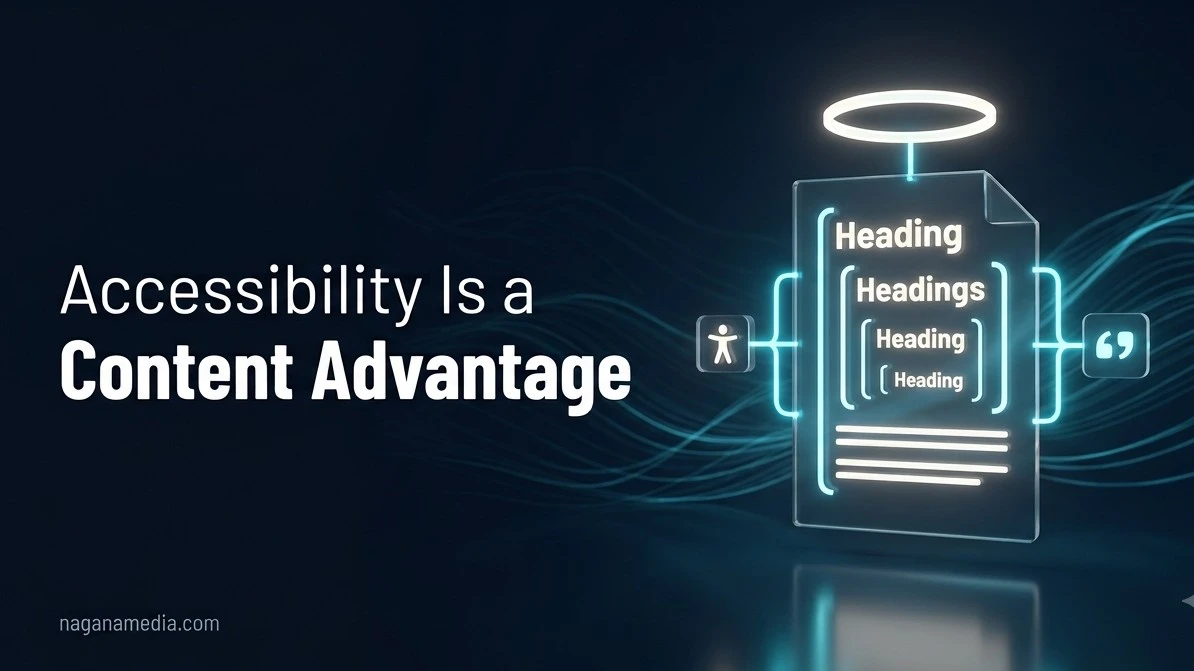
Most B2B marketing teams treat accessibility as a legal chore. Something to hand off to a compliance checklist, patch with an overlay widget, and forget about until a lawsuit or an enterprise procurement form forces the issue again. That framing misses something genuinely useful hiding in plain sight: the specific technical properties that make a page accessible are, almost exactly, the same properties that make it readable by an AI system deciding whether to cite it.
Why Should a B2B Marketing Team Actually Care About Accessibility?
Beyond the legal exposure, which is real and growing. Nearly 4,000 website accessibility lawsuits were filed in a single recent year under Title III, and the DOJ has been explicit that a website functioning as part of a business counts as a place of public accommodation. That's the compliance case, and it's worth taking seriously on its own.
But the more interesting case, the one almost nobody in B2B marketing has connected yet, is this. Proper heading structure, descriptive alt text, semantic HTML, logical reading order, clear link text, captions on video, these are all Web Content Accessibility Guidelines. They're also, independently, exactly the properties that determine whether an AI system can parse your content cleanly enough to extract and cite it. You're not choosing between accessibility work and AI visibility work. In almost every case, it's the same work, done once.
What Specific Technical Properties Overlap?
Heading hierarchy is the clearest example. A screen reader relies on a properly structured H1 through H3 hierarchy to let a visually impaired user navigate a page efficiently, jumping between sections without reading linearly through everything. An AI system extracting passages for citation relies on that exact same structure to understand what a given section is actually about, and to isolate a self-contained answer it can cite with confidence. A page with decorative, visually-styled headings that don't correspond to a real semantic hierarchy fails both audiences for the identical underlying reason.
Alt text works the same way. Descriptive alt text lets a screen reader convey what an image shows to someone who can't see it. It's also the only way an AI system, which generally can't interpret an image directly, knows what that image contains or represents. A chart with no meaningful alt text is invisible information to both a blind user and a language model, for the same structural reason.
Descriptive link text matters for a subtler reason. "Click here" tells a screen reader user nothing about where a link goes, forcing them to navigate to it blindly. "Read our SOC 2 compliance documentation" tells both a screen reader and an AI system exactly what's on the other side of that link, which affects whether that destination page gets meaningfully associated with the topic in either system's understanding of your site.
Does This Actually Change How Marketing Teams Should Prioritize Work?
Yes, and this is the practical shift worth making. Most marketing teams that do any accessibility work at all treat it as a periodic audit, run once, patched, forgotten until the next scare. Treating it instead as an ongoing content production standard, the same way a style guide or a keyword strategy gets applied to every new piece of content, means the AI visibility benefit compounds continuously rather than arriving as a one-time fix.
The specific first-tier fixes that matter most, and that also happen to be the highest-leverage AI visibility fixes: alt text on every meaningful image, not a placeholder or the filename. Real semantic heading structure that matches the visual hierarchy rather than diverging from it. Descriptive, specific link text instead of generic phrases. And a logical reading order in any PDF or downloadable content, since a PDF with visually correct but structurally scrambled reading order fails a screen reader and confuses an AI system attempting to parse it in exactly the same way.
Should a Company Rely on Automated Accessibility Overlays?
No, and this is worth being direct about, since automated overlay widgets are heavily marketed as a fast fix and frequently make the underlying legal exposure worse rather than better. These tools catch a portion of WCAG issues, generally the more mechanical, surface-level ones, but they don't replace the manual structural work, real heading hierarchy, real alt text, real semantic markup, that actually solves the problem for a human using assistive technology or for an AI system parsing the page.
The practical approach that holds up: automate the easy, mechanical checks to catch obvious issues quickly, but treat the actual fixes, particularly anything involving content structure and meaning, as work that requires a human decision, not a script running in the background.
What Does This Mean for a Company Already Investing in AEO or GEO?
It means accessibility work should sit inside the same content production checklist as AEO structure, not as a separate initiative owned by a different team with a different budget. A content team already thinking about answer-first structure, clear headings, and specific language for AI citation purposes is most of the way to strong accessibility compliance already, and the reverse is equally true. A company running an accessibility remediation project is, without necessarily realizing it, also doing meaningful AI search visibility work.
This connection matters most for companies operating in regulated or enterprise-heavy B2B categories, where accessibility compliance is increasingly a visible vendor qualification criterion during procurement reviews. A company that can point to genuine WCAG 2.2 compliance is differentiating on a metric more and more enterprise buyers are starting to ask about directly, while simultaneously building the exact content structure that earns AI citations. Two outcomes from one line item in the budget.
Where Should a B2B Company Actually Start?
A baseline audit, focused specifically on the tier-one issues: alt text coverage, heading structure integrity, link text specificity, color contrast, and keyboard navigation. This doesn't require a full site rebuild, and framing it that way is usually what causes teams to postpone the project indefinitely. Start with the highest-traffic pages, the ones a prospect is most likely to land on during evaluation, and build outward from there, treating each fix as a permanent addition to how content gets produced from that point on, rather than a one-time cleanup.
Frequently Asked Questions
Is website accessibility actually a legal requirement for B2B companies?
Yes, functionally. Nearly 4,000 website accessibility lawsuits were filed under Title III in a single recent year, and the DOJ has stated clearly that a business website counts as a place of public accommodation subject to nondiscrimination requirements. WCAG 2.1 Level AA has become the de facto standard referenced by courts, regulators, and increasingly by enterprise procurement teams.
How does web accessibility actually connect to AI search visibility?
The specific technical properties required for accessibility, proper heading hierarchy, descriptive alt text, semantic HTML structure, clear link text, logical reading order, are the same properties that determine whether an AI system can parse and extract content cleanly enough to cite it. A page built to be accessible to a screen reader user is, for largely the same structural reasons, more citable by an AI platform.
Should a company use an automated accessibility overlay tool to fix compliance issues quickly?
Automated overlays can catch a portion of mechanical WCAG issues but don't replace manual structural fixes, and courts and regulators have generally not treated overlay-only remediation as sufficient. The reliable approach combines automated checks for obvious issues with manual review of structure and meaning, which is also the level of fix that actually improves AI citation potential.
What accessibility fixes have the highest impact for a B2B marketing team to prioritize first?
Alt text on every meaningful image, real semantic heading hierarchy that matches the visual structure, descriptive and specific link text instead of generic phrases like "click here," and logical reading order in PDFs and downloadable content. These four fixes are both the highest-leverage accessibility improvements and the highest-leverage AI citation improvements, addressed by the same work.
Should accessibility be treated as a one-time project or an ongoing content standard?
An ongoing standard, applied to every new piece of content the same way a style guide or keyword strategy would be. Treating accessibility as a periodic audit produces a brief compliance bump that decays as new, non-compliant content gets published. Building it into the standard content production checklist means the AI visibility benefit compounds continuously rather than resetting after every audit cycle.
References
VisualFizz, Why Web Accessibility Is the Next Competitive Advantage for Brands, lawsuit volume data and named brand examples: https://www.visualfizz.com/blog/why-web-accessibility-is-the-next-competitive-advantage-for-brands/ AIMG, Web Accessibility in 2026: What B2B Websites Need to Know, direct accessibility-to-AI-readability connection and federal rule context: https://www.aimg.com/blog/web-accessibility-2026-deadline-extensions-b2b/ 4Thought Marketing, Web Content Accessibility | WCAG 2.2 for Marketers, procurement qualification criterion framing and Tier 1 fix prioritization: https://4thoughtmarketing.com/articles/web-content-accessibility Webability, Website Accessibility Guide 2026 (WCAG 2.2), AI-driven search machine readability connection: https://www.webability.io/blog/what-is-website-accessibility-2026-guide Mud, How to Build an Accessible Website in 2026, automated overlay limitations and manual review guidance: https://ournameismud.co.uk/articles/build-accessible-website-2026


