
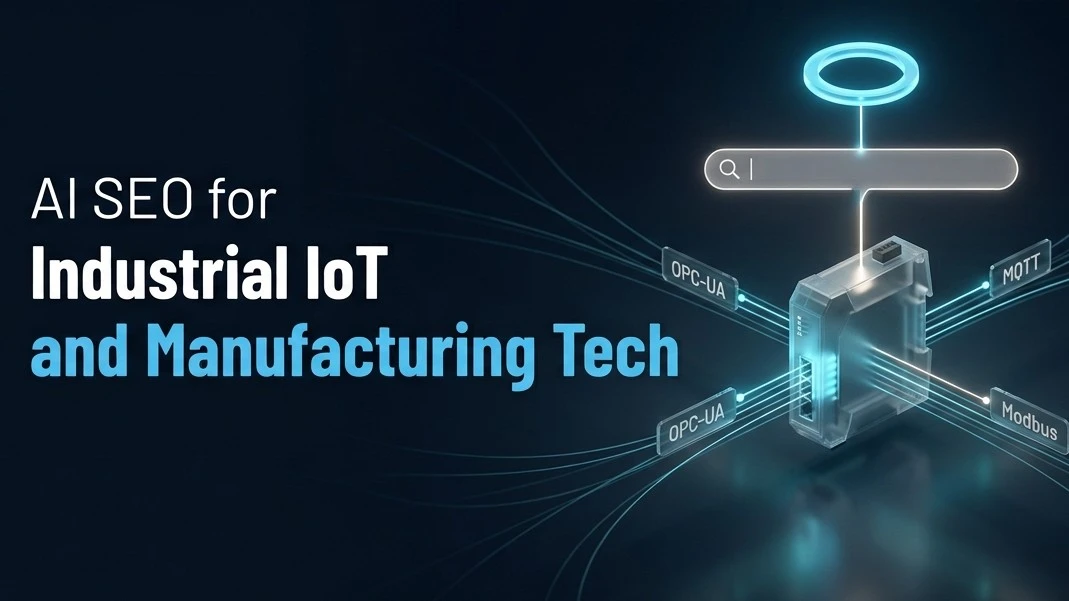
I want to start with a number that surprised me when I found it. Industrial IoT delivers an 866% average SEO ROI with a seven-month breakeven, making it the fourth-highest-returning vertical across B2B categories, according to First Page Sage's 2026 analysis. It ranks above B2B SaaS, above construction, above HVAC, and just below oil and gas. The category generates remarkable returns from search-driven content programs when those programs are actually built.
Most Industrial IoT companies do not build them. And the ones that do are optimizing for a search landscape that is shifting toward AI citation faster than most of their content programs are adapting.
What Is AI SEO for Industrial IoT and Manufacturing Technology?
AI SEO for Industrial IoT and manufacturing technology is the practice of structuring content so that AI platforms—ChatGPT, Perplexity, Google AI Overviews, and increasingly Microsoft Copilot for enterprise—can extract and cite IIoT and manufacturing tech vendors when engineers, plant managers, operations leads, and procurement teams research solutions.
The defining challenge of this vertical is a vocabulary mismatch: Industrial IoT buyers search using highly specific operational language, protocol names, certification standards, and equipment types that AI platforms have often absorbed from inconsistent, poorly-structured sources and may not map cleanly to vendor capabilities.
A plant operations manager asking Perplexity "which IIoT platforms support OPC-UA and MQTT protocol convergence for brown-field manufacturing environments" is not asking a vague question. They know exactly what they need. The AI platform's ability to answer it accurately depends entirely on whether vendors in this space have published content that uses that specific vocabulary, in a structure AI models can extract, and from sources AI models trust.
Why AI Platforms "Barely Understand" This Category
The title of this article is a modest exaggeration, but only a modest one. AI platforms develop confident, accurate answers about categories that are heavily documented in clean, structured, publicly accessible web content. B2B SaaS categories, CRM, project management, marketing automation, have years of comparison content, G2 profiles, and structured reviews that AI models have absorbed. Industrial IoT does not.
A few structural reasons explain the gap:
- Much of the technical specification content for IIoT solutions exists in PDFs, in proprietary documentation portals, or in technical white papers that AI crawlers cannot access or cannot parse cleanly.
- The buying community is small, the published review ecosystem is thin compared to software categories, and the content that does exist is frequently written in engineering-to-engineering language without the answer-first structure AI models favor for extraction.
The result is that AI platforms answering IIoT category queries are often drawing from a smaller, less consistent source pool than the buyer deserves, and vendors who structure their content for AI extraction have a disproportionate influence on what those answers say.
This is not a complaint about the category. It is a genuine opportunity. When AI platforms have limited reliable sources for a technical category, the first vendor that publishes clean, specific, answer-first content on the right topics earns citation at a rate that would be much harder to achieve in a category like CRM, where the content competition is already dense.
The Specific Content Gaps That Drive IIoT AI Invisibility
Three content types are almost universally missing from IIoT vendor websites, and each one is directly relevant to AI citation:
- Protocol and integration compatibility pages organized by buyer question, not by feature list. A buyer asking "does this platform support MQTT, Modbus, and OPC-UA simultaneously in a brownfield environment" is asking a specific integration question in specific technical language. A page that answers this directly, "Yes. This platform supports MQTT, Modbus RTU, and OPC-UA natively, with protocol conversion between all three in a single gateway deployment", is a citable answer. A page that lists "hundreds of supported protocols" without naming them is not.
- Industry-specific use case pages that describe a named operational scenario. "Predictive maintenance for CNC machining environments" is a specific buyer situation. "How our platform reduced unplanned downtime by 34% at a mid-size automotive stamping facility" is a case study. "How IIoT connects to existing SCADA systems in food and beverage manufacturing without replacing the historian" is the kind of explainer page that earns citations because it answers a real buyer question that AI platforms receive but rarely have a good source to cite. Most IIoT vendor websites have a generic "solutions" page that is not any of these things.
- Compliance and certification pages structured as answers, not badge collections. IIoT buyers in regulated verticals (pharmaceutical, food and beverage, aerospace, medical device) have compliance requirements that are foundational to their vendor selection. An IEC 62443 compliance page that explains specifically what the certification covers and what it means for a pharmaceutical manufacturing environment is far more citable than a page that lists "IEC 62443 compliant" next to a logo.
What the 866% ROI Number Actually Means for Content Investment
I want to come back to the ROI number from the introduction, because it changes the investment calculus for content in this vertical.
866% ROI with a seven-month breakeven means that for a B2B IIoT company with a meaningful average deal size, a well-built content program pays for itself in under a year and compounds from there. The content assets that produce those returns—the specific, technical, answer-first pages built around the operational questions buyers actually ask—are also exactly the content assets that earn AI search citations. These are not different content programs. They are the same program, because the content that answers a buyer's specific question well enough to rank in traditional search is the same content that answers it well enough to get cited by ChatGPT.
The 80% of B2B sales interactions moving through digital channels, per Gartner's prediction, is not a SaaS trend. It includes the plant operations manager and the procurement lead at the food and beverage manufacturer, both of whom are now using AI tools to build initial vendor shortlists before any human sales contact occurs. The IIoT vendor who gets cited in those initial AI answers is the vendor that shows up on the shortlist. The vendor who publishes only dense technical white papers that AI cannot parse does not.
A Practical Starting Point for IIoT AI SEO
If your IIoT company has not started this work yet, here is where I would begin, in the order that moves the needle fastest:
- Publish three to five specific protocol compatibility pages. One page per protocol cluster that your buyers actually specify in RFPs, with the answer in the first sentence and the supported protocol names explicit. This takes the technical knowledge your team already has and puts it in a format AI models can read.
- Build one named vertical use case page. Pick the industry where you have the strongest case study or the clearest differentiated positioning and build a page that walks through the specific operational problem, your specific approach, and a named customer result with a number attached. Vertical-specific content earns citations in vertical-specific queries at a much higher rate than horizontal content.
- Review your G2 or relevant review platform profile for the past six months. Make sure the capabilities visible in reviews match what your product actually does today. AI platforms weight review content heavily, and stale review profiles create gaps between what buyers read in AI answers and what they find when they contact your sales team.
Frequently Asked Questions
What is AI SEO for Industrial IoT and manufacturing technology?
AI SEO for Industrial IoT and manufacturing technology is the practice of structuring content so that AI platforms can extract and cite IIoT and manufacturing tech vendors when engineers, operations leads, and procurement teams research solutions. The core challenge is vocabulary precision: IIoT buyers use specific protocol names, certification standards, and operational scenarios that AI platforms may not accurately map to vendor capabilities unless those vendors have published answer-first content using that exact technical vocabulary.
Why do AI platforms often give imprecise answers about Industrial IoT categories?
Much of the technical specification content for IIoT solutions lives in PDFs, proprietary documentation portals, and dense white papers that AI crawlers cannot access or parse for clean extraction. The review ecosystem for industrial technology is thinner than for software categories, and the content that exists is often written for engineering audiences without the answer-first structure AI models favor. The result is that AI platforms answering IIoT queries draw from a smaller, less consistent source pool than buyers need, and the vendors who publish structured, specific content on the right topics influence AI answers disproportionately.
What content type earns the most AI citations for IIoT vendors?
Protocol and integration compatibility pages that answer specific buyer questions directly in the first sentence, named vertical use case pages that describe a specific operational scenario with a documented result, and compliance and certification pages that explain what certifications mean for a buyer's specific regulatory environment. Each of these answers the kind of specific, verifiable question that IIoT buyers ask in AI platforms and that AI models favor for citation because they can extract and attribute the answer with confidence.
What is the ROI case for content investment in Industrial IoT specifically?
First Page Sage's 2026 analysis puts Industrial IoT SEO ROI at 866% with a seven-month breakeven, the fourth-highest return across B2B verticals. This is a significantly stronger case than B2B SaaS at 702% or construction at 681%. The content that drives those returns, specific, technical, answer-first pages built around operational buyer questions, is the same content that earns AI search citations, so the investment serves both traditional SEO and AEO simultaneously.
How quickly can an IIoT company expect to see AI citation results from a content program?
Protocol-specific and vertical-specific pages can begin appearing in AI citations within four to eight weeks of indexing, particularly where AI platforms have limited reliable sources. The bar for becoming a cited source is lower in IIoT than in software categories with years of accumulated structured content. Track directional trends over a quarter rather than relying on point-in-time checks.
References
- First Page Sage, SEO ROI Statistics 2026, Industrial IoT 866% ROI and 7-month breakeven
- AEO Engine, Manufacturing SEO in the AI Era 2026, complete manufacturing AI search guide
- Optimist, Best AEO Agencies for B2B 2026, industrial manufacturing as distinct AEO vertical
- Adobe, SEO in 2026, Gartner 80% B2B sales interactions through digital channels


