
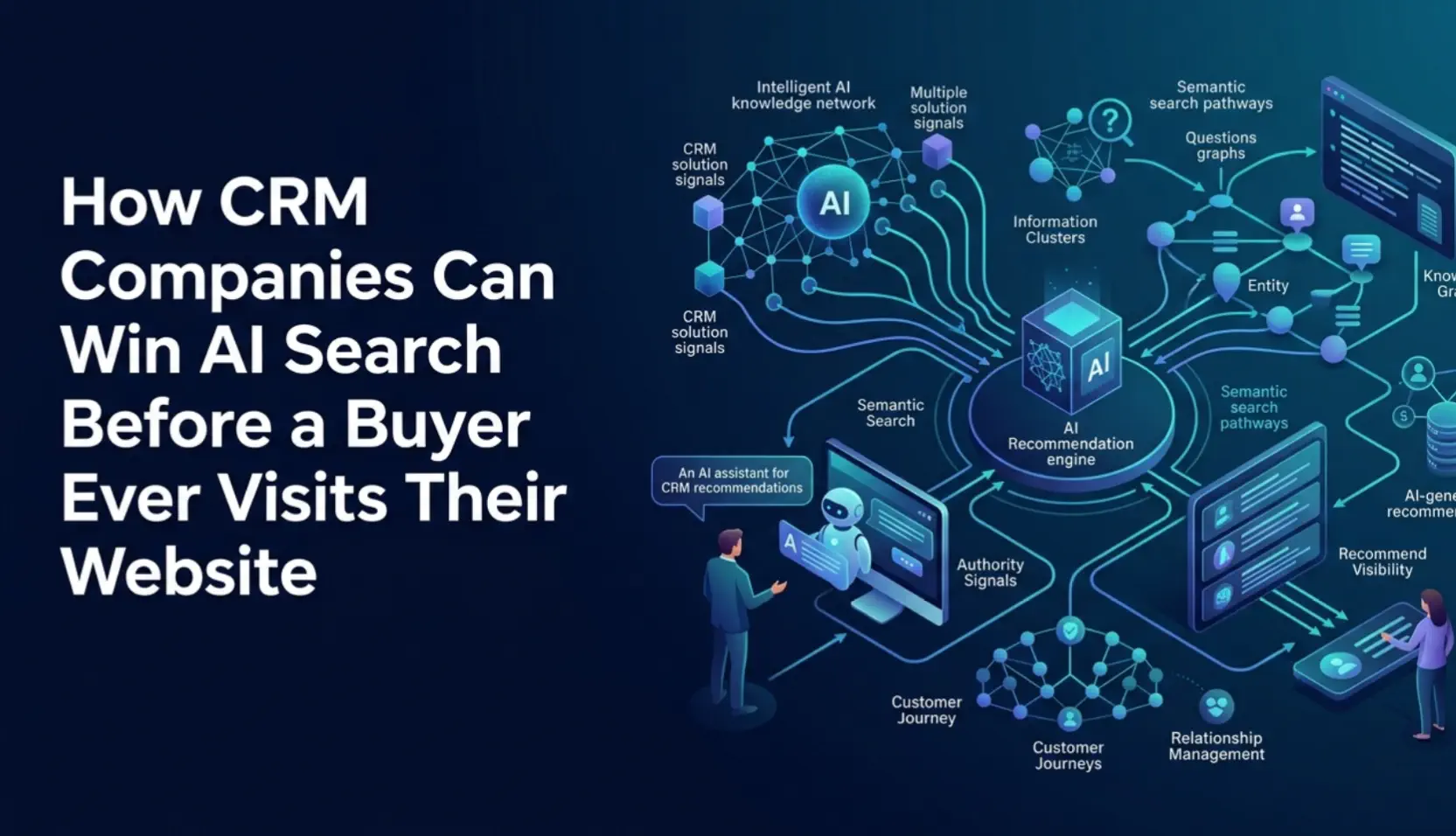
When a sales director types "best CRM for a 50-person SaaS company using HubSpot and Slack" into ChatGPT, they get an answer in seconds. Three brands. Maybe four. Salesforce. HubSpot. Possibly Pipedrive or Close.
If you are a mid-market CRM vendor with a genuinely better fit for that exact buyer, you are likely not in that response. Not because your product is worse. Because the AI does not have enough specific, structured, verifiable information about your brand to include it.
73% of B2B buyers now use AI tools like ChatGPT and Perplexity in their research process, according to a March 2026 analysis of 680 million AI citations (Averi/PRNewswire, 2026). AI search traffic converts at 14.2% compared to Google organic's 2.8%, a 5.1x advantage, making CRM AI citation a direct pipeline priority. The buyer who arrives at your website after reading an AI response that names your brand is not browsing. They are shortlisting.
80% of B2B deals are won by the vendor the buyer preferred before ever engaging sales (6sense, 2025). For CRM companies, that preference forms in AI search. The shortlist is built in ChatGPT, Perplexity, and Google AI Overviews, long before a demo is requested. The question is not whether your CRM belongs on that list. CRM ChatGPT visibility is the new top-of-funnel. The question is whether AI platforms have enough to go on to put it there.
Why CRM Is the Most Contested AI Citation Category in B2B Software
CRM is the single most competitive B2B software category in AI citation ecosystems. Salesforce, HubSpot, Pipedrive, Zoho, and Microsoft Dynamics all have years of editorial coverage, community presence, analyst citations, and domain authority behind them. Every major AI platform has absorbed enormous volumes of content about these brands. For any query containing the words "best CRM," the giants dominate by sheer weight of co-occurrence signals.
But here is where it gets interesting. ChatGPT does not pick one winner. It cites direct competitors together (Profound, February 2026). When a buyer asks about CRM software for a specific use case, role, or company type, AI platforms are looking for the most specific, most contextually aligned answer available, not the most frequently mentioned brand overall. A mid-market CRM vendor that owns the AI answer for "best CRM for professional services firms under 100 people" has something no amount of Salesforce budget can take away: vertical specificity.
The most common terms that trigger web searches in ChatGPT are "reviews," "2025," "free," "features," and "comparison." Commercial intent prompts are far more likely to trigger ChatGPT's retrieval layer than informational queries. That means the queries where CRM vendors have the highest citation opportunity are the comparison, review, and use-case-specific queries where specificity wins over brand recognition.
There is less than a 1-in-100 chance that ChatGPT or Google AI, asked the same question 100 times, will return the same list of brands in any two responses. AI recommendations are probabilistic, not deterministic. The brands that appear most consistently are the ones with the strongest multi-platform entity signals, not just the strongest SEO.
Three patterns explain why most mid-market CRM vendors are invisible in AI search:
- Generic positioning that every CRM also claims. "Streamline your sales pipeline." "Close more deals faster." "AI-powered CRM for growing teams." These phrases appear on virtually every CRM website. When AI platforms synthesize a response about CRM tools, identical language across multiple sources yields a generic answer that names only the brands with the most historical co-occurrence. Specific vertical and role-level positioning is what breaks through.
- Comparison pages written for SEO, not AI extraction. A comparison page structured as a feature table satisfies a human reader. An AI platform looking for a citable answer to "how does [your brand] compare to HubSpot for professional services firms?" needs a direct, 50-word answer in the first two sentences of the relevant section. Most CRM comparison pages are not built to produce that.
- Absent from the communities, AI platforms weigh most. Reddit, Wikipedia, and YouTube combined account for approximately 24% of all sources cited by ChatGPT, with listicle and how-to formats representing over 40% of LLM citations overall. CRM buyers are active on Reddit's r/sales and r/CRM communities, asking real questions about real tool comparisons. CRM vendors that participate genuinely in these communities build citation authority that no marketing budget can replicate.
Three AI SEO Moves Specific to CRM Companies
Move 1: Build role-specific and vertical-specific answer capsules
The most underused CRM citation strategy is also the most immediately actionable. Instead of one generic CRM positioning statement, build a library of role-specific and vertical-specific answer capsules, one for each major ICP segment your CRM serves.
A role-specific answer capsule for sales operations looks like this: "Sales operations teams using our CRM reduce CRM data entry time by 68% through automated activity logging, and cut reporting prep from four hours to 30 minutes per week, verified across 200 mid-market B2B accounts with Salesforce and HubSpot migration experience."
A vertical-specific capsule for professional services firms looks like this: "Professional services firms use our CRM to manage retainer renewals, track billable hours against deal stages, and automate client check-ins, reducing average client churn by 22% in the first year, based on data from 80 agency and consulting firm deployments."
Each capsule is a discrete AI citation target. It answers a specific query that a specific buyer is running in ChatGPT or Perplexity. It contains an outcome, a timeframe, a mechanism, and a proof signal. Build five of these, one per major ICP segment, and publish them on dedicated use-case pages with FAQPage schema markup on each. Those five pages become five separate citation surfaces for five different buyer queries.
Move 2: Dominate comparison queries with AEO-structured comparison content
Brands are 6.5x more likely to be cited in AI answers through third-party sources than through their own domains. For CRM companies, comparison content on your own site is still essential, but it needs to be structured for AI extraction, not just keyword ranking.
Every major CRM comparison query your buyers run in AI platforms should have a corresponding page on your site with an AEO-structured answer in the first two sentences. "How does [your brand] compare to HubSpot for professional services?" should have a page that opens with: "[Your brand] and HubSpot both serve professional services firms, but differ in retainer management and billable hour tracking. [Your brand] includes native retainer renewal automation and hour-to-deal-stage tracking, capabilities that HubSpot requires third-party integrations to replicate."
That is a citable answer. It is specific. It names the differentiator. It names the mechanism. It does not require reading the full page to extract. Then earn placement on third-party comparison sites, G2 comparisons, Capterra alternative pages, and independently published CRM comparison roundups, where sites with over 32,000 referring domains are 3.5 times more likely to be cited by ChatGPT.
Move 3: Build community presence where CRM buyers ask real questions
The CRM buyer community is active, opinionated, and concentrated in specific online spaces that AI platforms heavily index. Reddit's r/sales has over 180,000 members discussing pipeline management, CRM evaluation, and sales tool recommendations in genuine, unsponsored conversations. A helpful, expert answer to "what CRM works best for a 30-person agency transitioning from spreadsheets?" from a named expert at your company is worth more citation authority than a dozen press releases.
Distributing content to a wide range of publications can increase AI citations by up to 325% compared to only publishing content on your own site. For CRM companies, earned media distribution means guest articles in sales operations publications, contributions to CRM evaluation guides in industry-specific outlets, and participation in expert roundups. Each third-party mention is a co-occurrence signal that AI platforms use to validate your brand's authority in the CRM category.
YouTube matters too. Reddit, Wikipedia, and YouTube combined account for approximately 24% of ChatGPT's citation sources. A CRM vendor with a YouTube channel covering specific use cases, "how to manage retainer renewals in [your CRM]," "comparing [your brand] vs HubSpot for agency workflows", is building citation authority on a platform that AI systems weigh heavily for commercial software queries.
The Four-Step CRM AI SEO Audit
Start here before touching any content or community strategy:
- Run 15 buyer-intent prompts across ChatGPT and Perplexity. Use the most common commercial intent triggers: "best CRM for [your primary vertical]," "compare [your brand] vs [HubSpot/Salesforce/Pipedrive]," "[your ICP job title] CRM recommendations 2026," "CRM for [specific use case]." Record whether your brand appears, in what position, and with what description. That gap is your AI SEO brief.
- Audit your G2 and Capterra profiles for outcome specificity. Read your G2 product description as if you were an AI platform deciding whether to cite it. Does it contain specific outcomes, named verticals, and integration signals? If it reads like a brochure, rewrite it with the same answer-first discipline as your best-performing blog content.
- Map your top five ICP segments to missing answer capsules. For each segment, ask: Does our website have a page that answers "best CRM for [this ICP]" in the first two sentences? If not, those missing pages are your five highest-priority content gaps.
- Identify three community surfaces where your buyers ask real questions. Reddit communities, LinkedIn group discussions, and YouTube comment threads where CRM buyers evaluate tools. Start with genuine participation - answering real questions from named experts at your company - before any content strategy is in place.
Frequently Asked Questions
What is AI SEO for CRM companies?
AI SEO for CRM companies is the practice of optimizing CRM brand presence and content so AI platforms, ChatGPT, Perplexity, Google AI Overviews, and Gemini cite and recommend the CRM when buyers research sales tools for their specific role, vertical, or use case. It combines traditional SEO foundations with AEO (Answer Engine Optimization) content structure and GEO (Generative Engine Optimization) multi-platform presence. The goal is not to compete with Salesforce and HubSpot on generic queries but to own the AI citation for specific vertical and role-level buyer queries where specificity wins over brand recognition.
Why do mid-market CRM vendors go uncited in ChatGPT even when they rank on Google?
Mid-market CRM vendors rank on Google but go unmentioned in ChatGPT responses because the two surfaces reward different signals. Google rewards keyword alignment and domain authority. ChatGPT rewards entity consistency, multi-platform presence, third-party co-occurrence, and content that contains specific, extractable answers in the first 30% of each page. A CRM vendor with strong SEO but generic positioning, incomplete G2 profiles, and no community presence will rank on Google and be absent from ChatGPT. The fix is vertical-specific answer capsules, AEO-structured comparison content, and genuine community participation across the platforms AI systems index most heavily.
How should CRM companies structure comparison content for AI citations?
CRM companies should structure comparison content for AI citations by opening every comparison section with a direct, 40-to-60-word answer capsule that names the primary differentiator immediately, without requiring the reader or the AI to read further. Each major comparison query should have a dedicated page section or full page: "[Your brand] vs HubSpot for agencies," "[Your brand] vs Pipedrive for sales operations," and so on. The opening sentence of each comparison section is the citation target. FAQPage schema markup on comparison pages turns each comparison question into a discrete, extractable citation surface for ChatGPT, Perplexity, and Google AI Overviews.
Which platforms matter most for CRM GEO strategy?
The platforms that matter most for CRM GEO strategy are: G2 and Capterra (core review profiles that AI platforms cite heavily for software recommendation queries), Reddit communities where sales and CRM buyers ask real implementation questions (r/sales, r/CRM), YouTube for use-case and comparison content (YouTube and Reddit combined account for a significant share of ChatGPT citations), LinkedIn published posts from named sales and product experts, and independently published CRM comparison roundups on authoritative industry sites. Third-party mentions are 6.5 times more likely to be cited in AI answers than content on your own domain. Building presence on these external surfaces is the highest-leverage GEO investment for CRM companies.
How long does AI SEO take to show results for CRM companies?
Profile updates on G2, Capterra, and LinkedIn can improve AI entity recognition within two to four weeks as platforms re-index updated content. New vertical-specific answer capsule pages can appear in Perplexity citations within hours of indexing due to Perplexity's real-time retrieval. Community participation takes 60 to 90 days of sustained presence to build measurable citation authority. Third-party earned media placements typically appear as consistent AI citation signals within 30 to 60 days of publication. Full citation consistency across ChatGPT, Perplexity, Google AI Overviews, and Gemini for a specific vertical segment typically builds over three to six months of combined AEO and GEO implementation.


