
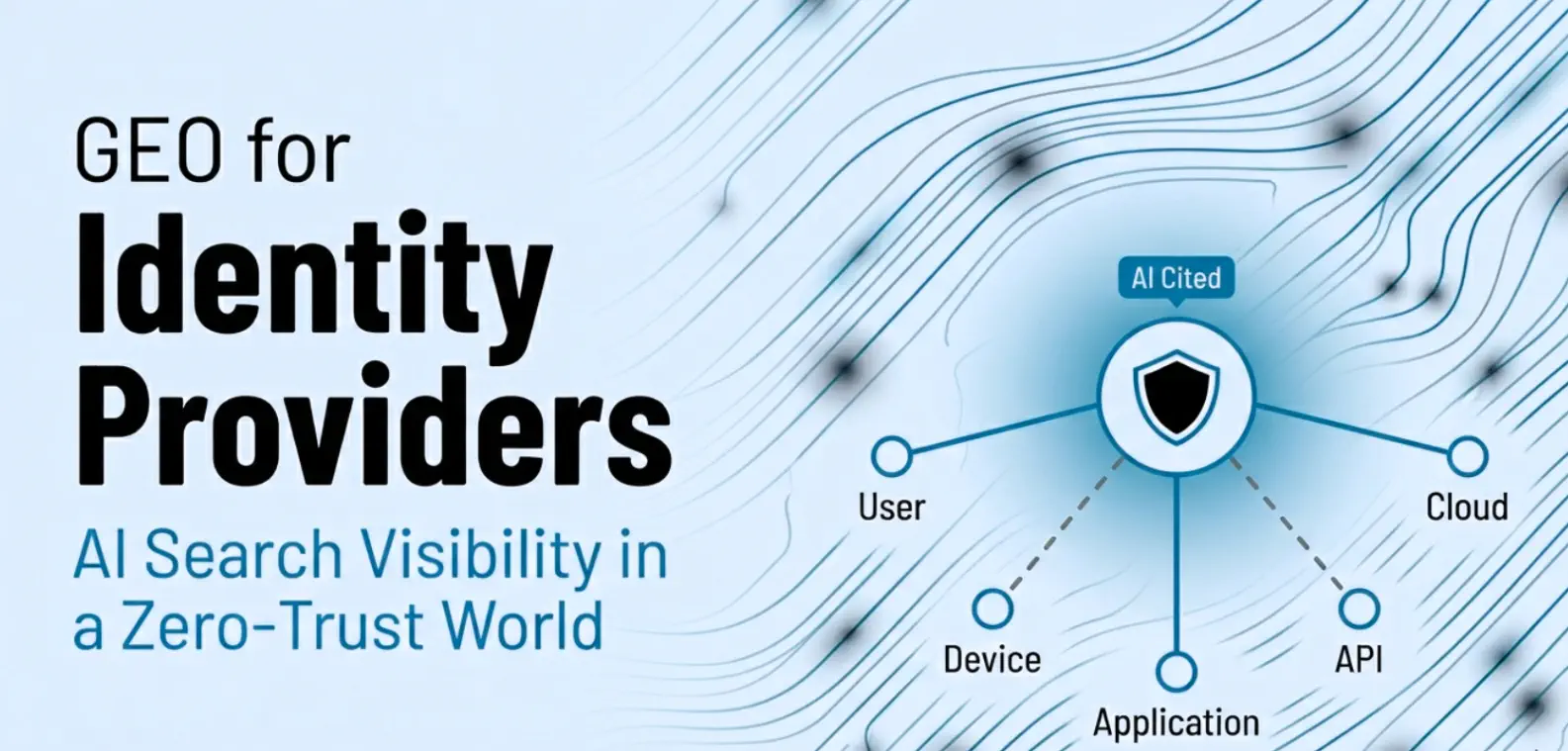
GEO for Identity Providers: How to Fix AI Search Visibility in a Zero-Trust World
A CISO opens ChatGPT. Types: "What is the best IAM solution for zero trust in a mid-market financial services company?"
The platform names two or three vendors. The buyer builds a shortlist from them. There is no page two. There are no ten blue links. The vendors not named do not exist for that buyer at that moment.
One enterprise cybersecurity firm with 50,000-plus monthly Google visitors received zero ChatGPT citations when buyers searched for their category. A competitor with a fraction of their organic traffic appeared consistently across multiple AI platforms due to structured, citation-friendly content. That is the GEO problem for identity providers in one case study. Large organic footprint. Zero AI presence. Invisible where it matters most.
Identity management AI SEO is more consequential in this category than in any other B2B security vertical. Identity and access management is where the stakes of AI invisibility are highest. Security buyers are risk-averse, research-intensive, and increasingly reliant on AI platforms to build preliminary shortlists before engaging any vendor.
Perplexity accounts for 15.1% of AI traffic globally, approximately 20% in the US. Unlike ChatGPT, it performs real-time web searches and cites five to eight-plus sources per response, creating more citation opportunities. It favors fresh, well-structured content regardless of domain authority; a vendor publishing a comparison page today could appear in results within hours.
Zero trust content strategy, SASE architecture, and passwordless authentication, identity, and access management are one of the most jargon-saturated categories in B2B security. Every vendor uses the same three terms. Every website promises "seamless, secure access." And AI platforms, when synthesizing a response about IAM tools, encounter a wall of identical language and default to the vendors with the strongest earned media presence: Okta, Microsoft Entra ID, and Ping Identity.
Cybersecurity GEO for mid-market identity providers is not to out-cite these giants on generic queries. It is to own the AI citation for specific security architectures, compliance frameworks, and industry verticals where the giants are too broad to be the precise answer.
Why Identity Providers Struggle Most With AI Search Visibility
The September 2025 University of Toronto study confirmed a systematic bias in AI search toward earned media over brand-owned content. Your blog posts and product pages are far less likely to be cited than a Gartner mention, a G2 review, a Reddit thread in r/cybersecurity, or a third-party comparison article.
That earned media bias hits identity providers harder than almost any other B2B technology category. Here is why.
Security buyers are deeply skeptical of vendor-produced content. They trust peer reviews, analyst reports, and community discussions, exactly the earned media that AI platforms weigh most heavily. An identity provider with excellent website content but thin G2 coverage, no analyst mentions, and no presence in r/netsec or r/cybersecurity is building content for a surface that AI systems treat as less credible than a Reddit thread from three years ago.
Three patterns explain most IAM AI invisibility:
- Identical jargon across every competitor. "Zero trust architecture." "Passwordless authentication." "Least-privilege access." "Single sign-on with MFA." These phrases appear on every IAM vendor's homepage. They are security requirements described as differentiators. When AI platforms see twenty vendors using the same language, they synthesize a generic category response and cite only the brands with the most historical co-occurrence in third-party sources. Compliance-specific, outcome-specific language is what breaks through.
- Security incident data is sitting unused. Identity providers often have access to powerful AEO citation material they never publish. Aggregate statistics on credential-based breaches prevented. Mean time to detect and respond to identity threats. Authentication friction reduction percentages from customer deployments. Adding statistics to content improves AI visibility by 30 to 40%, per the Princeton GEO study. The data exists inside customer success teams. It just never makes it into structured, web-accessible answer capsules.
- Regulatory specificity is treated as fine print. SOC 2 Type II, FedRAMP, ISO 27001, HIPAA, PCI DSS - compliance certifications that procurement teams treat as deal-breakers are buried in footnotes on most IAM vendor websites. These regulatory terms are among the highest-intent query triggers in security procurement AI searches. A buyer whose organization requires FedRAMP authorization types that into ChatGPT. If your FedRAMP status is not in a structured, extractable answer on a dedicated page, you are invisible to that buyer.
Three GEO Moves for Identity Providers
Move 1: Build compliance-specific answer capsules as your citation foundation
The highest-leverage GEO move for an identity provider is owning AI citations for specific compliance framework queries. Not generic "enterprise IAM" queries. Specific queries like "what IAM solutions are FedRAMP authorized for federal agencies?" or "which identity providers support HIPAA-compliant MFA for healthcare organizations?"
A compliance-specific answer capsule looks like this: "FedRAMP High authorized identity platform supporting zero-trust access for federal agencies, providing MFA, privileged access management, and session recording with full audit trail for NIST SP 800-63B compliance. Average implementation time 14 days for agencies under 10,000 users."
That is citable. It contains the compliance framework (FedRAMP High), the buyer vertical (federal agencies), the specific capabilities (MFA, PAM, session recording), the regulatory standard (NIST SP 800-63B), and an operational outcome (14-day implementation). Build one of these for every major compliance framework your platform supports. Each capsule is a discrete citation target for a specific regulatory buyer query that your giant competitors answer too generically to win.
Move 2: Earn the third-party citations AI platforms actually trust
The earned media bias is systematic and significant. A Gartner mention, a G2 review, a Reddit thread in r/cybersecurity, or a third-party comparison article is far more likely to be cited by AI platforms than your own blog or product pages.
For identity providers, the earned media priority list has a specific order of impact.
- G2 and Gartner Peer Insights come first. Security buyers are heavy G2 users, r/cybersecurity members frequently reference G2 reviews in tool evaluation discussions, and AI platforms pulling citations for security tool queries draw heavily from review platforms. A complete G2 profile with outcome-specific language, named compliance certifications, and recent reviews from customers in regulated industries is a citation asset worth more than a hundred blog posts.
- Reddit's r/netsec, r/cybersecurity, and r/sysadmin are next. 99.2% of Reddit citations in ChatGPT point to specific discussion threads, not subreddit landing pages. A named security expert at your company contributing genuinely helpful answers to "what IAM vendor handles FedRAMP well for agencies under 5,000 users?" is building the kind of citation authority that no advertising budget can manufacture. The community validates the expertise. The AI platform indexes the validation.
- Independent analyst mentions in reports from Forrester, Gartner, KuppingerCole, and Omdia carry the highest single-citation weight in IAM AI responses. One Gartner Magic Quadrant mention outperforms years of website content for AI citation purposes. Prioritize earned placement in analyst research.
Move 3: Use security incident data as your proprietary citation anchor
Every identity provider has access to security performance data that no competitor can replicate. The number of credential-based breach attempts blocked. The average reduction in authentication friction for specific customer profiles. The mean time to detect anomalous login behavior compared to industry benchmarks. The percentage reduction in help desk password reset tickets after passwordless deployment.
37% of product discovery queries now start in AI interfaces like ChatGPT and Perplexity. For security buyers, those queries are increasingly specific, not "best IAM tool" but "which identity provider reduces credential-based breach risk for healthcare organizations with hybrid infrastructure?" The vendor with proprietary security outcome data structured as AEO answer capsules owns those citations.
A claim like "healthcare organizations using our platform see a 94% reduction in credential-based breach attempts in the first 180 days, based on aggregate threat intelligence across 200 hospital and clinic deployments" is a citation anchor. It is specific to a vertical (healthcare). It contains a metric (94% reduction), a timeframe (180 days), and a sample size (200 deployments). ChatGPT, Perplexity, and Google AI Overviews will extract it in response to healthcare IAM queries. No generic "seamless, secure access" claim competes with it.
The GEO Foundation Identity Providers Need First
Before any of the moves above produce results, three foundational requirements must be confirmed:
- Entity consistency across security-specific platforms. Your company name, IAM category description, primary compliance certifications, and core security differentiation must be identical across your website, G2, Gartner Peer Insights, LinkedIn, and any analyst coverage. Security AI citation requires consistent entity verification across multiple independent sources. "Identity and access management platform," and "enterprise identity security solution," and "zero trust access provider" are not equivalent entity signals. Pick one. Use it everywhere.
- AI crawler access confirmed. GPTBot, ClaudeBot, PerplexityBot, and Google-Extended must all be whitelisted in your robots.txt. Many security-minded organizations have restrictive crawler configurations that inadvertently block AI indexing. This is a five-minute check that unlocks every other GEO investment.
- Compliance certification pages with AEO structure. Every compliance certification your platform holds - FedRAMP, SOC 2, ISO 27001, HIPAA, PCI DSS - should have its own page or dedicated section with a 40-to-60-word answer capsule at the top and FAQPage schema marking up the most common compliance evaluation questions. These pages are your highest-value citation assets for regulated industry buyers.
Frequently Asked Questions
What is GEO for identity providers?
GEO for identity providers is the practice of building multi-platform brand presence so AI systems, ChatGPT, Perplexity, Google AI Overviews, and Gemini cite and recommend identity and access management vendors when security buyers research IAM, zero trust, or compliance-specific solutions. Unlike generic GEO, identity provider GEO focuses on compliance framework specificity (FedRAMP, SOC 2, HIPAA, ISO 27001), security incident data as citation anchors, and earned media in cybersecurity-specific communities that AI platforms weigh heavily over brand-owned content.
Why do identity providers with strong Google rankings go uncited in AI search?
Identity providers go uncited in AI search despite strong Google rankings because AI platforms weigh earned media over brand-owned content. A Gartner mention, G2 review, Reddit thread in r/cybersecurity, or third-party comparison article is far more likely to be cited than a vendor's own product pages, regardless of that page's Google ranking. The September 2025 University of Toronto study confirmed this earned media bias systematically. Identity providers that invest heavily in website content but neglect G2 profiles, analyst relationships, and security community participation are optimizing for a surface that AI citation algorithms treat as less credible than peer community discussions.
How should identity providers use compliance certifications for GEO?
Identity providers should treat compliance certifications as AEO citation assets rather than fine print. Each certification, FedRAMP, SOC 2 Type II, HIPAA, ISO 27001, PCI DSS, should have a dedicated page or section with a 40-to-60 word answer capsule naming the specific certification, the buyer vertical it serves, the operational outcome it enables, and the implementation timeline. These compliance-specific pages answer the exact procurement queries that regulated-industry buyers run in ChatGPT and Perplexity. The FAQPage schema on compliance pages turns each certification question into a discrete citation target for AI platforms responding to regulated industry IAM queries.
Which communities matter most for the identity provider GEO strategy?
For identity provider GEO, the highest-impact communities are Reddit's r/cybersecurity, r/netsec, and r/sysadmin, where security professionals discuss real IAM evaluation decisions; G2 and Gartner Peer Insights, where security buyers research tools and AI platforms source review-based citations; and independent analyst reports from Gartner, Forrester, KuppingerCole, and Omdia, which carry the highest single-citation weight in AI-generated IAM responses. Genuine expert participation in community discussions, answering real implementation questions from named security professionals at your company, builds citation authority that advertising and press releases cannot replicate.
How long does GEO take to show results for identity providers?
Profile updates on G2, Gartner Peer Insights, and LinkedIn can improve AI entity recognition within two to four weeks as platforms re-index updated content. New compliance-specific answer capsule pages can appear in Perplexity citations within hours of indexing. Reddit community participation takes 60 to 90 days of sustained, genuine presence to build measurable citation authority. Analyst mentions typically begin appearing as consistent AI citation signals within 30 to 60 days of report publication. Full citation consistency across ChatGPT, Perplexity, Google AI Overviews, and Gemini for a specific compliance framework or vertical typically builds over four to six months of combined GEO implementation.
References
- GrackerAI, 2026 - State of AI Search Visibility in Cybersecurity Benchmark Report (100 vendors, 250 prompts, September 2025 to January 2026): https://gracker.ai/data-and-research-reports/state-of-ai-search-visibility-cybersecurity-2026
- University of Toronto, September 2025 - Systematic earned media bias in AI search citations: Referenced in GrackerAI Cybersecurity Benchmark Report
- Princeton GEO Study, KDD 2024 - Statistics addition boosts AI citation probability 30-40%: Princeton University / Georgia Tech / IIT Delhi / Allen Institute for AI
- Profound, December 2025 to January 2026 - YouTube citation patterns, Reddit citation thread analysis (180,994 citations): https://www.tryprofound.com
- Nick Lafferty / Profound, 2026 - 99.2% Reddit citations point to specific threads; LinkedIn jump from 11th to 5th cited domain: https://nicklafferty.com/blog/best-ai-visibility-optimization-platforms/
- Stackmatix, April 2026 - GEO tools guide, Perplexity traffic share (15.1% global, 20% US): https://www.stackmatix.com/blog/geo-tools-guide
- Netwrix, 2025 Cybersecurity Trends Report - 37% of organizations adjusted security approach due to AI-driven threats: https://netwrix.com
- GrackerAI Insights Hub, 2026 - Best AI visibility tools for IAM and identity security vendors: https://gracker.ai/blog/ai-visibility-tools-identity-security
- 6sense, 2025 Buyer Experience Report - 80% of deals won by preferred vendor before sales engagement: https://6sense.com
- Quattr, Spring 2026 - G2 rankings for AEO Results and AI search visibility platforms: https://www.quattr.com


