
If you are reading this, there's a good chance you want to know how we ended up here. We are referring to the go-to-market aspect of launching a product or service, and it's becoming increasingly complex by the day.
GTM Strategy is becoming increasingly digitally integrated, and there's no straight line for its execution anymore. For SaaS companies, the GTM strategy encompasses multiple channels, including B2B partnerships, listing in digital marketplaces such as the Microsoft Partner Portal, AWS partnerships, or the Google Partner ecosystem.
There are other tactics like account-based marketing, social selling, hosting webinars, brand building, integrated marketing and sales initiatives, and event marketing.
To get to the current state of GTM strategy, it makes sense to revisit the GTM efforts of the past decades, to truly understand how this space has evolved.
Let's visit some of the most iconic GTM strategies of the past that have worked.
For research purposes alone, we'll also try to find the commonalities in these strategies and why they hit it off with their target audience. In essence, we'll try to get into the thinking process of your target users and how they choose one solution over the other.
What is GTM Strategy?
Go-to-market strategy is a plan or sequence of tactics and activities that help you build awareness about your product or service. For example, a car company can maximize exposure to its new car at a car show.
In the current times, though, the traditional GTM strategy is changing and is becoming more digitally integrated. For a car company, the GTM strategy is changing too. We'll discuss that with an example here in the next section.
How was GTM in the Old Days?
Back in the days before the internet, the GTM strategy was more in-person. For a car buyer, a car show was a way to see and experience the product. Legendary cars like the Mustang and the Chevy Camaro all started at an auto show.
They grabbed the eyeballs of the show-goers, and the car magazine went into a blitzkrieg of opinions on any new machine they saw at the show. This gave massive visibility and an initial boost to new cars. It also helped manufacturers better understand public response to new concepts, which might make it to market in the near future.
For example, the Ford Mustang, the highest-selling sports car in the US in 2024, was first showcased as a concept back in 1961. The humble two-seater sports car concept made its public debut at the United States Grand Prix at Watkins Glen, New York, on October 7, 1962.
That's not the end, though; the concept car did a few laps around the track and managed to reach a promising 120mph. In IT terms, as revolutionary as some crazy 5G download speeds we see today.

This stunt attracted much attention, exactly what Ford needed to push this concept into production. Cha the Mustang is the longest-running production car in automobile history.
The stunt itself was Ford's GTM strategy to take the Mustang to market. Over the years, the American carmaker has still used the same tactics for its other vehicles, like the F-150 or the Focus.
How to inspire my target audience in my GTM plan?
Inspiring your key audience is one main component. Once you've identified your target group, which in Ford's case was sports car enthusiasts, you need to think about the solutions and products they are looking for.
You need to understand where your key audience is, which is becoming increasingly challenging in the digital age. GTM is more than creating a 90-day plan, or a social media campaign, or having an email cadence.
GTM is an integrated function, where you need to think about your overarching strategy. Let's look at some modern examples.
What's OpenAI's GTM strategy for ChatGPT?
AI is all the rage these past few years. Every day, software companies are bringing new use cases of AI to the market. Names like Microsoft are offering better ways to integrate AI into business processes. OpenAI, one of the biggest AI players, has a lot of lessons for us when it comes to GTM strategy.
OpenAI used a multi-faceted approach while creating its GTM strategy to popularize its AI assistant, ChatGPT. Its key elements include:
- Strategic partnerships
- Product enhancements at speed
- Enterprise-focused GTM
- User-centric innovation
- Mass adoption through accessibility
What's the role of Strategic Partnerships and Integrations in GTM?
OpenAI got its initial boost with a key Microsoft partnership. It got a flying start by integrating OpenAI's models into Microsoft platforms, like Azure, Microsoft 365, and Dynamics 365.
This initiative enabled OpenAI engineers to refine the product before its broader release to enterprise users. A number of Microsoft Partner companies were able to integrate and test ChatGPT's capabilities within their existing services and tools.
Before word-of-mouth spread, this provided ChatGPT with early credibility and visibility. Soon, this generative AI model became the focus of discussion within technology circles, and subsequently, around the world.
OpenAI gained popularity within Microsoft's technology circles through early strategic partnerships and integrations. ChatGPT was popularized by its integration into mainstream Microsoft platforms, specifically Azure and Microsoft Dynamics 365, which in the focus of the Microsoft Partner Program.
OpenAI continues to develop new partnerships, like the one with Apple back in 2024. While a bit late to be considered part of its go-to-market strategy, this nonetheless represents a significant company decision, demonstrating the value of fostering impactful partnerships.
OpenAI's go-to-market (GTM) strategy for ChatGPT has a two-tiered approach aimed at maximizing both consumer and enterprise adoption through partnerships, continuous innovation, and rapid deployment.
As per The Strategy Deck, it has:
- First-party applications like the ChatGPT window, we are so used to having a conversation with.
- A customizable enterprise version that can be tuned to specific business needs – Enterprise ChatGPT
- An API providing direct access to the catalog of GPT models
- A distribution partnership with Microsoft and Scale AI.
Although partnerships were the crucial piece of this puzzle, for the GTM to succeed, there were several other factors. OpenAI's capable team also championed the other aspects of building a great product.
Does Frequent Product Enhancement Help in GTM?
Absolutely - frequent enhancements are a powerful GTM accelerator. Take OpenAI's rollout of GPT-5 as a case in point. Released in August 2025, GPT-5 didn't just bring incremental upgrades; it unified prior advances (like the o-series reasoning models) into one smarter, faster, more reliable platform. It added multimodal capabilities, deeper reasoning, and enhanced "vibe coding" for seamless prompt-to-code workflows Financial Times OpenAI.
What made this rollout especially noteworthy was how quickly OpenAI integrated GPT-5 across its ecosystem. Teams, Enterprise, Education, and developers on the API began using it immediately. Enterprise users like Amgen reported early benefits:
"GPT-5 has met our high bar for scientific accuracy… we are seeing increased accuracy, reliability, higher quality outputs, and faster speeds compared to prior models." Sean Bruich, SVP of AI & Data at Amgen OpenAI
This rapid, high-impact iteration witnessed broad adoption across platforms like Vercel, casting GPT-5 as the default engine for creative coding tasks. Users praised its ability to catch bugs, generate prototypes, and execute long-horizon tasks with renewed confidence, driving value across both technical and strategic domains CNBC.
Why It Works for GTM?
-
Buzz and Availability - A major model upgrade like GPT-5 creates instant media traction and user curiosity - especially when it's rolled out broadly and quickly.
-
Proof of Progress - Industry leaders publicly touting tangible gains (like Amgen) create real-world trust and encourage others to follow suit.
-
Functional Leap, Not Just Hype - GPT-5 wasn't merely iterative - it combined advanced reasoning, multimodal understanding, and agentic behavior into a single, unified experience.
How Custom AI Agents Build Enterprise-Focused Solutions?
What could be a better GTM strategy than saying that this AI solution will help you build your own AI agents? Enterprises are increasing automation in always-on tasks like customer support or cybersecurity measures.
OpenAI is ramping up its appeal to enterprises by introducing customizable AI agents via its agent-building platform, giving companies the power to design agents for tasks like customer support or financial analysis. Early adopters include Stripe, which crafted an agent that reads a sales-tracking spreadsheet and generates and sends invoices autonomously, and Box, building agents that securely connect to files stored in their platform for streamlined internal workflows mint.
These enterprise-grade agents offer the security, control, and flexibility that corporate clients demand-making GTM far more compelling. The result? High engagement and growing adoption across enterprise user bases.
What Are the User-Centric Innovations Driving GTM Forward?
OpenAI keeps ChatGPT compelling by continually pushing the envelope with features that expand its usefulness and appeal. One standout addition in 2025 is Agent Mode-a smart assistant capable of browsing the web, sending emails, running code, even creating spreadsheets and presentations autonomously.
Originally unveiled in ChatGPT's livestream, it's now available to Pro, Plus, Team, and Enterprise users-and is already transforming workflows in sectors like education. Educators, for example, are using Agent Mode to manage emails, build presentations, and compile job listings with minimal effort, Tech & Learning.
These user-centric innovations aren't just about cool tech-they turn ChatGPT into a genuine productivity suite. By solving real-life problems and saving time, OpenAI makes ChatGPT indispensable both for users and organizations.
Global Outreach: In tandem with technology partnerships, OpenAI expanded its visibility through marketing, demonstrations, and user education efforts. This strategy resulted in fast-growing adoption, as evidenced by ChatGPT reaching hundreds of millions of users within a short time frame.
These tactics collectively allowed OpenAI to dominate both consumer and enterprise AI markets rapidly, leveraging partnerships, targeted innovations, and continuous improvements to make ChatGPT a leading AI tool across multiple sectors. This approach has enabled OpenAI to stay competitive as other major tech firms invest in similar AI initiatives.
What Does GTM Strategy Look Like for Technology in 2025?
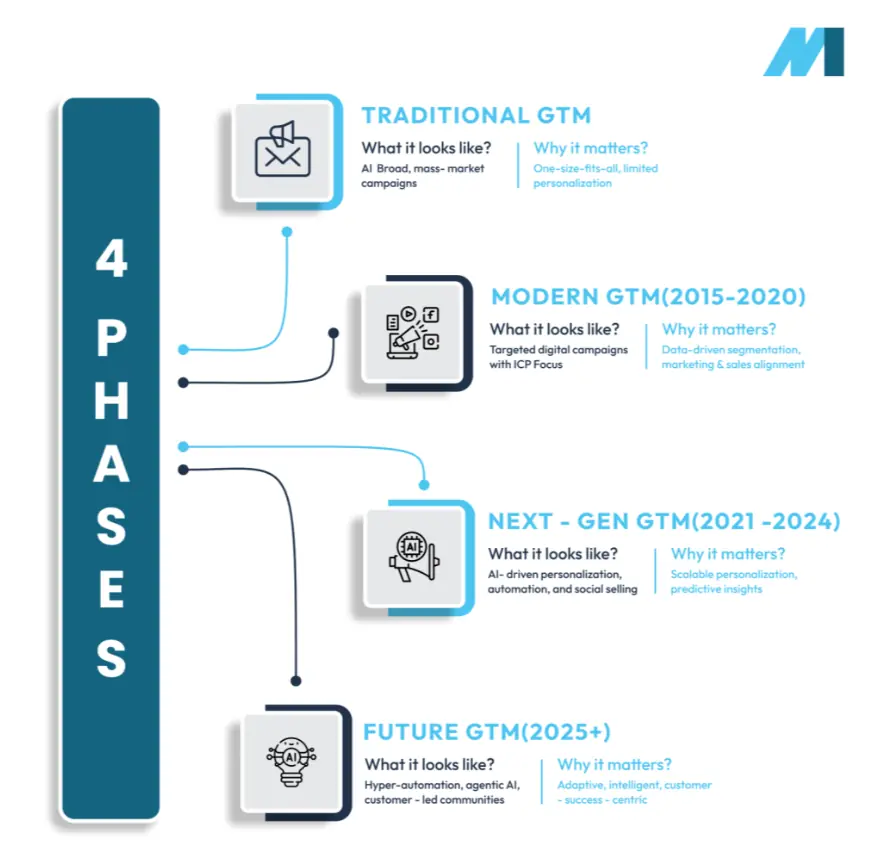
In 2025, the GTM strategy for technology companies is all about being agile, data-driven, and incredibly focused on the customer. It's a far cry from the mass-market approaches of the past. Think hyper-personalization and deep understanding of your Ideal Customer Profile (ICP).
One of the biggest shifts is the increased reliance on AI and automation. As per RenderTribe, we're not just talking about automating emails; AI is now helping predict buyer behavior, optimize sales processes, and deliver truly personalized content at scale. This means your GTM teams can focus on strategic activities rather than repetitive tasks.
Sales and marketing alignment is more crucial than ever. No more silos! Teams need to share data in real-time and work towards unified revenue-focused KPIs. As per RenderTribe, It's about looking at the entire pipeline performance, not just individual departmental metrics like MQLs (Marketing Qualified Leads) or SQLs (Sales Qualified Leads).
Another key trend is the rise of social selling and networking. LinkedIn, for instance, isn't just for job hunting; it's a powerful tool for connecting with prospects, building relationships, and nurturing leads. A RenderTribe article explains, buyers are doing their research online, and social platforms are where sellers can build rapport and provide value even before a formal sales conversation begins.
The same article says that Data diversification is also a huge part of the puzzle. Companies are moving beyond traditional data and looking at intent data, engagement metrics, and other advanced data collection methods to refine their targeting and personalization efforts. This means knowing not just who your customers are, but also what they are actively looking for and when.
Finally, for technology companies, the concept of Product-Led Growth (PLG) continues to gain traction. This is where the product itself becomes the primary driver of customer acquisition, activation, and retention. According to an article from Asana, think freemium models and free trials that let users experience the value firsthand, leading to organic growth and strong user retention.
What's Next for GTM?
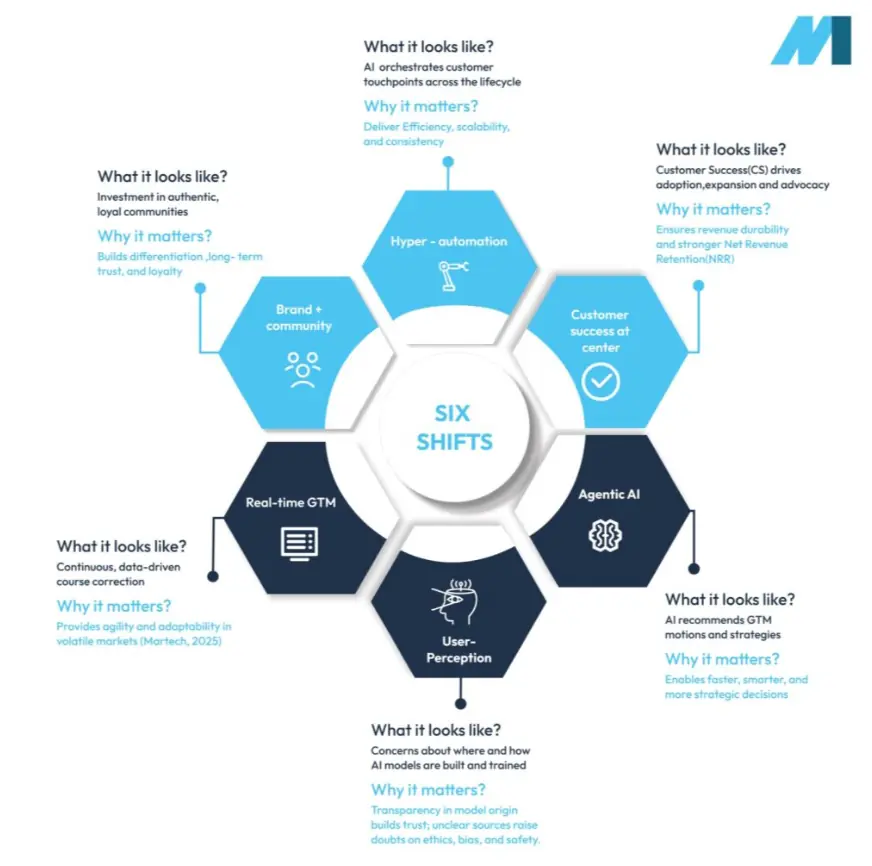
The future of GTM is exciting and, frankly, a bit like a rapidly evolving organism. We're heading towards even more integrated and intelligent GTM motions. Expect to see:
Hyper-automation across the entire customer journey: From initial contact to post-sale support, AI and automation will streamline almost every interaction, making processes incredibly efficient and responsive. This allows for greater scalability and a more consistent customer experience.
A renewed focus on brand building and community: While data and technology are powerful, the human element won't disappear. Building strong communities around your product and fostering authentic brand loyalty will be key differentiators.
Even greater emphasis on customer success as a GTM driver: Happy customers are your best marketing. Proactive customer success initiatives that drive adoption, expansion, and advocacy will become central to GTM strategies. It's not just about acquiring customers; it's about making them wildly successful.
Adaptive strategies in real-time: The market is constantly shifting. RenderTribe says that GTM plans will need to be less about rigid annual blueprints and more about dynamic, data-driven adjustments based on real-time feedback and market signals. Think of it like a GPS for your business, constantly rerouting as conditions change.
The rise of "agentic" AI tools: These aren't just for automating tasks but for intelligent decision-making and even generating new strategies based on complex data analysis. Imagine AI agents assisting with everything from market analysis to personalized outreach.
The core principle will remain to understand your customer deeply, offer exceptional value, and deliver it through the channels and experiences they prefer. The tools and techniques will just get a whole lot smarter.
2025 GTM FAQ
Q1: What are the biggest changes in GTM strategy for 2025?
The biggest changes in the 2025 GTM strategy revolve around increased digital integration, hyper-personalization driven by AI, and much stronger alignment between sales and marketing teams. We're moving away from generic outreach to highly targeted and data-informed engagements.
Q2: How does AI impact Go-to-Market strategies today?
AI is a game-changer. It's impacting GTM by enabling predictive analytics for buyer behavior, automating personalized content delivery, and optimizing sales processes. This helps companies become more efficient and deliver highly relevant messages to their target audience.
Q3: What is Product-Led Growth (PLG) and why is it important in 2025?
Product-Led Growth (PLG) is a GTM strategy where the product itself drives customer acquisition and retention. It's important in 2025 because it allows potential customers to experience the product's value firsthand through free trials or freemium models, often leading to organic growth and higher customer satisfaction. Think of it as your product doing the selling for you.
Q4: How can businesses ensure their GTM strategy is effective in a rapidly changing market?
To ensure effectiveness, businesses need to embrace agility and data. Regularly review and refine your GTM strategy based on real-time market feedback and performance metrics. Focus on deep customer understanding, integrate your sales and marketing efforts, and leverage new technologies like AI to stay ahead.
Q5: What are the key components of a successful GTM strategy in the tech industry?
For tech companies, a successful GTM strategy in 2025 needs a clear product-market fit, well-defined target audience and buyer personas, a strong and differentiated value proposition, and a flexible pricing model. Crucially, it also includes strategic partnerships, continuous product innovation, and a strong emphasis on user experience and global outreach, much like OpenAI's approach with ChatGPT.


