
On May 15, 2026, Google finally spilled some beans about something it had never quite committed to paper before. It’s an official guide, sitting inside Search Central's own documentation, talking to website owners about how to optimize for AI Overviews and AI Mode. The documentation is now a permanent reference page, the kind Google expects people to link back to for years.
In my opinion, one line in it did more damage to the GEO consulting industry than anything else published this year. From Google Search's perspective, optimizing for generative AI search is optimizing for the search experience, and thus still SEO. Answer Engine Optimization and Generative Engine Optimization, according to Google, aren't new disciplines. They're the same job with a new name attached.
Search Engine Journal's Matt Southern covered it the same week, and the headline says the whole thing plainly: Google's new AI search guide calls AEO and GEO "still SEO." That's Google's own words, quoted directly.
I want to walk through what the guide actually says, because a lot of the coverage since has flattened a nuanced document into a single soundbite. Google is right about a lot of this. It's also only telling half the story, because it's only talking about its own results page, and everything I've researched about ChatGPT, Perplexity, and Claude suggests a different set of rules applies there.
What Does Google Actually Mean When It Says AEO and GEO Are "Still SEO"?
Google argues that its generative AI features, AI Overviews and AI Mode specifically, are built on top of the same core ranking and quality systems that have always powered Google Search. Two mechanisms sit underneath this.
Retrieval-augmented generation, which Google calls grounding, pulls relevant pages from the existing Search index and uses them to build a response, with clickable links back to the source. Query fan-out breaks a single search into several related sub-queries behind the scenes, so a search for "how to fix a lawn full of weeds" might quietly also search "best herbicides for lawns" and "remove weeds without chemicals" to build a fuller answer.
Both mechanisms depend entirely on your page already being crawlable, indexed, and eligible to appear in regular Google Search. There's no separate AI index you submit to. If your page doesn't meet Google's core Search technical requirements, it's not eligible for AI Overviews either, no matter how well-structured the content is.
This is the part I think gets underappreciated in most of the reaction pieces. Google isn't saying AEO and GEO are meaningless concepts. It's saying that, for its own surfaces, the work is indistinguishable from the SEO fundamentals that were already true. Gary Illyes and Cherry Prommawin apparently made the same point at Search Central Live before this guide existed, according to reporting that's since circulated. The guide just made it official and citable.
Should I Stop Using llms.txt, Content Chunking, and AI-Specific Schema?
For Google Search specifically, yes, according to Google. The guide has a section titled "Mythbusting generative AI search," and it names names.
llms.txt files and other special markup don't help. Google states plainly that it doesn't use these files in any special way, and creating one "will neither harm nor help your site's visibility or rankings in Google Search."
Chunking content into small pieces isn't required either. "There's no requirement to break your content into tiny pieces for AI to better understand it," the guide says, adding that Google's systems can "understand the nuance of multiple topics on a page" without that kind of restructuring. There's no ideal page length. Write for your audience, Google says, not for a hypothetical parser.
Rewriting content specifically for AI systems is also called out as unnecessary. Google's position is that its models already understand synonyms and general meaning well enough that you don't need to manually cover every possible phrasing or long-tail variation of a query.
Seeking inauthentic mentions across the web and the practice of manufacturing brand mentions on forums and review sites to build apparent buzz gets a direct warning. Google says its core ranking systems focus on genuinely high-quality content while separate systems actively work to block spam, and both layers matter for how generative AI features behave.
And structured data, while still useful for traditional rich results, isn't a requirement for showing up in AI Overviews specifically. There's no special schema.org markup that unlocks AI visibility on its own.
Here's where the nuance actually lives, and it's the same nuance Search Engine Journal's coverage and several other analysts flagged independently. Google's mythbusting list is scoped to Google Search. It says nothing about ChatGPT, Perplexity, Claude, or Gemini as a standalone product, and those systems don't run on Google's index at all. One analysis put it plainly: llms.txt didn't die, it moved. Google ignores it for ranking, but AI agents and documentation tools are adopting it as a real convention elsewhere. Dead for Google Search. Alive for the rest of the AI ecosystem.
I'd extend that logic to schema and structured FAQ formatting. Independent research, including the Princeton and Georgia Tech generative engine optimization study this industry cites constantly, found real citation lift from structured content, named statistics, and question-based headings, specifically on platforms that retrieve and synthesize differently than Google's grounding process. Google saying it doesn't need your FAQPage schema is true about Google. It isn't evidence that schema is worthless everywhere.
What Does Google Mean by "Non-Commodity Content"?
This is, in my opinion, the single most useful concept in the entire guide, and it maps almost exactly onto what I've been telling clients for two years under a different name.
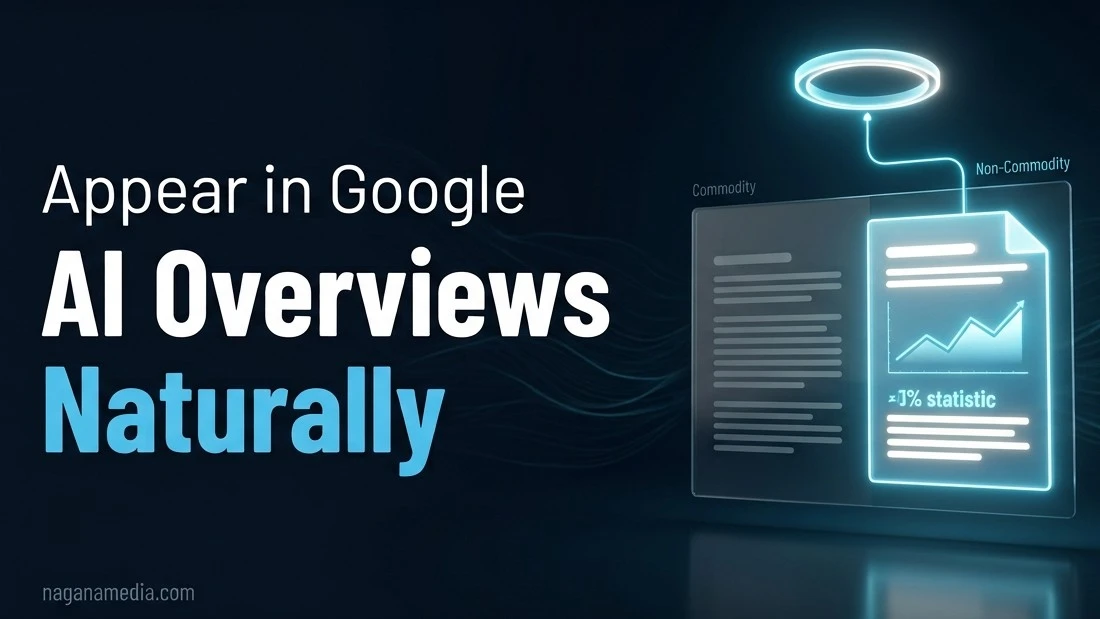
Google draws a direct contrast between commodity content and non-commodity content. Commodity content is something like "7 Tips for First-Time Homebuyers," built on common knowledge that could have come from anyone, adding little that a reader couldn't have gotten from the first three search results. Non-commodity content is something like "Why We Waived the Inspection and Saved Money: A Look Inside the Sewer Line," a specific, first-hand account built on real experience that nobody else could have written the same way.
For a B2B technology brand, the commodity version looks like "5 Benefits of Cloud Migration." Every competitor has written that exact post, usually with the same five bullet points. The non-commodity version looks like "We Migrated 40 Enterprise Clients Off Legacy Infrastructure, Here's the One Mistake That Cost Us Three Weeks Each Time," built from your own delivery data, naming the actual failure mode, with numbers nobody else has access to.
Google's guide says this single principle will likely influence your visibility in generative AI search more than anything else in the entire document. That's a strong claim from the company that runs the index, and it's one I'd sign my name to independently of whether Google said it.
Does This Guidance Apply to ChatGPT, Perplexity, and Claude Too?
Partially, and this is worth being honest about rather than pretending the whole AI search landscape runs on one rulebook.
The underlying instinct to write something specific, credible, and genuinely useful rather than generic holds everywhere. Every platform I've researched, like ChatGPT, Perplexity, Claude, and Gemini as a standalone product, values some version of expertise and specificity over generic restated knowledge. That part of Google's guidance is close to universal.
Where the platforms diverge is in the technical and structural layer. Google explicitly tells you structured data and llms.txt don't matter for its own AI features. Perplexity's own documentation and independent research on its citation behavior suggest the opposite for that specific platform, where structured, extractable passages and clear source attribution measurably improve citation odds. Claude's citation behavior, per research from teams tracking hundreds of brands, rewards structured factual attributes and named authorship more heavily than Google says it needs for its own surfaces.
So the honest answer is that Google's mythbusting list is real, accurate, and scoped narrowly. Treating it as universal advice for every AI platform is exactly the mistake several analysts flagged the same week the guide came out. One useful reframe I saw: build for the common denominator across platforms – genuinely expert, clearly structured, verifiably specific content – and treat the platform-specific technical layer, schema, llms.txt, structured FAQs, as additive insurance for the platforms where research shows it still helps, rather than assuming Google's rules are everyone's rules.
What Does "Good" Actually Look Like for a B2B Technology Page?
Take a real example. A company selling API integration software wants to rank for "how to reduce API latency in a microservices architecture." The commodity version defines latency, lists five generic tips anyone could find in a textbook, and closes with a soft pitch.
The non-commodity version states the specific latency reduction the company's own customers achieved, with a number attached, in the first two sentences. It walks through the actual architecture decision that caused the problem, using a real, anonymized customer scenario. It names the specific protocols involved, not "best practices" as a category. It includes a chart built from the company's own monitoring data, not a stock illustration.
That page satisfies Google's non-commodity standard because a competitor couldn't have written it without the same underlying data. It also happens to satisfy what Perplexity and Claude research points to, specific statistics, clear organization, verifiable claims, because good writing built on real expertise tends to produce that structure naturally, without engineering for any single platform.
How Do I Know If My Content Is Actually Satisfying E-E-A-T Instead of Just Claiming To?
Google's broader helpful content guidance, which this new AI guide explicitly points back to, has always been organized around Experience, Expertise, Authoritativeness, and Trustworthiness. Most B2B content fails the Experience test specifically, because it's written from research rather than from having actually done the thing being described.
A genuinely useful test: could this exact piece of content have been written by someone who never worked at your company, never talked to your customers, and never touched your product? If the honest answer is yes, it's commodity content wearing an expert costume, and Google's own guide is telling you, in writing, that this is exactly the content least likely to earn a citation.
The fix isn't complicated, though it is genuinely more work. Pull a real customer story, with permission. Cite your own usage data instead of an industry-wide statistic everyone else is also citing. Let a named person on your team, with a real title and a real LinkedIn profile, put their name on the claim. Google's guide never uses the word authorship directly, but the entire non-commodity argument depends on the content being traceable to a specific, credible source rather than sounding like it emerged from a general knowledge base.
What Should a B2B Marketing Team Actually Do This Week?
Start by pulling up your last ten published articles and running Google's own test against each one. Does this contain a unique point of view, or does it restate what's already searchable? Would a reader feel this was written by someone with genuine, specific experience in the topic? Is the technical foundation, crawlability, indexing, and page experience actually sound, since none of the content quality work matters if Google can't retrieve the page in the first place?
Then check Search Console's Generative AI performance report, which Google specifically recommends in the guide for tracking how content performs inside AI Overviews and AI Mode. Most teams have never opened this report. It exists specifically to answer the question this whole guide is about.
Beyond that, resist the urge to either strip out every piece of structured data because Google said it doesn't need it, or to keep chasing "AI-specific" tactics that were built for a version of AI search that only ever existed in a consultant's sales deck. The fundamentals Google names – non-commodity content, technical clarity, genuine expertise – are the same fundamentals that have mattered for years. They were just given a new, official name this year.
Where Nagana Media Fits Into This
This is, in a lot of ways, the exact argument we've been making with clients since before Google put it in writing. B2B technology content has a commodity problem. Too many companies publish the same five-bullet blog post their three closest competitors already wrote, then wonder why an AI Overview cites someone else instead.
What we actually do at Nagana Media is help B2B technology brands write the non-commodity version. That means pulling real usage data out of your product, structuring genuine customer outcomes into content that can't be replicated by a competitor with no access to your delivery history, and building the technical foundation, crawlability, structured data where it genuinely helps, clean page experience that makes sure Google and every other AI platform can actually find and retrieve what you've built. Google's new guide didn't change our approach. It just gave us better language to explain why it works.
Frequently Asked Questions
Did Google say AEO and GEO don't matter anymore?
No. Google said that for its own Search surfaces, AEO and GEO work is the same work as traditional SEO, not a separate discipline requiring new tactics. It did not say AI search visibility is unimportant, and it explicitly published tools like the Generative AI performance report specifically to help track it.
Is llms.txt actually useless now?
For Google Search specifically, Google states directly that it doesn't use llms.txt files in any special way, so creating one has no effect on Google's AI features. It may still serve a purpose for other AI agents and platforms that have adopted it as a convention, so removing an existing file isn't necessary, but building a strategy around it for Google visibility isn't supported by Google's own guidance.
Does this guide apply to ChatGPT and Perplexity as well as Google?
Only partially. The guide is explicitly about Google Search's generative AI features, AI Overviews and AI Mode. Other platforms retrieve and synthesize content differently and are not covered by Google's mythbusting claims. Independent research on Perplexity and Claude specifically has found continued citation benefits from structured content and schema that Google says its own systems don't require.
What is "non-commodity content" and why does Google care about it?
Non-commodity content is Google's term for content built on genuine, specific, first-hand expertise or experience, as opposed to commodity content that restates common knowledge available from many other sources. Google states this single distinction will likely influence AI search visibility more than any other factor in its guide, because generic content gives its systems no unique reason to select one source over another.
What should I check first if I'm not appearing in AI Overviews?
Start with the technical basics. A page must be indexed and eligible to appear in regular Google Search with a snippet before it's eligible for any generative AI feature. If the foundation isn't there, no amount of content quality work will fix visibility. Once that's confirmed, evaluate whether the content itself passes Google's non-commodity test, or whether it's a version of something already widely available elsewhere.
References
Google Search Central, Optimizing your website for generative AI features on Google Search, official guide published May 15, 2026: https://developers.google.com/search/docs/fundamentals/ai-optimization-guide
Search Engine Journal, Matt G. Southern, Google's New AI Search Guide Calls AEO And GEO 'Still SEO': https://www.searchenginejournal.com/googles-new-ai-search-guide-calls-aeo-and-geo-still-seo/575026/
Averi, Google's New AI Optimization Guide Just Killed 4 GEO Myths (And Validated 3 Things Smart Companies Already Do), platform-specific caveat analysis: https://www.averi.ai/blog/google-s-ai-guide-just-killed-4-geo-myths-(and-validated-3
Frase, Google's AI Optimization Guide: AEO and GEO Are Still SEO, RAG and query fan-out mechanics breakdown: https://www.frase.io/blog/google-ai-optimization-guide
Powerful Combo, Google AI Optimization Guide: What Everyone Gets Wrong, llms.txt platform-specific nuance analysis: https://powerfulcombo.com/blog/google-ai-optimization-guide/


