
There's a meeting that happens at almost every B2B SaaS company, usually around the time the first enterprise prospect asks for pricing, and it goes roughly like this. Sales says the pricing is too complicated to publish. Legal says publishing it creates liability. Marketing says hiding it hurts conversion. Someone suggested "Contact us for pricing" as a compromise. Everyone goes home vaguely unsatisfied, and the pricing page becomes a three-tier card layout with "Custom" printed in bold on the enterprise column, which satisfies nobody and answers nothing.
I have been to this meeting. It is not a good meeting.
What Does a B2B Pricing Page Actually Need to Do?
It needs to do two things at the same time: help a human buyer understand whether this product is in their budget and their tier, and give an AI platform enough structured, specific information to cite this page when someone asks about your pricing.
Those goals are more aligned than most teams realize. AI-referred traffic converts at 14.2%, compared to a 2.8% conversion rate for traditional organic search. The buyer who arrives at your pricing page from a Perplexity or ChatGPT answer has already done comparison research. They know the category. They know your competitors. They are there to verify whether what AI told them is accurate. If the page is vague, they read it as confirmation that there is something to hide.
The Transparency Debate Is Over
I want to address the "we can't publish pricing" argument directly, because it still slows more teams down than it should. The data is clear, and transparency wins. Hiding pricing doesn't protect you. All it does is frustrate buyers. When a prospect lands on your page and can't find any pricing information, they assume the product is too expensive, the sales process will be time-consuming, or they should deal with an organization that is more upfront.
This is also true for AI. When a buyer asks ChatGPT "how much does [Your Product] cost" and the answer is "pricing is not publicly available," one of three things happens. The model cites a competitor instead. The model cites a third-party review site or community thread that may have incorrect information. Or the model says it cannot find pricing and the buyer moves on. None of those outcomes help you.
You do not have to publish enterprise pricing to the last dollar. You can provide a range, explain how costs scale, and still direct larger buyers to sales with language like: "If your team has over 500 users, contact us for a custom quote." That is transparency without operational risk. It gives AI models enough to extract an accurate answer and gives buyers enough to self-qualify.
The Six Structural Elements AI Needs From Your Pricing Page
Failing to provide these blocks causes AI engines to ignore first-party pricing pages in favor of third-party aggregators. However, when properly formatted, brands retain control, with 86% of AI citations originating from brand-managed sources and 44% coming directly from first-party websites.
Here is what "properly formatted" actually means for a pricing page.
An answer-first summary at the top. Not a headline that says "Pricing." An actual sentence: "Plans start at $49 per month for teams of up to five users, with a Professional tier at $149 per month and an Enterprise tier available on request." A buyer scanning for qualification and an AI model extracting structured information need the same thing: the answer immediately, before the feature table starts.
Specific plan math, not ranges. Replacing terms like 'affordable monthly plans' with 'Plans starting at $49/mo (as of 2026)' provides the hard data required by AI logic models. When language models encounter vague marketing copy without numeric grounding, they bypass the text entirely. "Competitive pricing" is not a price. A number is a price.
A dated update stamp. Content freshness directly influences inclusion. Pages updated within the last 30 days receive 3.2x more AI citations compared to older content. A visible "pricing last updated: June 2026" at the top of the page takes thirty seconds to add and signals recency to both buyers suspicious of stale information and AI models weighting freshness.
An honest feature table, including what each tier does not include. Most pricing tables try to make the lower tier look good by listing what it has. The tables that convert better show what it is missing, because a buyer trying to decide between Starter and Professional needs to know what they lose by choosing the cheaper option, not just what they gain by choosing the more expensive one. This also applies to AI extraction: a table with clear limits per tier is far more parseable than a table where every row says "Advanced features available."
Tier-matched social proof. A testimonial from an enterprise customer on the Starter card confuses a buyer and signals mismatch. Match case studies and testimonials to the tier they represent. Buyers considering the Professional tier want to hear from a Professional-tier customer in a similar company. This is a conversion principle that also helps AI models understand which proof points apply to which buyer segment.
A structured FAQ section below the table. The questions should be exactly the ones your sales team fields constantly: "Do I need a credit card to start a trial?", "What happens to my data if I downgrade?", "Is there a setup fee?", "How does pricing scale as we add users?" These are extractable question-answer pairs, and they directly feed the queries buyers run in AI platforms when they want to understand your pricing without talking to sales. FAQPage schema on these questions turns them into structured data AI models can read directly.
The "Contact Us for Pricing" Problem, Specifically
"Contact us for pricing" is not a pricing strategy. It is a lead capture mechanism that actively filters out buyers who could have self-qualified online and decided to convert, replacing them with an inbox full of exploratory inquiries from people who may or may not be your ICP.
It also creates an AI search problem. When a model cannot find pricing, it often says so in the answer. "Pricing for [Product] is not publicly available and requires contacting sales" is an accurate and unhelpful AI-generated response that directly increases the friction for a buyer who would have converted if the page had given them a number.
The compromise position, a starting price plus a range plus an enterprise contact prompt, gives buyers and AI models what they need without requiring you to publish a full enterprise price list.
The Design Note Nobody Asks For But Everyone Needs
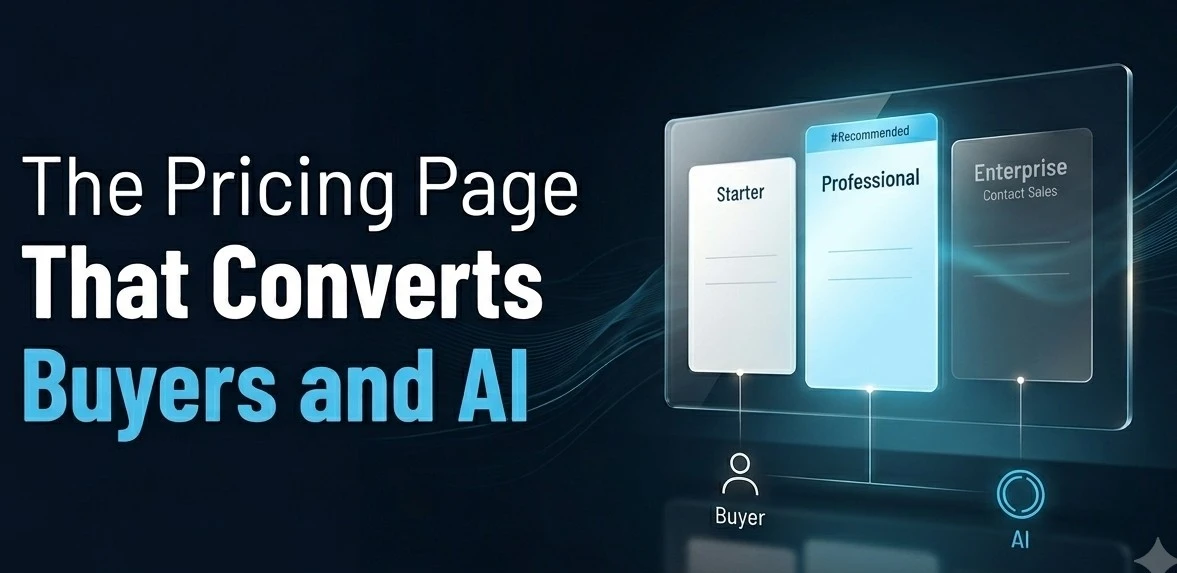
Pricing pages with three tiers convert better than two or five. Research suggests three or four tiers is the sweet spot. Two tiers look incomplete. Five or more create analysis paralysis. Three tiers is the sweet spot. The decoy effect, placing a middle tier that makes both the premium and the starter seem like clearer choices, is real and documented. The recommended tier should be visually distinct: a highlighted card, a "Most Popular" label, a slightly different background. None of this is new information. Most pricing pages still do not do it, which is why it keeps showing up in conversion research.
Frequently Asked Questions
Why does hiding B2B pricing hurt AI search visibility?
When a buyer asks ChatGPT or Perplexity about your product's pricing and the answer is "pricing is not publicly available," one of three things happens: the model cites a competitor instead, cites a third-party source that may have inaccurate pricing information, or says it cannot help and the buyer moves on. All three outcomes give your competitor an advantage. AI models cannot cite pricing information that does not exist on a publicly indexed page.
What is the minimum pricing information a B2B SaaS page should publish?
A starting price for the entry tier, an indication of how pricing scales (per user, per seat, per usage), the key functional differences between tiers, and a clear prompt for enterprise buyers to contact sales. This gives AI models enough to extract a useful answer to "how much does this cost" while still routing complex deals through sales for custom quoting.
How does a pricing page FAQ section improve AI search visibility?
FAQ sections with question-and-answer pairs structured around the actual queries buyers run in AI platforms ("Is there a setup fee?", "What happens when I add more users?") become extractable citation units for AI models. Combined with FAQPage schema markup, each question-answer pair becomes structured data that AI systems can read directly without parsing surrounding page copy.
Does page freshness really affect how often a pricing page gets cited?
Yes, measurably. Pages updated within the last 30 days receive approximately 3.2x more AI citations than older content. For pricing pages specifically, freshness signals matter both to AI models weighting recency and to buyers who are skeptical of pricing information that may have changed since the page was last updated. A visible "last updated" timestamp and a quarterly review cadence for pricing content addresses both concerns simultaneously.
What is the decoy effect in pricing page design and does it actually work?
The decoy effect is a pricing psychology principle where adding a middle-tier option at a price point that makes the premium tier seem like a better deal increases premium tier conversion. Research from Duke University and subsequent replication studies found that a deliberately positioned middle option increases sales of the premium tier by 35 to 50%. B2B SaaS pricing pages with three tiers, where the middle tier is positioned as "recommended," consistently outperform two-tier and five-tier layouts in conversion testing.
References
AnyMorph, Make SaaS Pricing Pages Citation-Ready for AI Search, six-block architecture and citation data: https://anymorph.ai/guide/make-saas-pricing-pages-citation-ready
Bayleaf Digital, Build a SaaS Pricing Page That Converts in 2026, transparency data and enterprise pricing arguments: https://www.bayleafdigital.com/saas-pricing-page-best-practices/
InfluenceFlow, SaaS Pricing Page Best Practices Guide 2026, three-tier research and mobile optimization data: https://influenceflow.io/resources/saas-pricing-page-best-practices-guide-2026/
Genesys Growth, Best Practices for Designing B2B SaaS Product Pages 2026, AI search optimization and conversion structure: https://genesysgrowth.com/blog/designing-b2b-saas-product-pages


