
A prospect evaluating your product asks the question every SaaS company eventually gets: "is this thing actually still being built, or did you stop investing in it two years ago?" A public roadmap is supposed to answer that question before anyone has to ask it out loud. Most roadmap pages I come across don't. They either promise specific dates nobody's going to hit, or they say so little that a visitor learns nothing at all.
What Actually Makes a B2B Product Roadmap Page Trustworthy?
94% of consumers say they're more likely to stay loyal to a brand that practices transparency. That's a consumer stat, but it maps directly onto B2B buying behavior, where a roadmap page functions less like marketing and more like evidence. A buyer isn't reading it to get excited about a feature. They're reading it to answer a specific, quiet worry: will this company still be investing in this product in eighteen months?
Trust here comes from three things working together. Honesty about status, meaning items are labeled accurately rather than optimistically. Consistency of update, meaning the page reflects something that actually changed recently rather than sitting untouched for two quarters. And restraint about promises, meaning the page commits to less than it could, on purpose, because every unmet promise on a public page costs more trust than it gains by being listed in the first place.
Should a B2B Product Roadmap Show Actual Dates?
Almost never, and this is the mistake I see most often. A specific date on a public roadmap is a promise, and product timelines slip constantly for completely legitimate reasons: engineering complexity, a security issue that jumps the queue, a customer escalation that reprioritizes the quarter. When the date passes, and the feature hasn't shipped, you haven't just missed a deadline. You've broken a specific, written commitment in front of every prospect who read that page.
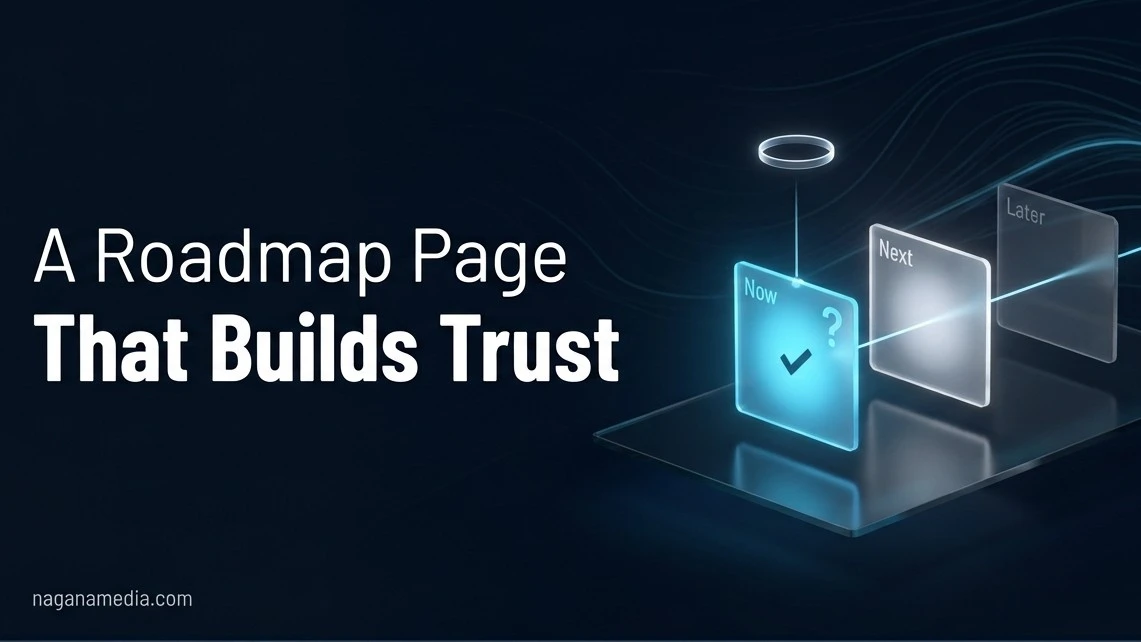
The better convention, and the one most mature SaaS roadmaps have converged on, is time horizons instead of dates. Now, Next, and Later, or some close variant. "Now" means actively in development this quarter. "Next" means planned for the following one or two quarters, direction set, scope still flexible. "Later" means it's a real direction, not a placeholder, but no committed timeline yet. If a specific prospect needs an actual date for a purchasing decision, that's a conversation for sales to have individually, not a promise to put in front of every visitor.
What Should Happen to Items That Get Cut?
Say so, briefly. A roadmap with a graveyard of items that quietly vanished with no explanation reads as either disorganized or evasive, and buyers notice both. A single line, "Not Planned: this conflicts with our approach to data portability," respects the reader more than silence does, and it's a far smaller trust cost than pretending the request never existed.
This also applies to votes and requests customers submitted. Most roadmap tools let users upvote or request features, and the instinct once something ships is to clear the votes and move on. Leaving them visible, showing the direct line from "37 customers asked for this" to "shipped in March," is a small thing that does real work. It shows a customer that raising a request actually connects to something real, which is exactly the kind of evidence that makes the next round of feedback worth giving.
How Often Does a Roadmap Actually Need to Update?
More often than most B2B companies manage, honestly. A roadmap with a dozen items stuck in "Under Review" and nothing recently moved to "Shipped" signals neglect just as loudly as no roadmap at all, maybe more, since it demonstrates the company built the page once and then stopped caring about it.
A reasonable operating rhythm: review and refresh monthly, even if the changes are small, and archive anything that's sat untouched for more than a quarter. A shorter, current roadmap with eight real items beats a sprawling one with forty, most of them stale, every time a prospect actually reads it closely enough to notice the difference.
Does a Public Roadmap Actually Risk Giving Away Strategy to Competitors?
This is the objection I hear most often internally, and it's worth taking seriously rather than dismissing. Competitors absolutely can and do read public roadmaps. The practical answer most companies land on is keeping roadmaps thematic rather than granular, "improving reporting and analytics" instead of the specific technical implementation detail that would actually be useful to a competitor building the same thing. That level of abstraction still answers the buyer's real question: is this company investing here, without handing over a blueprint.
The companies that end up regretting a public roadmap are usually the ones that put genuinely sensitive competitive detail on it, not the ones that kept it directionally honest. The trust benefit, in most SaaS categories, outweighs the competitive exposure, which is why public roadmaps have become close to standard practice among companies like Slack, GitHub, Trello, and Buffer, none of whom seem to have lost meaningful ground to a competitor reading their public page.
What Does Product Roadmap Have to Do With AI Search Visibility?
A roadmap page is, structurally, exactly the kind of specific, dated, verifiable content that earns AI citation trust. A buyer researching whether your product is actively developed increasingly asks an AI platform that question directly, and a well-maintained public roadmap with clear status labels and recent activity is a page an AI model can extract a confident, current answer from. A roadmap that hasn't moved in eight months, or that doesn't exist publicly at all, gives the model nothing to work with, and the buyer's question goes unanswered or gets answered by whatever a competitor's roadmap happens to say instead.
What Does a Roadmap Page That Gets This Right Actually Look Like?
Three columns: Now, Next, Later, each with a small number of genuinely current items, not an exhaustive list. Each item has a short, specific description, not a vague theme, and a status that's honest about where it actually stands. A brief note at the top stating when the page was last updated. A short, respectful line for anything recently moved to "Not Planned." And a visible connection between customer requests and what's actually shipped, so the page reads as a living record of a real relationship rather than a marketing artifact somebody built once for a launch.
Frequently Asked Questions
Should a B2B SaaS company publish a public product roadmap?
In most cases, yes. 94% of consumers report greater loyalty to brands that practice transparency, and a public roadmap answers one of the quietest, most common buyer concerns directly: whether a product is still being actively developed. The main risk, competitors reading the page, is manageable by keeping the roadmap thematic rather than granular.
Should a public roadmap include specific launch dates?
Generally no. Specific dates function as public promises, and product timelines change for legitimate reasons often enough that missed dates become a recurring trust cost. Time horizons like Now, Next, and Later communicate direction and priority without creating a commitment that's likely to be broken.
What should happen to roadmap items that get cancelled or deprioritized?
State it plainly, with a brief reason. A one-sentence explanation, such as noting a feature conflicts with the product's broader direction, respects the reader more than silently removing the item, and costs far less trust than pretending the request never existed.
How often should a public roadmap be updated?
Monthly is a reasonable minimum for most B2B SaaS companies. A roadmap that sits untouched for a quarter or longer signals neglect, sometimes more visibly than having no roadmap at all, since it shows the page was built once and abandoned rather than genuinely maintained.
How does a product roadmap page affect AI search visibility?
A well-maintained, clearly dated roadmap is exactly the kind of specific, verifiable content that earns AI citation trust when a buyer asks an AI platform whether a product is actively developed. A stale or nonexistent roadmap gives AI models nothing current to extract, leaving that buyer question unanswered or answered by a competitor's page instead.
References
Heedback, Public Roadmap Best Practices for SaaS Companies (2026), time horizon conventions and honest status labeling: https://www.heedback.io/en/blog/public-roadmap-best-practices
Featurebase, 15 Best Public Roadmap Examples for SaaS in 2026, transparency and trust benefits of public roadmaps: https://www.featurebase.app/blog/public-roadmap-examples
AnnounceKit, 15 Best Public Roadmap Examples For SaaS (2026), named company examples and abandonment risk signaling: https://announcekit.app/blog/public-roadmap-examples/
EasyDesk, Public Product Roadmap Best Practices For 2026, 94% consumer transparency loyalty statistic: https://easydesk.app/blog/public-product-roadmap
Frill, 11 User-Friendly Public Roadmap Examples for SaaS Companies, visible vote-to-shipped connection practice: https://frill.co/blog/public-roadmap-examples


