
Most teams treat landing pages and SEO as two completely separate disciplines. Paid traffic goes to landing pages, stripped down, punchy, built for a warm click that already knows what it wants. Organic traffic goes to blog posts, longer, more patient, built for someone still figuring things out. The two never really meet, and that separation is more expensive than most teams realize, because it means you're building two assets to do the work one well-structured page could handle.
PPC landing pages convert at roughly 10.9%, compared to 2.4% for organic pages. That gap is real, and it's tempting to read it as proof these need to stay two different things forever. I'd read it differently. It's proof of what a page built with one very clear job, converting a warm, high-intent visitor, can do when it's not diluted trying to also educate a cold stranger. The fix isn't keeping them apart. It's understanding which visitor is showing up and giving each one the specific thing they actually need, on the same page, without either one getting shortchanged.
The Actual Mistake Most Teams Make
A landing page can convert beautifully from a paid campaign and still fail in organic search, and it's almost always the same root cause. The page was built for a warm campaign click, not a cold searcher who needs context before they'll act on anything. Strong offer, clean form, clear CTA, and it gets nowhere in Google because there's not enough substance on the page for search engines to understand what it's actually about, and cold organic visitors get pushed toward converting before they've had any reason to trust the page at all.
The reverse mistake happens just as often. A 400-word page with one hero image and a CTA has an extremely narrow window to demonstrate relevance for anything competitive. Long-form content that ranks well can convert at a fraction of what a stripped-down PPC page manages, because length alone was never actually the goal. Matching the content to what the specific visitor, on that specific channel, actually needs at that specific moment always was.
The Structure That Actually Threads This Needle
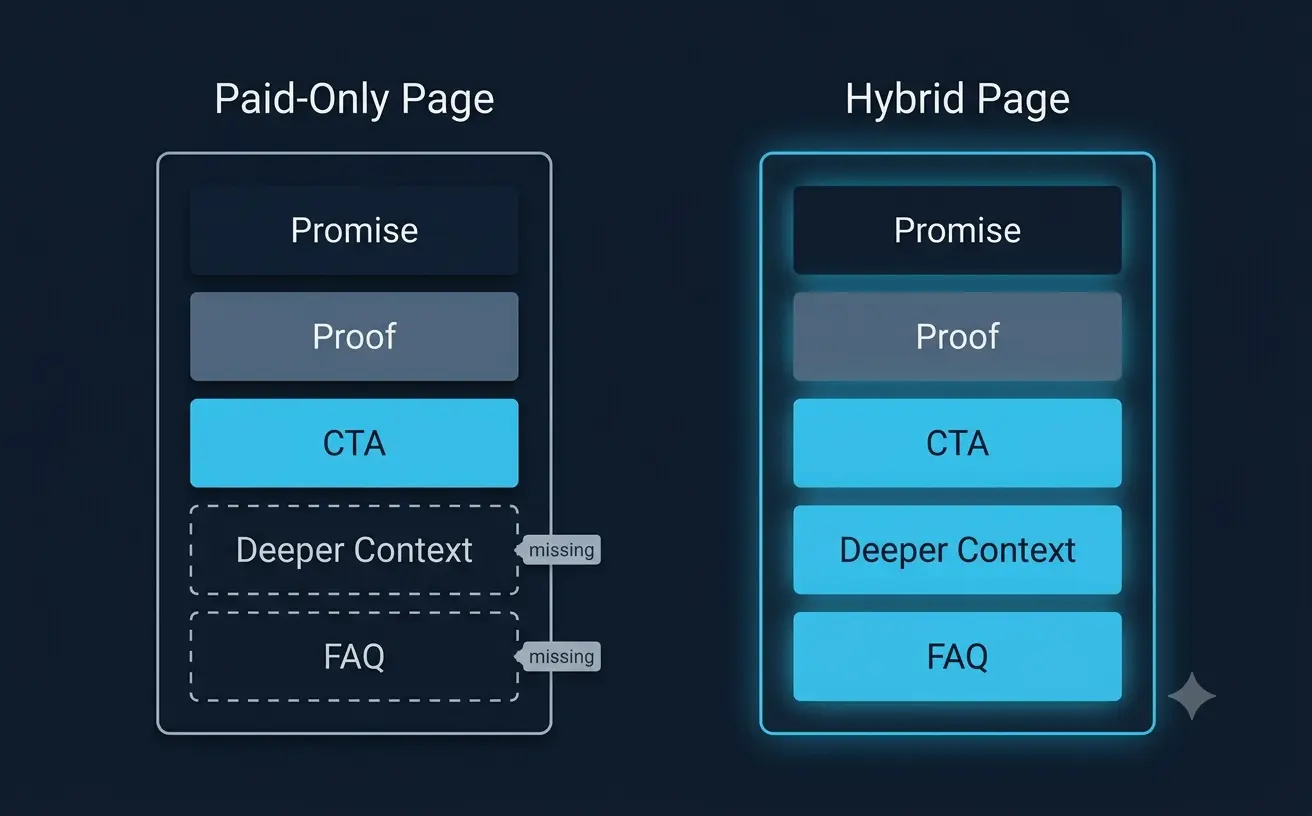
Put the promise, the proof, and the CTA near the top. This part serves everyone, paid or organic, immediately. Below that fold is where the two audiences genuinely diverge, and where most teams either give up entirely or overcorrect by cramming in a wall of undifferentiated text nobody asked for.
Add the deeper sections a cold, skeptical searcher actually needs: comparison points against the alternatives they're probably also considering, specific examples instead of abstractions, direct answers to the objections that stop people from converting, an FAQ section that resolves real doubt rather than restating the sales pitch in question form. The point was never to clutter the page with generic "SEO content" nobody reads. It's answering the specific, silent objections that are quietly stopping someone from taking the action you want.
Here's the test that actually matters: does adding this section give the page missing information a real buyer needs, or does it exist purely to hit a word count? A use-case table. A short, honest comparison. A process explanation. A screenshot that actually proves the headline claim rather than just decorating the page. That's the content that helps. Padding that exists because someone once said "landing pages need 800 words to rank" helps nobody, least of all your conversion rate.
Match the Content to the Actual Search Intent, Not Just the Keyword
Before writing a word of copy, get clear on what someone actually wants when they type in your target keyword. Someone searching "best CRM for real estate agents" is in commercial investigation mode. They want to understand the landscape, compare a few real options, and decide whether this is worth handling internally or handing off. A page that opens straight into "Book Your Demo" and nothing else badly misreads that intent. A stronger structure opens with a genuine explanation of what the buying decision actually involves, walks through the real considerations, and only then introduces your product as the logical next step once the reader's actually oriented. The content satisfies the search. The CTA captures the intent once someone's actually ready for it, rather than the moment they land.
Someone searching "book real estate CRM demo," on the other hand, has already made most of these decisions. That page can, and should, be far more direct. Same underlying product. Completely different page, because the person reading it is in a genuinely different place.
The Technical Layer Most Teams Skip Entirely
Landing pages built for paid campaigns often carry UTM parameters or get duplicated across subdomains for A/B testing, and both of these quietly create canonicalization problems that confuse Google, and increasingly AI crawlers, about which version is actually the "real" page worth indexing. Set a self-referencing canonical tag on every landing page variant so there's no ambiguity about which one counts.
Server-side rendering matters more here than most teams assume, especially now. A lot of modern landing pages lean hard on client-side rendering for speed and slick interactivity, which AI crawlers frequently can't execute at all. If your landing page's actual content only shows up after JavaScript runs, it may be functionally invisible to the AI systems your future buyers are increasingly asking before they ever type your brand name into a browser.
Writing for AI Citation Without Wrecking the Conversion Path
AI-referred traffic converts at genuinely extraordinary rates compared to typical organic traffic, some reports show over 10%, because these visitors have already done their research through an AI platform before ever landing on your page. They're not browsing. They're confirming. Which means your landing page needs to hold up under a very specific kind of scrutiny: does it match what the AI already told them about you?
Structure content so AI systems can extract it cleanly: clear entity definitions, specific verifiable claims instead of marketing fluff, direct answers to the exact questions a buyer would ask. "We increase conversion rates by an average of 14%" gets extracted and cited. "We have the best conversion rates" gets extracted by nothing, because there's no actual fact sitting inside that sentence for a model to grab onto.
Two Ways to See This
Infographic 1 should show a simple side-by-side split: "Paid-Only Landing Page" versus "Hybrid Landing Page," each with the same five structural blocks (Promise, Proof, CTA, Deeper Context, FAQ), but the paid-only version missing the deeper context and FAQ blocks entirely, visually showing exactly what's absent and why that absence costs organic and AI visibility.
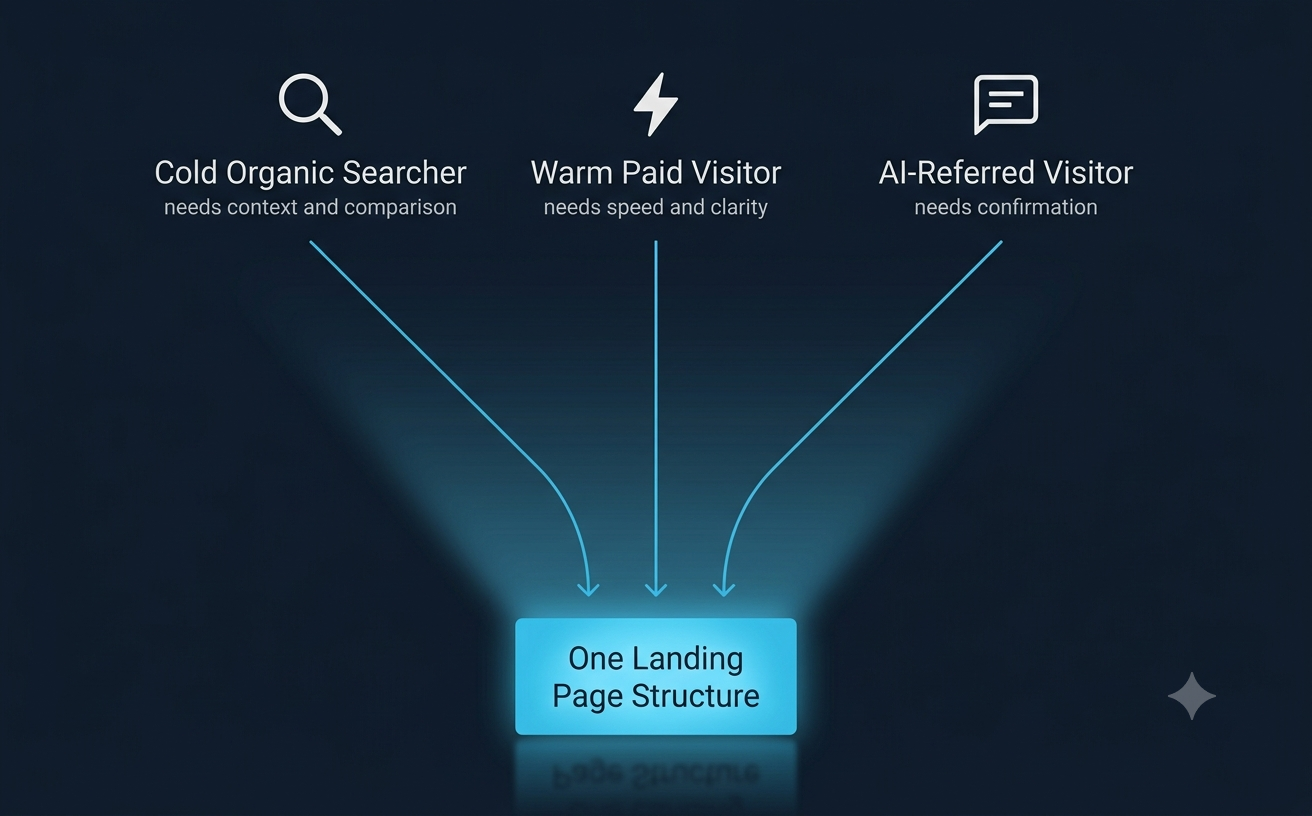
Infographic 2 should map the intent-to-structure decision: three simple boxes representing "Cold Organic Searcher," "Warm Paid Visitor," and "AI-Referred Visitor," each pointing to what that specific visitor needs first on the page (context and comparison, speed and clarity, confirmation of what the AI already told them), converging into one shared page structure below.
Frequently Asked Questions
Can one landing page really serve both paid campaigns and organic search effectively?
Yes, using a hybrid structure: the promise, proof, and CTA positioned near the top for warm paid visitors who already know what they want, with deeper sections below, comparisons, examples, FAQs, addressing the context a cold organic searcher needs before they're willing to convert. The key is treating the added depth as genuinely useful information, not padding added purely to hit a word count.
Why do PPC landing pages convert at a much higher rate than organic landing pages?
PPC landing pages convert at roughly 10.9% compared to 2.4% for organic pages largely because paid traffic arrives pre-qualified and already warm, while organic visitors are often still comparing options and need more context before they'll trust a page enough to convert. This gap reflects visitor intent more than it reflects some inherent superiority of stripped-down pages; a well-structured hybrid page can serve both audiences without sacrificing either conversion rate.
What's the biggest technical mistake landing pages make that hurts both SEO and AI visibility?
Relying on client-side rendering for content that should be present in the raw HTML. Many AI crawlers can't execute JavaScript, which means content that only appears after a script runs is functionally invisible to them. Server-side rendering ensures the actual page content is readable immediately by both search engines and AI systems, not just human visitors with a fully loaded browser.
How should landing page copy change to earn AI citations specifically?
Replace vague claims with specific, checkable ones. "We increase conversion rates by an average of 14%" is extractable and citable. "We have the best conversion rates" contains no actual fact for an AI model to grab onto. Clear entity definitions and direct answers to likely buyer questions matter just as much as the specific numbers themselves.
Should a landing page's structure change based on whether the target keyword signals research intent or purchase intent?
Yes, significantly. A keyword like "best CRM for real estate agents" signals commercial investigation, someone still comparing options, and the page should open with genuine context and comparison before introducing the CTA. A keyword like "book real estate CRM demo" signals someone who's already decided, and that page can go direct immediately. Using the same structure for both intents means underserving one of them.
References
Junia AI, Landing Page SEO Checklist: Why You're Not Ranking, hybrid structure approach and search intent classification framework: https://www.junia.ai/blog/seo-for-landing-pages Byte Technology, Why Landing Pages and SEO Are a Match Made in Search Heaven, PPC versus organic conversion rate data and AEO structuring guidance: https://bytetechnology.com/blog/why-landing-pages-and-seo-are-a-match-made-in-search-heaven/ Landdding, Landing Page Predictions 2026: How Design, UX, SEO and AEO Are Converging, AI-referred traffic conversion rates and entity clarity requirements: https://landdding.com/blog/landing-page-predictions-2026-design-ux-seo-aeo Thimpress, Search Engine Optimization Landing Page Guide in 2026, canonicalization issues and search intent content matching: https://thimpress.com/search-engine-optimization-landing-page/


