
Microsoft has increased Copilot-related partner investments by 50% and expanded Azure outcome-based incentives by 70% year-over-year.
The question is: Is your organization ready to align?
In our latest breakdown, we cover:
- Why AI business solutions now sit at the core of MCAPS priorities
- How security and compliance requirements will redefine partner operations
- Where regional programs (U.S., EMEA, APAC) are diverging-and how to capitalize
- A readiness checklist designed for executive planning
This isn’t about reacting to Microsoft’s strategy. It’s about positioning your organization to lead in it.
Ultimate Guide to MCAPS 2025–2026: What You Need to Know
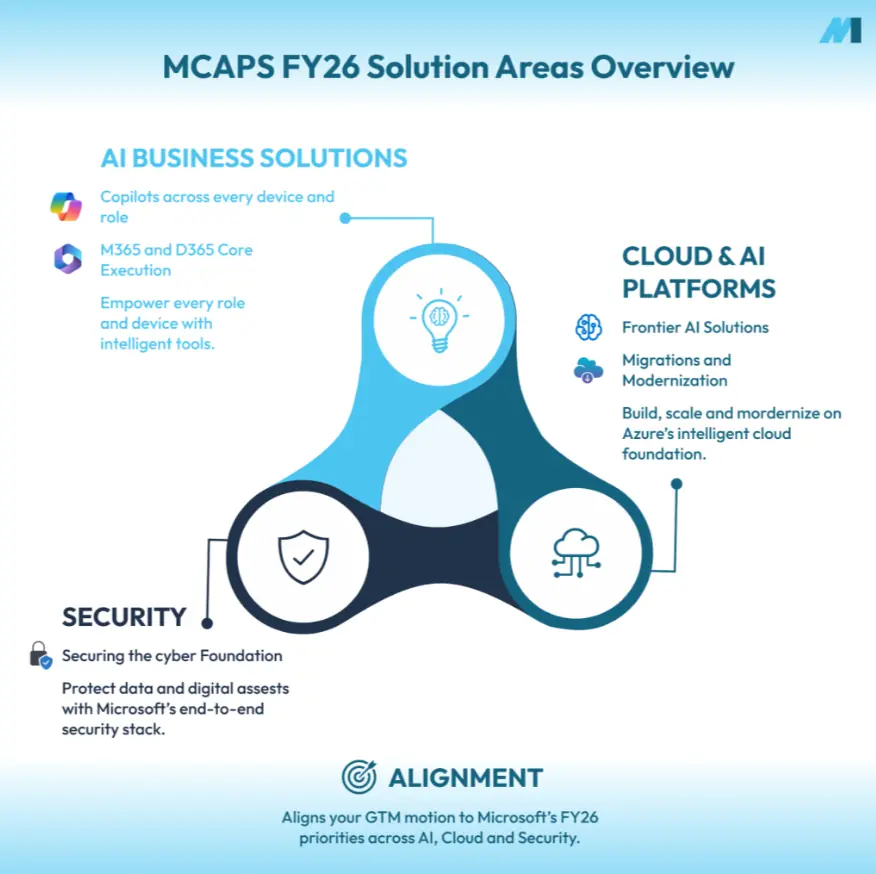
A new fiscal year means new goals, and for FY 2025–2026, Microsoft’s MCAPS (Microsoft Customer and Partner Solutions) is the playbook that guides partners to the real growth lanes. At its July 15 MCAPS Start for Partners event, Microsoft outlined three solution areas at the heart of its next wave: AI Business Solutions, Cloud & AI Platforms, and Security.
MCAPS isn’t an abstract strategy; it’s the operating system for how Microsoft engages customers, mobilizes partners, and rewards innovation. This year’s emphasis goes deeper than product launches: it’s about helping partners build end-to-end businesses on AI, accelerate cloud adoption, and respond to rising cybersecurity demands. Think of it as Microsoft clearing the runway, so partners can scale faster with incentives, co-selling opportunities, and go-to-market support.
For partners, that means opportunity on two fronts: meeting today’s urgent customer needs and positioning for the industries of tomorrow. In this guide, we’ll unpack what MCAPS 2025–2026 really signals, and how aligning early can turn Microsoft’s priorities into your competitive advantage.
What Exactly Is MCAPS 2025?
MCAPS isn’t just another Microsoft acronym; it’s the operating system that defines how customers are engaged and how partners grow alongside Microsoft. In FY 2025–2026, the program has been refocused around three consolidated solution areas, AI Business Solutions, Cloud & AI Platforms, and Security, giving partners a clear map of where Microsoft is placing its biggest bets.
The timing is intentional. The demand for generative AI is at its peak. The urgency for modernizing hybrid cloud environments, and escalating cybersecurity pressures, is reshaping the expenditure of enterprises. Microsoft is leaning into these realities by increasing partner funding and refining incentives, particularly around Copilot adoption and Azure modernization.
At the MCAPS Start for Partners event, Microsoft announced a 20% increase in its Enterprise Customer Investment Funds, explicitly aimed at helping partners deliver more Copilot deployments, migrations, and “AI design wins.” Additionally, Azure outcome-based incentives have increased by 70% year over year, rewarding partners for expanding workloads, growing seat usage, and accelerating solution adoption.
So a partner that accelerates Copilot usage across its customer base, not just selling licenses but embedding Copilot experiences, will directly benefit via higher incentive payouts and support. This isn’t hypothetical; it’s built into Microsoft’s current partner‐program structure.
For partners, ISVs, and MSPs, it’s an immediate opportunity: richer incentives, co-sell backing, and tighter alignment with Microsoft’s go-to-market. Microsoft’s AMMP has enrolled over 500 partners globally to simplify and speed up cloud migrations and estate modernization. One key enhancement: incentives for Windows Server and SQL Server migrations have increased by up to 2.5 times, providing partners with a meaningful advantage when migrating mission-critical workloads.
As part of AMMP, partners also gain deeper access to Azure’s best practices and technical frameworks, like the Azure Migrate tool and the Azure Well-Architected Framework, enabling them to build repeatable blueprints. These changes aren’t theoretical: deals led by partners using AMMP are closing faster, with measurable reductions in deployment time and increased Azure consumption.
Simply put, MCAPS points partners toward the growth opportunities that matter most today, not just down the road.
Why MCAPS FY 2025–2026 Matters to Your Business?
MCAPS 2025–2026 changes the rules of engagement between Microsoft and its partner ecosystem. Partners, ISVs, MSPs, and customers now need direct alignment to Microsoft’s strategic bets, AI-first applications, hybrid cloud scale, and elevated security mandates. At MCAPS Start for Partners, Microsoft confirmed a 20% increase in enterprise customer investment funds to push Copilot deployments, migrations, and AI design wins.
Rising cybersecurity threats, rapid AI adoption, and demand for hybrid cloud are the macro forces pushing Microsoft to double down on MCAPS 2025–2026 priorities. These trends now shape what Microsoft will fund, co-sell, and prioritize through the fiscal year.
For partners, the upside is tangible: larger incentives, tighter go-to-market alignment, and deeper co-sell support built around Microsoft’s core solution areas. Align early, and you position your team not just to compete, but to lead.
What Are the Top MCAPS 2025–2026 Partner Priorities?
Microsoft is orienting MCAPS 2025–2026 around a handful of growth engines that reflect both customer demand and market forces: AI-driven business outcomes, cloud scale, and secure-by-design architectures. This is a direct response to what enterprise buyers, midmarket customers, and governments are asking for in the next 18–24 months.
The message is clear: partners who align early to these priorities, whether by embedding Copilot into vertical solutions, modernizing workloads on Azure, or building security-rich services, will be better positioned to capture new revenue streams.
In What Ways Is AI Business Solutions Becoming the Core?
Microsoft has re-centered its FY 2025–2026 go-to-market around AI Business Solutions, folding in top priorities like Copilot everywhere and tighter integration across Microsoft 365 and Dynamics 365.
Under this umbrella, Microsoft is increasing Copilot funding by 50% and boosting enterprise investment funds by 20% year-over-year to accelerate AI design wins, migrations, and deployments.
Partners today are expected to deliver “AI design wins”, essentially customer deployments where AI is not just an add-on, but the differentiator of the solution. That means building or customizing intelligent agents, embedding Copilot experiences, and architecting automation first.
In Germany, Microsoft partner Solutions2Share utilized the Microsoft 365 Copilot framework to create a governance tool for Teams, known as Teams Manager Agent. Instead of asking users to click through multiple menus, the solution lets them make simple requests in plain English, such as “show me all Teams channels with specific metadata.” This saves time, improves accuracy, and demonstrates how partners can quickly build value by tailoring Copilot and agent technology to real business needs, without requiring a heavy development lift.
Microsoft also introduces the notion of Frontier Firms, organizations built natively for AI, where machine intelligence and human judgment fuse to scale decision-making.
Partners should view Frontier Firm alignment as a north star: tailor your offerings to help customers evolve into that class of enterprise. With AI Business Solutions as Microsoft’s strategic core, you’ll want to lean in early.
How Will Cloud & AI Platforms Drive Partner Opportunity in FY25-26?
For FY 2025–2026, Microsoft has made it clear that Azure + AI + hybrid edge is no longer optional; it’s today’s growth lane.
Azure outcome-based incentives have increased by nearly 70% year over year, creating direct upside for partners that expand workloads, accelerate seat growth, and drive real adoption across enterprise accounts.
Hybrid and edge scenarios, once niche, are now strategic priorities as organizations push toward distributed architectures.
On the tools front, Azure Accelerate now brings migration, modernization, and innovation under one roof, providing prescriptive blueprints and financial benefits for partners delivering at scale.
At the same time, Microsoft Fabric is evolving into a true AI-ready platform, transforming raw data into contextual intelligence to fuel Copilot, agents, and real-time analytics.
The partner opportunity is straightforward: lead migrations, accelerate modernization, and build AI on top of Azure’s expanding platform scale.
With Microsoft committing an additional 20% in enterprise customer investment funds, this is the moment to align execution with where Microsoft is placing its bets.
What’s Changing in Security and Risk Management for MCAPS 2025?
Security is no longer a back-office safeguard; it’s the front line of Microsoft’s FY 2025–2026 strategy. The shift is clear: partners are expected to move from patch-and-respond models to AI-driven threat defense and a Zero Trust foundation woven into every solution.
Microsoft’s Secure Future Initiative underscores this proactive approach, where identity, data, and systems are protected by design rather than defended after the fact.
Two forces stand out for leaders: the rise of quantum-safe cryptography and the growing compliance burden around regulated industries and cross-border data. Both will directly shape customer expectations and partner accountability. Microsoft recently added ML-KEM (a lattice-based, post-quantum key encapsulation algorithm) and other PQC (Post-Quantum Cryptography) algorithms into its SymCrypt library-used in Windows, Azure, Microsoft 365, and other core services-to begin protecting apps and data from future quantum threats.
Operationally, Microsoft is tightening requirements in Partner Center. Multifactor authentication (MFA) becomes mandatory for all access on August 30, 2025, and API calls that bypass MFA will be blocked beginning April 1, 2026. The message is straightforward: your security posture isn’t just a best practice, it’s a prerequisite to compete. For partners aiming to lead in MCAPS, investing early in next-gen security isn’t optional; it’s the price of admission.
Which Microsoft Partner & SMB Programs Are Getting a Spotlight in 2025?
Microsoft is doubling down on partner-first programs in FY 2025–2026 with expanded incentives, deeper specializations, and a unified marketplace experience.
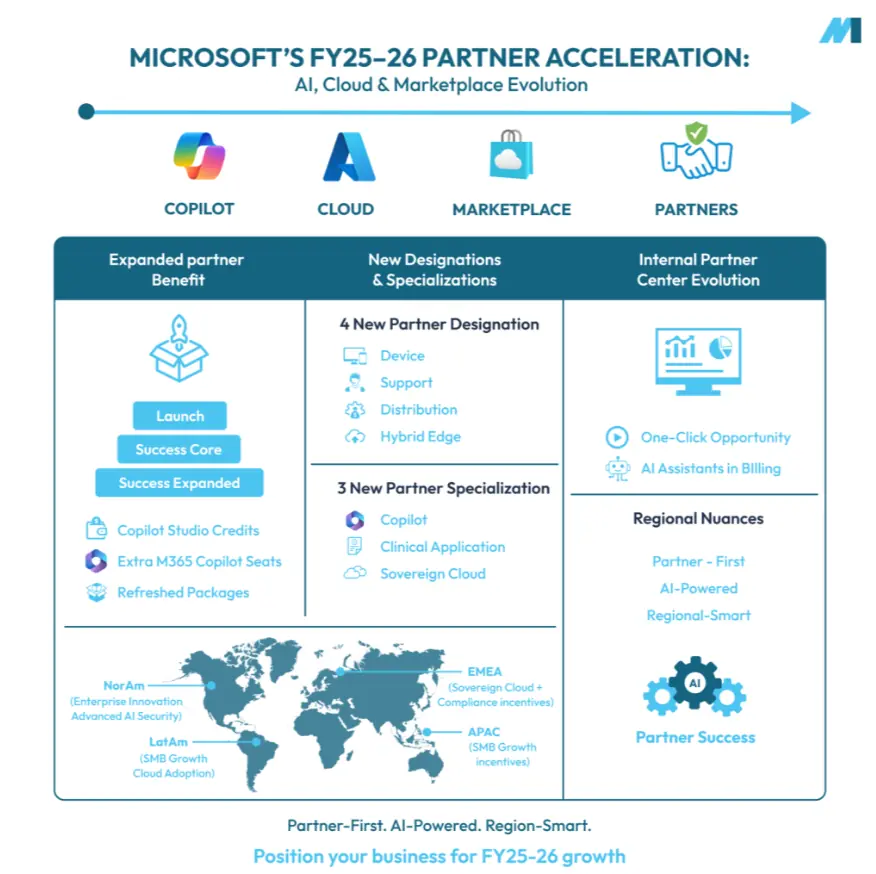
The AI-Cloud Partner Program is getting an overhaul: Copilot Studio credits, extra Microsoft 365 Copilot seats, and refreshed benefits packages across Partner Launch, Success Core, and Success Expanded are already live.
Later in FY26, expect four new Solutions Partner designations (device, support, distribution, hybrid edge) and three new specializations, Copilot, Clinical Applications, and Sovereign Cloud, to help you visibly differentiate in the market.
On the platform side, Microsoft is collapsing AppSource and Azure Marketplace into a single Microsoft Marketplace, improving discoverability and transaction flow for partner solutions and agents.
Internally, Partner Center is evolving toward more automation and security. A “One-Click Opportunity” experience (launched September 2025) simplifies lead conversion into a co-sell motion. Also, AI assistants are entering pricing and billing workspaces in preview form.
Regional variation is expected. In EMEA, compliance and data sovereignty will amplify the value of Sovereign Cloud specialization.
In the Asia-Pacific, CSP incentives tied to SMB growth will be prominent. In the U.S., you’ll benefit most from advanced go-to-market and co-sell programs.
In your content, embed GEO keywords (e.g., “EMEA partners,” “APAC incentives,” “U.S. co-sell”) to reflect this regional nuance.
Where Does Sustainability & Social Impact Fit Into MCAPS 2025?
Sustainability is no longer an add-on in MCAPS 2025–2026; it’s table stakes. Microsoft’s commitment to be carbon negative, zero waste, and water positive by 2030 creates both a benchmark and a business opportunity for partners.
Through Microsoft for Sustainability, partners can now access AI-driven insights, cloud-native tools, and unified data frameworks to help customers measure, manage, and reduce their environmental footprint.
This goes well beyond corporate values; it’s about being prepared for where the market is headed.
Sectors such as energy, manufacturing, and government are already facing tighter regulatory expectations, and in Europe, the Corporate Sustainability Reporting Directive (CSRD) is raising the bar on transparency and accountability.
For partners, the opportunity lies in moving early: those who design solutions with these requirements in mind aren’t just checking the compliance box, they’re positioning themselves to win with customers who see sustainability as a core part of their buying decision.
For partner organizations, co-branding opportunities and joint sustainability offerings are emerging. You might build solutions using Microsoft’s sustainability platform, promote them under “sustainability by design,” or embed ESG dashboards into your IP.
Customers increasingly expect their vendors, and their vendors’ partners, to share accountability for environmental impact. In MCAPS, sustainability isn’t just a nice-to-have; it’s a differentiation you can build and sell.
How Do You Take Action as a Microsoft Partner or Stakeholder?
To align with MCAPS 2025–2026, begin with a strategic audit and roadmap. Assess your current AI, cloud, and security capabilities against Microsoft’s three solution pillars.
Next, realign staffing, assign clear owners for Copilot, the data platform, and security practices.
Tap into Microsoft’s latest resources right away. The MCAPS Start for Partners portal offers session recordings, playbooks, and co-sell assets. Also, watch for updates to Partner Center, including the new AI assistant in billing and pricing workspaces.
Or, follow Nagana Media’s blog regularly!
Here’s a tactical MCAPS Readiness Checklist:
- Launch Copilot pilot projects to generate design wins.
- Map your solutions into Microsoft’s incentive bands (AI, cloud, security).
- Complete Partner Center security and compliance requirements like MFA and API readiness.
- Certify team members in Microsoft’s AI/Cloud specializations.
Follow these steps now, and you’ll position your organization not just to align, but to lead in the new MCAPS era.
How Do MCAPS 2025-26 Priorities Play Out in Your Region or Industry?
MCAPS is far from “universal.” Regional nuance and industry context are everything. In Europe or the Middle East, you might highlight data-sovereignty incentives or sovereign cloud support; in India or Latin America, local market development funds or localized CSP pricing tiers deserve emphasis.
In the U.S., for example, partners in health care and the public sector are early adopters of Copilot-enabled compliance and security offerings. Microsoft is already enabling a Clinical Applications specialization, slated for FY26, which aligns directly with health-tech and life sciences verticals.
Manufacturing, finance, and public sector customers are seeing momentum too, particularly where AI + process automation can unlock efficiency. Localize your narrative by inserting GEO tags (e.g., “in Texas,” “across São Paulo”), referencing partner success stories from those markets, and using region-specific metrics or forecasts. Decision-makers respond when you speak their geography, not a generic global script.
How Do You Stay Ahead After This Guide MCAPS 2025 Guide?
Completing your “Ultimate Guide” is only the beginning; the real game is staying ahead of MCAPS’s curve.
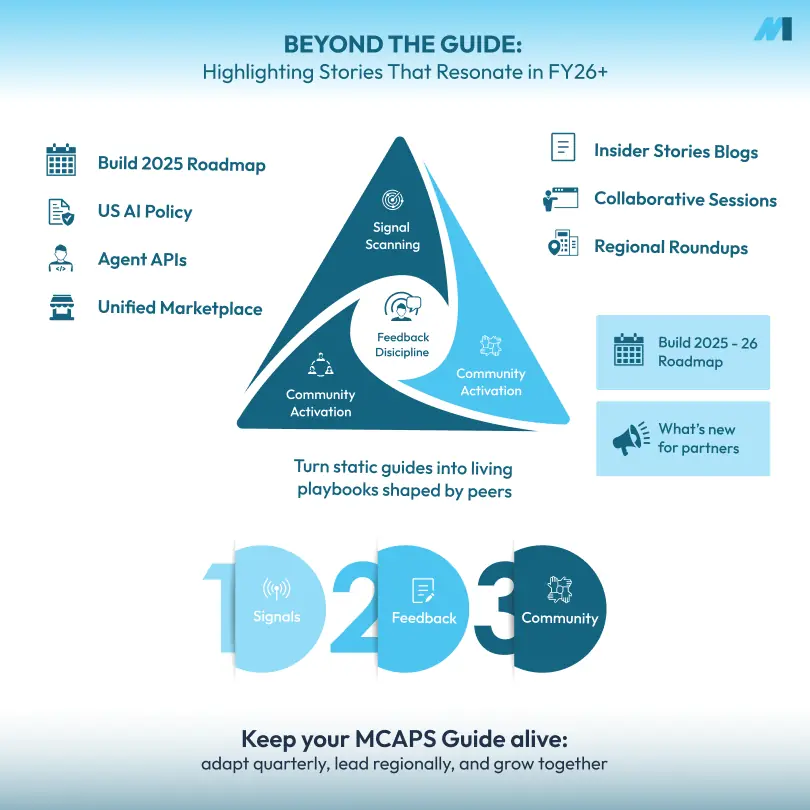
First, watch these future signals closely: evolving AI regulations (e.g., EU AI Act, U.S. AI policy), breakthroughs in security and identity tech, and platform evolution (e.g., agent APIs, unified marketplace strategies).
Microsoft’s own Build 2025 roadmap signals where the platform is heading.
Second, build a feedback loop into your operations. Collect partner input through surveys, advisory boards, and regular partner check-ins.
Monitor performance metrics (consumption growth, co-sell conversions, specialization attainment) and compare results against your guide’s assumptions. Iterate quarterly. Microsoft’s “What’s New for Microsoft Partners” updates explicitly call out enhancements driven by partner feedback.
Third, seed a community of practice around MCAPS in your sphere. Invite thought leaders, Microsoft evangelists, and seasoned partners to contribute guest essays, host webinars, or share regional case studies.
Encourage user-generated content, partner-led blogs, video interviews, and regional breakout roundups. Over time, your guide becomes less a static white paper and more a living reference shaped by community insight and market shifts.
Together, this trifecta- signal scanning, feedback discipline, and community activation. It is how you ensure your guide stays relevant, trusted, and ahead of the curve in FY 26 and beyond.
Frequently Asked Questions
Q1: How will MCAPS affect my small or mid-market business?”
Be ready to explain how Microsoft is channeling more incentive and go-to-market support into SMB segments in FY26, including expanded SaaS, CSP, and solution incentives.
Q2: Where do I stay updated on MCAPS program changes in my region?
Point them to the Microsoft Partner Blog, regional Partner Center announcements, and the MCAPS Start for Partners archive.
Q3: Will Microsoft change partner designations or specializations in FY 26?
Yes. Microsoft is introducing new designations (e.g., support, distribution, device-focused) and evolving specializations during FY26.
Q4: How does co-sell or marketplace revenue tie into MCAPS priorities?
Co-selling via Microsoft sales teams and leveraging marketplace offers now directly feed into how Microsoft spotlights and rewards partner impact.
Q5: What thresholds or metrics will Microsoft use to evaluate partner success under MCAPS?
Partners will increasingly be evaluated by net new cloud consumption, solution adoption growth, co-sell deal wins, and skilling achievements.
References
- MCAPS Start for Partners: post-event (includes FY26 solution areas and event details). https://partner.microsoft.com/blog/article/mcaps-start-for-partners-2025-post-event
- MCAPS Start for Partners - Incentives & investments details (enterprise investment +20%, Copilot funding +50%, Azure incentives +70%). https://partner.microsoft.com/en-us/blog/article/mcaps-start-for-partners-2025-post-event
- New fiscal year, new partner investments: designations and specializations (Copilot, Clinical Applications, Sovereign Cloud; new designations). https://partner.microsoft.com/en-us/blog/article/new-benefits-designations-specializations
- AI apps and agents / unified Microsoft Marketplace announcement (AppSource + Azure Marketplace consolidation and agent publishing). https://partner.microsoft.com/blog/article/ai-apps-and-agents-marketplace
- Partner Center announcements (Lead to Opportunity: One-Click Opportunity experience; Pricing workspace AI assistant preview; Sept 2025 Partner Center updates). https://learn.microsoft.com/en-us/partner-center/announcements/
- Microsoft Build 2025 Book of News / Build 2025 coverage (agentic web, agent APIs roadmap). https://news.microsoft.com/build-2025/
- Microsoft Fabric updates (July 2025 feature summaries; Cosmos DB in Fabric preview; Copilot integration notes). https://learn.microsoft.com/en-us/fabric/fundamentals/whats-new
- Microsoft for Sustainability - What's new and 2025 Environmental Sustainability Report. https://learn.microsoft.com/en-us/industry/sustainability/whats-new-2025-09
- MCAPS Start for Partners content hub / collection (session recordings, playbooks). https://partner.microsoft.com/asset/collection/mcaps-start-for-partners
- Microsoft Entra / Partner Center MFA enforcement and API readiness announcements (MFA enforcement schedule and Partner Center announcement pages). https://learn.microsoft.com/en-us/entra/identity/authentication/concept-mandatory-multifactor-authentication
- Solutions2Share boosts customer efficiency with Teams Manager agent in Microsoft 365 Copilot https://partner.microsoft.com/en-gb/blog/article/copilot-solutions2share
- Securing our future together https://partner.microsoft.com/en-US/blog/article/securing-our-future-together
- Drive impact in the era of agentic AI with new benefits and resources in FY26 https://partner.microsoft.com/en-in/blog/article/new-benefits-and-resources-for-partners-fy26
- Overview of CSRD template https://learn.microsoft.com/en-us/industry/sustainability/esg-reporting-csrd-overview
- MCAPS Start for Partners: Accelerating growth and innovation together https://partner.microsoft.com/en-US/blog/article/mcaps-start-for-partners-2025-post-event


