
Microsoft Ignite 2025 felt different and for good reason. For the first time, AI didn't just show up as a feature inside Microsoft products. It showed up as a new kind of teammate.
Until now, Microsoft Copilot has helped people write emails, summarize meetings, document code, and navigate daily tasks. Useful, yes, but still very much an assistant.
At Ignite 2025, Microsoft raised the bar.
What began a few years ago as copilots assisting users inside Microsoft 365 has now transformed into a full ecosystem of autonomous AI agents, intelligent digital workers capable of executing tasks, managing workflows, and collaborating with teams without human micromanagement.
Microsoft partners now have an opportunity to move beyond one-off solution deployments and step into a more strategic role: helping customers design, operate, govern, and scale AI across their entire digital estate.
How's the AI Evolution at Microsoft Ignite 2025: From Copilots to Autonomous Agents
AI is no longer just helping us work; it's starting to work for us.
From Copilots to Agents: What's Changing?
For the past couple of years, Microsoft Copilot has been the familiar face of Microsoft's AI strategy. Copilot lives inside apps you already use, including Word, Excel, Teams, and Outlook, to help with tasks like drafting documents, summarizing meetings, or analyzing data. Think of Copilot as a brilliant assistant sitting beside you.
But the world of enterprise AI has been rapidly evolving, and Microsoft made a game-changing leap this year with the introduction of autonomous AI agents.
An embedded Microsoft AI agent can now:
- Monitor business systems
- Detect events or exceptions
- Make decisions based on defined policies
- Communicate with other agents or apps
- Execute multi-step processes end-to-end
This moves AI from "a productivity tool" to a new layer in the workforce, one that runs continuously in the background.
What are the Key Microsoft Ignite 2025 Launches (That Make This Evolution Possible)?
Microsoft didn't just announce agents; they built the full infrastructure needed to bring enterprise-grade agents to life. Three announcements stood out:
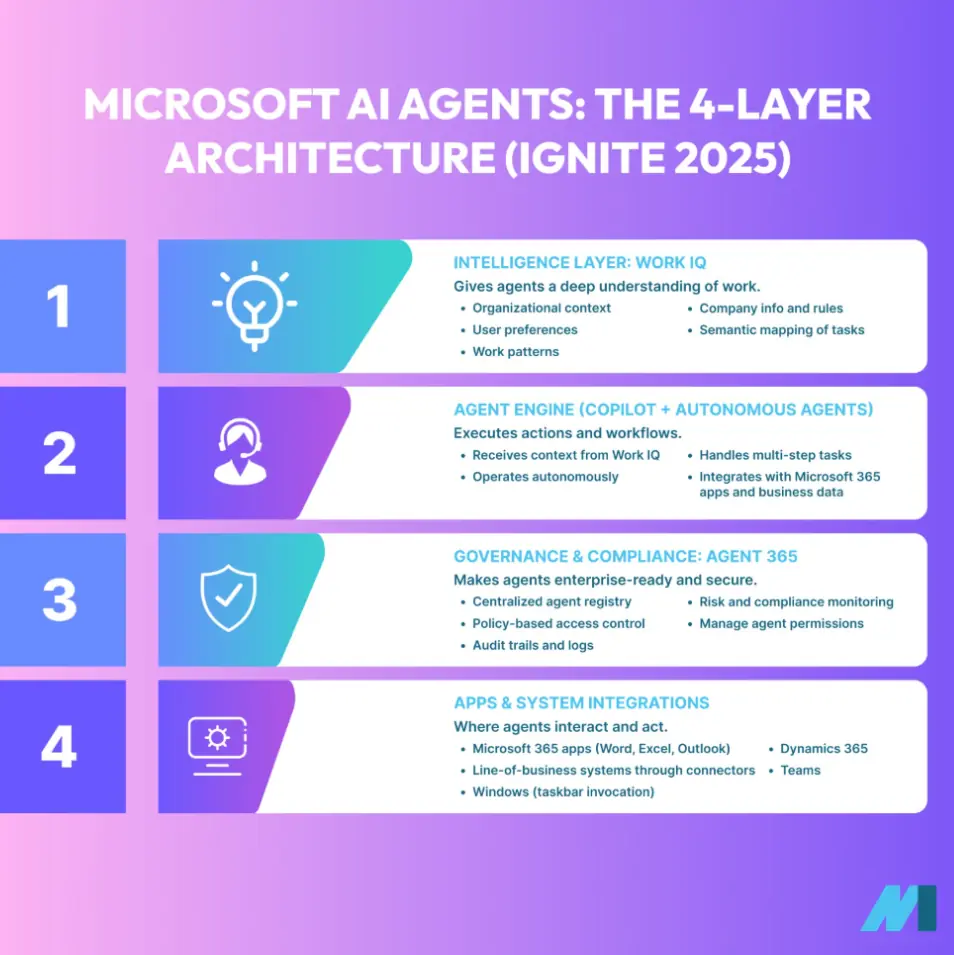
Work IQ: The New Intelligence Layer for Enterprise Work
Work IQ helps AI agents understand:
- Organizational context
- User preferences
- Historical patterns
- Business logic and dependencies
Instead of treating each task in isolation, Work IQ gives agents a more complete understanding of how work actually happens in a company.
Agent 365 - Unified Governance for AI Agents
This was one of the most important launches for enterprises and partners alike because Agent 365 provides:
- A centralized dashboard for all AI agents
- Policy-based controls
- Data access governance
- Risk and compliance monitoring
- Audit trails for every action an agent takes
It brings enterprise trust, which is essential for industries like BFSI, healthcare, government, and manufacturing.
Industry-Specific Agents
Microsoft went beyond generic automation and introduced agents pre-designed for key industries. For example, agents for:
- Sales Development
- Workforce Insights
- Operations and supply chain
- Healthcare documentation and triage
- Retail task automation
Each comes with specialized logic tailored to real industry workflows.
What's the New Microsoft Partner Mandate?
It's becoming a Microsoft AI Operating Partner.
The shift to autonomous AI agents doesn't just redefine Microsoft's product landscape; it redefines what customers now expect from Microsoft partners. Many partners who once focused on deployments, migrations, or app development will now find themselves stepping into a new, more strategic role.
How Can a Project Vendor Become an AI Operating Partner?
Traditionally, partners delivered outcomes tied to a project timeline:
- Deploy Microsoft 365
- Build a Power App
- Integrate Azure services
- Migrate workloads
But AI agents aren't a "deploy it and forget it" solution. They are digital workers that need:
- Continuous oversight
- Policy management
- Workflow refinement
- Risk evaluation
- Performance tuning
- And ongoing alignment with business changes
This means customers need partners who can stay with them throughout the lifecycle of their AI systems, not just during initial implementation.
Where Do Microsoft Partners Add Value in the Age of Agentic AI?
Partners now have a unique opportunity to reshape their offerings around:
- Workflow redesign: Helping customers rethink processes so agents can take over repetitive or decision-heavy tasks.
- Custom agent development: Building and fine-tuning agents through tools like Copilot Studio and Foundry services.
- Enterprise-wide governance: Using Agent 365 Microsoft to put the right controls, policies, and auditing in place.
- Security and compliance: Ensuring agents respect data boundaries, industry regulations, and organizational governance.
- Co-innovation programs: Working with Microsoft through Frontier Partner communities and AI Cloud Partner Program (AI-CPP) initiatives.
Customers are looking for trusted hands, and partners who master governance, data security, and AI lifecycle management will stand out immediately.
Why Governance Is the New Competitive Advantage in the Age of AI?
AI governance is no longer optional; it's the backbone of trust.
Microsoft made this very clear at Ignite 2025: customers will only scale AI if it feels safe, predictable, and compliant.
This creates a new service category for partners, AI Governance-as-a-Service, powered by:
- Agent 365
- Azure policy and Purview
- Entra-based identity controls
- Data access boundaries
- Continuous monitoring
Partners who can provide this will become indispensable to enterprise customers navigating autonomous AI adoption.
What are Frontier Microsoft Partner Ecosystems?
Microsoft also introduced the expanded Frontier Partner ecosystem in 2025, a community focused on building and scaling next-generation AI solutions.
Being part of this ecosystem gives partners access to:
- Early previews
- AI-forward design patterns
- Co-innovation plays
- Go-to-market support
This aligns perfectly with Microsoft's broader vision of AI agents becoming the default operating layer across Microsoft 365, Azure, Dynamics, and Teams.
How to Leverage Microsoft Tools to Build and Scale AI Agent Solutions?
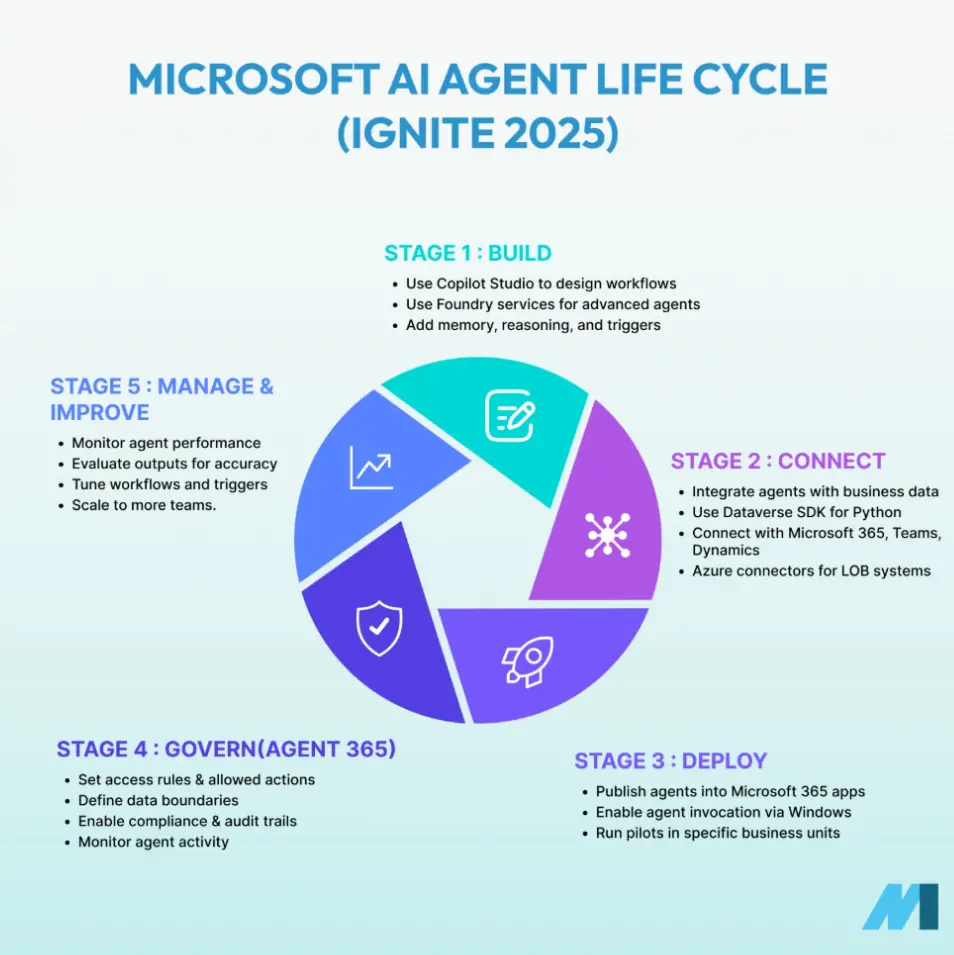
With autonomous agents becoming VIP citizens in the Microsoft ecosystem, partners now have access to a richer toolkit than ever before. Microsoft Ignite 2025 showcased a clear end-to-end path for partners who want to build, test, deploy, and operate AI agents at scale, without having to reinvent the wheel.
How Does Copilot Studio Help in Building Custom AI Agents?
Copilot Studio has evolved from a low-code Copilot builder into a full-fledged agent creation environment. Partners can now use it to:
- Design multi-step autonomous workflows
- Connect agents to enterprise systems through connectors and APIs
- Add reasoning, memory, and guardrails
- Test agents in controlled environments before deployment
With the new Ignite updates, partners can also package agents as reusable playbooks that customers can adopt directly, opening up new marketplace and co-sell opportunities.
What are Microsoft Foundry Services and Engineering Grade Agent Development?
For advanced scenarios, Microsoft introduced expanded Foundry services, giving partners a deeper engineering layer to build more complex, high-governance agents.
Think of Foundry as the place where you can:
- Add sophisticated retrieval logic
- Integrate external models
- Embed domain-specific intelligence
- Run high-scale agent workloads backed by Azure
This is especially powerful for partners serving regulated industries or global enterprises.
How do the Dataverse SDK for Python and Azure Databricks support the AI agent lifecycle?
AI agents require data, and they need it fast, secure, and structured. That's where Dataverse and Azure Databricks come in.
Dataverse SDK for Python lets partners:
- Build agents that interact directly with business data
- Pull contextual information in real time
- Maintain consistency across Microsoft 365 and Dynamics ecosystems
Meanwhile, Azure Databricks adds the data engineering and MLOps foundation needed for:
- Feature pipelines
- Vector embeddings
- Model monitoring
- Data governance
- Multi-agent orchestration
Together, they simplify the entire AI lifecycle from ideation to production.
What's the Highlight for Marketplace & Co-Sell at Microsoft Ignite 2025?
Key highlight: turning agents into revenue
One of the biggest opportunities highlighted at Ignite 2025 was the ability for partners to package AI agents as market-ready solutions. This includes:
- Industry-specific agent playbooks
- Preconfigured automation bundles
- AI governance templates
- Domain-focused agent kits (finance, retail, healthcare, manufacturing)
Agents can now be listed on the Microsoft commercial marketplace, opening doors for global reach and co-sell incentives.
What is the Microsoft Partner Skilling Hub and how does it help partners build AI fluency?
To help partners keep up with the pace of innovation, Microsoft expanded the Partner Skilling Hub with:
- Role-based AI agent learning paths
- Hands-on labs for Copilot Studio and Agent 365
- Certification prep for AI Cloud Partner Program badges
This ensures partners can quickly build internal competency.
How do Microsoft's AI Forward-Deployed Engineers support partners building AI agent solutions?
A major highlight this year was Microsoft's commitment to hands-on collaboration.
With AI Forward Deployed Engineers, partners get direct guidance from Microsoft specialists who can help:
- Design agent architectures
- Optimize performance
- Validate governance setups
- Prepare for large-scale customer rollouts
This acts as a force multiplier for partners ready to accelerate their AI transformation.
What are the Real-World AI Agent Use Cases Delivering Business Impact?
One of the biggest questions partners had going into Ignite 2025 was simple: "What can AI agents actually do in the real world?"
Microsoft Ignite 2025 showcased a wave of practical, industry-ready examples that demonstrated just how quickly agents can create measurable business value. These weren't lab demos; they were real workflows, real users, and real ROI.
What is Microsoft's Sales Development Agent, and how does it automate pipeline generation?
It's a digital Sales Development Representative (SDR) that never sleeps. The Sales Development Agent showcased at Ignite can:
- Scan CRM data for buying signals
- Draft personalized outreach
- Schedule follow-ups
- Qualify leads based on intent
- Escalate opportunities to the sales team
Partners working with Dynamics 365 or CRM systems can customize this agent to match any industry, from B2B SaaS to manufacturing distributors.
For customers, this means better pipeline velocity. For partners, this means introducing new services focused on agent tuning, integration, and performance optimization.
What is Microsoft's Workforce Insights Agent and how does it turn operations data into actionable insights?
The Workforce Insights Agent is built for HR, operations, and frontline teams. It can:
- Analyze workforce patterns
- Recommend staffing adjustments
- Surface compliance or overtime risks
- Provide daily summaries to managers
- Identify training gaps using Work IQ context
Industries like retail, logistics, and healthcare stand to gain the most here, as these teams struggle with real-time workforce coordination.
Partners can extend this agent with custom KPIs, dashboards, and sector-specific templates, which means a clear opportunity to build repeatable IP.
What is Microsoft's Teams Facilitator Agent and how does it improve meetings without manual preparation?
This was one of the most relatable demos at Ignite 2025. The Teams Facilitator Agent can:
- Prepare meeting agendas from emails and shared docs
- Track action items
- Assign ownership
- Send post-meeting summaries
- Follow up automatically after deadlines
This moves beyond "meeting notes" to true meeting management.
Partners can embed this into larger collaboration modernization projects, combining Teams, Microsoft 365, and SharePoint workflows to enhance overall productivity.
How can Microsoft AI agents be customized for industry-specific workflows and use cases?
Microsoft emphasized that agents are not one-size-fits-all. Partners can tailor agents to unique industry contexts, such as:
Finance:
- Transaction monitoring
- Compliance checks
- Risk alerts
- Loan processing workflows
Healthcare:
- Clinical documentation
- Patient intake triage
- Insurance verification
- Care coordination
Retail:
- Shelf inventory agents
- Supply chain triggers
- Price updates
- Customer insights
Manufacturing:
- Predictive maintenance
- Work order agents
- Quality control workflows
These examples are just the start. The real opportunity lies in the long tail of specialized enterprise workflows.
What business impact do Microsoft AI agents deliver and why are customers willing to pay for them?
Businesses aren't excited about AI agents because they're new. They're excited because the impact is tangible:
- Reduced manual work (up to 40–50% in early pilot data)
- Lower error rates because agents follow rules consistently
- Faster decision-making driven by real-time context
- Better customer experiences from quicker responses
- Higher employee satisfaction as routine tasks get automated
For partners, this translates directly into:
- Higher recurring revenue (managed agent services)
- More cross-sell opportunities (data, security, automation)
- Stronger account stickiness through ongoing AI lifecycle support
AI agents aren't just a technology shift but a new business model.
What strategic steps should Microsoft partners take to prepare for an AI-driven transformation?
With autonomous AI agents moving into the mainstream, Microsoft partners are entering a new era. Customers aren't just asking "How do we use AI?" anymore, but they're asking "How do we run our business with AI?"
This shift opens the door to long-term, high-value opportunities for partners who modernize their service model, deepen their AI capabilities, and position themselves as trusted guides in this journey.
Here are the key strategic priorities partners should focus on after Ignite 2025:
1. Shift From Project Delivery to AI-Powered Managed Services
AI agents require continuous monitoring, policy updates, error analysis, and workflow refinement. This creates an opportunity for partners to move from traditional project work to recurring services such as:
- Managed Agent Operations
- AI Governance-as-a-Service
- Continuous Optimization and Tuning
- Agent Performance Monitoring
- Monthly Agent Workflow Refreshes
Think of it as "Managed Services 2.0", but built around autonomous workflows instead of infrastructure alone.
2. Build Deep Capabilities in AI Governance and Security
Governance is the linchpin of enterprise AI adoption. Ignite 2025 made it clear: customers will scale agents only when governance feels reliable and compliant. Partners should invest in expertise across:
- Agent 365 Microsoft for centralized control
- Data access policies using Purview
- Identity and permissions via Microsoft Entra
- Risk assessments and audit frameworks
- Compliance workflows for regulated sectors
This is one of the strongest differentiators a partner can build in 2025.
3. Adopt Microsoft Frontier Badges and AI Certifications Early
Microsoft's AI Cloud Partner Program (AI-CPP) and Frontier badges are becoming trust signals.
These badges demonstrate that your team understands:
- Responsible AI
- Advanced agent design
- Governance best practices
- Azure AI and fabric integrations
- Enterprise security
Customers are increasingly seeking partners who hold these recognitions, especially in regulated industries such as BFSI, healthcare, and the public sector.
4. Develop Cross-Stack Expertise Across Microsoft 365, Azure, Dynamics, and Security
AI agents don't live in a single product; they span the entire Microsoft ecosystem. Partners need to build internal competency across:
- Microsoft 365 data flows
- Azure AI and orchestration
- Dynamics 365 process logic
- Teams workflows
- Entra identity
- Purview governance
- Azure Databricks pipelines
The best-performing partners will be those who can design cohesive, cross-cloud agent solutions instead of isolated experiences.
5. Reposition AI Agents as Workforce Augmenters in Customer Conversations
AI agents are not just automation tools; they are the next layer of the digital workforce.
Partners should coach customers on how to:
- Rethink roles and responsibilities
- Assign tasks to agents vs. humans
- Build blended human–agent workflows
- Measure productivity and operational efficiency
- Introduce AI safely in change-sensitive environments
Partners who can explain AI in human terms, rather than just technical terms, will earn executive trust more quickly.
From Insight to Impact: The Partner Imperative in Microsoft's AI Future
Microsoft Ignite 2025 didn't just introduce new features but signaled a deep shift in how businesses will operate in the years ahead. AI agents are no longer experimental tools or productivity add-ons. They are becoming core contributors to how work gets done across sales, operations, HR, finance, IT, customer service, and more.
For Microsoft partners, this moment presents a rare, high-impact opportunity.
Enterprises will need guidance at every stage, from identifying the right workflows for automation to building custom agents to setting guardrails that ensure safe and compliant adoption. They will also look for long-term partners who can help them manage these AI workers with the same rigor as any mission-critical system.
Ignite 2025 set the foundation. Now, it's partners who will bring this future to life - helping organizations everywhere unlock new levels of efficiency, intelligence, and resilience.
The era of autonomous AI agents has begun. And for Microsoft partners, the opportunity has never been greater.
References
-
"Microsoft Ignite 2025: Copilot and agents built to power the Frontier Firm" - Microsoft 365 blog
https://www.microsoft.com/en-us/microsoft-365/blog/2025/11/18/microsoft-ignite-2025-copilot-and-agents-built-to-power-the-frontier-firm/?utm_source=chatgpt.com -
"Introducing Microsoft Agent 365" – official Microsoft blog post
https://www.microsoft.com/en-us/microsoft-365/blog/2025/11/18/microsoft-agent-365-the-control-plane-for-ai-agents/?utm_source=chatgpt.com -
"The complete lifecycle of AI on display at Ignite 2025" - Microsoft blog
https://blogs.microsoft.com/blog/2025/11/18/from-idea-to-deployment-the-complete-lifecycle-of-ai-on-display-at-ignite-2025/?utm_source=chatgpt.com -
"Ignite 2025: Windows at the frontier of work" - Windows Blog
https://blogs.windows.com/windowsexperience/2025/11/18/ignite-2025-windows-at-the-frontier-of-work/?utm_source=chatgpt.com -
"Ambient & Autonomous Security for the Agentic Era" - Microsoft Security Blog
https://www.microsoft.com/en-us/security/blog/2025/11/18/ambient-and-autonomous-security-for-the-agentic-era/?utm_source=chatgpt.com


