
If 2024 was the year of AI experimentation and 2025 was the year of integration, 2026 is strictly the year of orchestration. The old playbook, where "growth at all costs" justified burning cash on bloated SDR teams and broad-stroke ads, is effectively dead. In its place, a leaner, smarter, and significantly more automated Go-To-Market (GTM) engine has emerged.
For B2B technology leaders, the challenge today isn't just about having a superior product. It is about how your technology resonates in a market flooded with noise and synthetic content.
At Nagana Media, we’ve watched the landscape shift. We’ve seen the rise of Agentic AI and the explosion of Cloud Marketplaces redefine how software is bought and sold. To win this year, you cannot simply optimize your funnel; you must rebuild your engine.
Here is your blueprint for the top GTM strategies that will define B2B success in 2026.
What Are the Winning GTM Strategies for 2026?
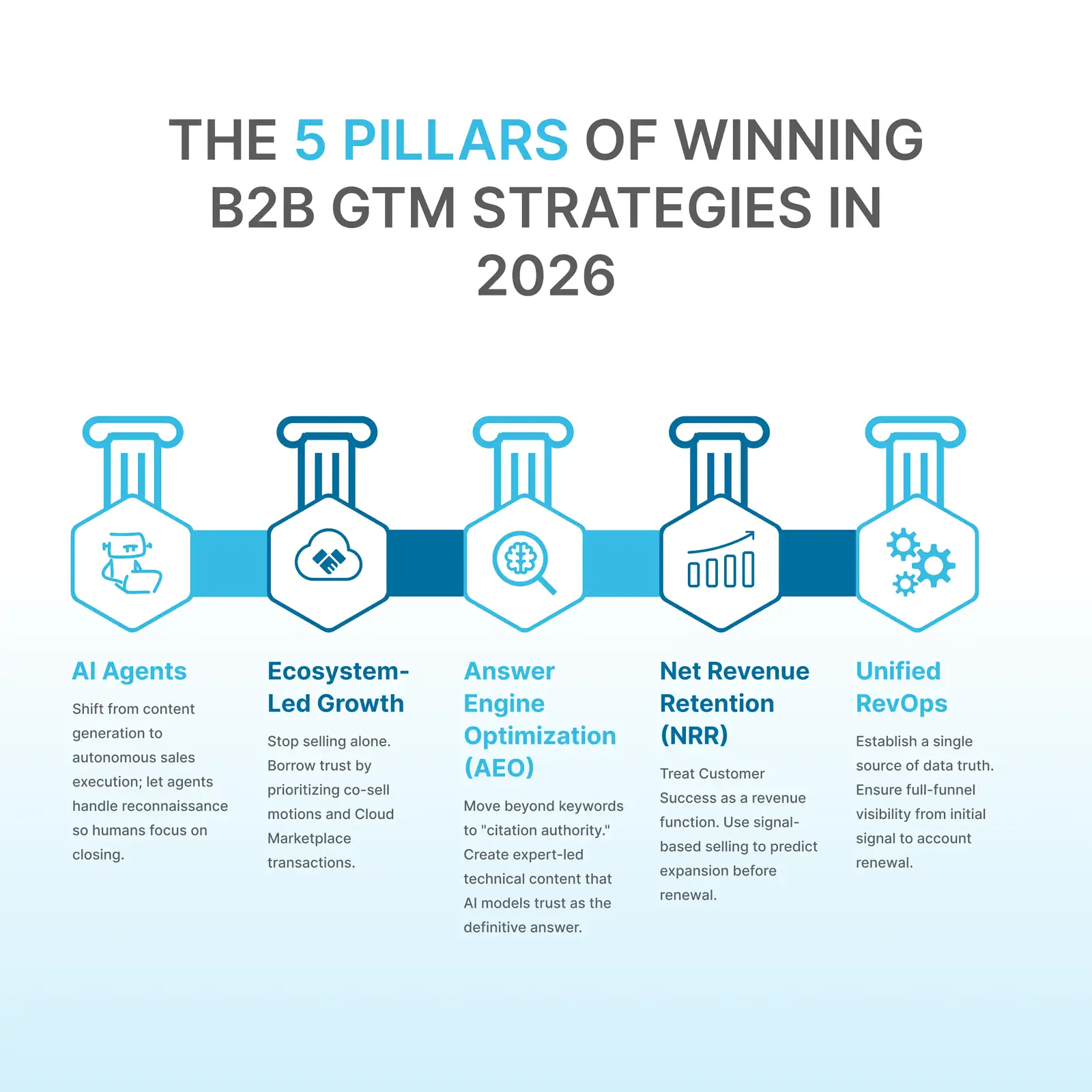
Success in the current market requires moving from linear sales funnels to a unified, data-led ecosystem. Below are the five strategic pillars that distinguish market leaders from laggards this year.
1. How will AI Agents transform the sales motion?
AI Agents transform sales motions by shifting from passive content generation to active, autonomous execution of complex tasks.
Two years ago, we used GenAI to write emails. Today, Agentic GTM means deploying autonomous agents that act as the preliminary layer of your sales team. These aren't chatbots; they are a combination of research analysts and SDRs. In 2026, high-performing revenue teams are using agents to monitor prospect signals, like a CTO posting about "cloud migration" on LinkedIn or a company announcing a Series B funding round and instantly triggering a personalized outreach sequence.
The human seller no longer spends hours on "detective work." They step in only when a high-intent context is established. For B2B tech companies, this shift is non-negotiable. If your human talent is still manually enriching leads or sending "just checking in" emails, you are burning capital. The strategy for 2026 is straightforward: let agents handle the reconnaissance, allowing your team to focus on building relationships.
The "Silent" SDR: Imagine a DevOps infrastructure company targeting mid-market SaaS firms. In the old world, an SDR would blindly email 50 CTOs.
In the 2026 Agentic model, an autonomous agent monitors GitHub repositories and public tech forums. It detects that "Company X" has suddenly increased their query volume on a specific open-source database, signaling a scaling issue.
The agent autonomously drafts a technical briefing note, not a sales pitch, highlighting how your solution optimizes that specific database, cites a relevant case study, and sends it to the VP of Engineering. The human seller only gets a notification when the VP clicks the technical documentation link. The conversation starts at "solution," not "discovery."
2. Why is Ecosystem-Led Growth (ELG) replacing direct sales?
Ecosystem-Led Growth is replacing direct sales because trust is now the primary currency in B2B buying, and that trust is already held by established partners and marketplaces.
Cold outbound is facing diminishing returns. Buyers are fatigued. Instead of building trust from scratch, smart GTM strategies borrow it. This is the core of Partner-First Execution. We are seeing a massive consolidation of spend through Cloud Marketplaces like Microsoft AppSource and Azure Marketplace.
For many of our clients in the Microsoft ecosystem, the "Co-sell" motion isn't a bonus; it’s the main event. Your GTM strategy must prioritize getting your solution into these catalogs and incentivizing partners to transact there.
When you align your product with a hyperscaler’s incentives, such as helping them reduce a customer's cloud commitment, for example, you stop pushing a product and start solving a budget problem. In 2026, if you aren't selling with partners, you are selling against the wind.
Solving the Budget Block: Consider a Cyber-Risk platform trying to close a $150,000 deal with a Fortune 500 retailer. The CISO loves the product, but the CFO has frozen all new vendor procurement for Q1.
In a traditional sales motion, this deal dies. In an ELG motion, the Sales Director pivots. They are aware that the retailer has a multi-million-dollar Microsoft Azure Consumption Commitment (MACC) that they are struggling to utilize. Because the Cyber-Risk platform is transactable on the Azure Marketplace, the deal is restructured. The retailer buys the software through Azure, burning down their committed spend. The CFO approves it because it’s not a "new" budget; it’s drawing down a prepaid liability. The partner wins, the cloud provider wins, and the deal closes in half the time.
3. How do we optimize for Answer Engines (AEO) and AI Search?
Optimizing for Answer Engines requires shifting focus from keywords to "citation authority," ensuring your brand is the primary source cited by AI models like ChatGPT and Gemini.
The days of users clicking ten blue links are fading. Now, a buyer asks an AI, "What is the best cybersecurity compliance tool for a mid-sized fintech using Azure?" If the AI doesn't mention you in its generated answer, you are invisible. This is Generative Engine Optimization (GEO).
To win here, your content strategy must evolve. "Fluff" content is penalized. You need to publish high-density, expert-led technical content that LLMs (Large Language Models) recognize as authoritative. Use data, proprietary research, and clear, structured formatting. The goal is no longer just traffic; it is citability. You want the AI to trust your site enough to reference it as the definitive answer.
Winning the "Perplexity" Query: A Logistics Manager asks an AI search engine: "Compare the top supply chain visibility tools for cold chain management."
Company A has a blog titled "5 Reasons You Need Visibility" filled with generic keywords. The AI ignores it.
Company B (The Winner) has published a "2026 Cold Chain Latency Report" featuring proprietary data tables, direct API comparison benchmarks, and structured schema markup.
Because Company B provided "high-information-gain" content, the AI summarizes their data and lists them as the primary recommendation. The user never visits Company A’s website, despite their high SEO spend, because the AI judged their content as lacking "expert depth."
4. Is Net Revenue Retention (NRR) the new obsession?
Yes, Net Revenue Retention has eclipsed Net New Revenue as the primary health metric for B2B SaaS in 2026.
Acquiring a new customer today is significantly more expensive than it was five years ago. Consequently, the "Growth" function has migrated post-sale. The most successful GTM strategies now treat Customer Success (CS) not as a support function, but as a revenue function.
This is Signal-Based Expansion. It involves using product usage data to predict upsell opportunities before the customer even realizes they need them. If a client is hitting 90% of their storage limit, your CS team shouldn't wait for a ticket; they should already have a proposal ready. In 2026, the sale doesn't end at the contract signature; that is simply where the real margin begins.
The "Greyed-Out" Feature Upsell: A Project Management platform notices a pattern in a client's usage data: five different users from the "Marketing" account have clicked on the "Advanced Analytics" tab in the last week, only to hit a paywall (a feature restricted to the Enterprise tier).
Instead of waiting for a renewal conversation in six months, an automated workflow triggers a task for the Account Manager. They reach out immediately: "I noticed your team is trying to access Analytics. Since you're already at 20 seats, we can upgrade you to Enterprise for just 15% more, unlocking that feature today." This transforms a passive user frustration into an active revenue expansion event.
5. How can we unify RevOps to break down silos?
RevOps unifies the organization by establishing a single source of data truth across Marketing, Sales, and Customer Success, eliminating the friction of disconnected tools.
Silos are the silent killer of GTM velocity. You cannot have Marketing optimizing for MQLs while Sales optimizes for closed-won and CS optimizes for NPS, all using different datasets.
The "One Revenue Team" approach demands a unified data architecture. A lead's behavior in the marketing funnel must be visible to the CS manager six months later during renewal discussions. RevOps in 2026 is about full-funnel visibility. It ensures that when an AI Agent flags a risk, the entire revenue engine, from marketing nurture tracks to account management, reacts in unison.
The Unified Hand-off: In a siloed organization, a customer mentions during the sales demo that their primary goal is "reducing report generation time." The deal closes, and the Sales Rep high-fives the team. The Customer Success Manager (CSM) then takes over, completely unaware of this goal, and spends three weeks training the customer on "admin settings" instead of reporting. The customer churns a year later due to a lack of perceived value.
In a Unified RevOps model, the "Goal: Reduce Reporting Time" field captured by the AI note-taker during the sales call is automatically mapped to the Onboarding Project Plan. The CSM’s first call is: "I know your main goal is speed, let's set up your automated reports first." Time-to-value is halved, and retention is secured.
How Do You Build a Data-Driven Ideal Customer Profile (ICP)?
The concept of the ICP has matured. In the past, "Fintech companies in New York with 50+ employees" was a sufficient definition. Today, that is just a list, not a strategy.
To build a winning ICP in 2026, you must layer Intent and Context over firmographics.
Technographic Readiness: Don't just target banks; target banks that installed a specific competitor’s software 11 months ago and are coming up for renewal.
The "Dark Funnel" Insights: Are the decision-makers active in niche communities? Are they listening to specific podcasts?
Your GTM motion must be precise. We utilize predictive analytics to score accounts not just on who they are, but on when they are likely to buy. If your ICP doesn't include timing signals, you are wasting resources pitching to closed doors.
Common GTM Mistakes B2B Companies Make
Even with the best tools, we see technology companies stumble by falling into familiar traps.
Treating AI as a Cost-Cutter Only: If you only use AI to fire writers or SDRs, you are missing the point. AI should be used to scale capacity, allowing your best people to do more, not just to reduce headcount.
Neglecting the Partner Incentive: Launching a partner program is useless if you don't understand how your partners make money. If you aren't helping them increase their service margin or retire their cloud quota, they will not sell your product.
Ignoring the "Dark Funnel": Attribution software misses a huge chunk of the buyer journey. Just because a lead came from "Direct Traffic" doesn't mean they didn't hear about you on a peer call three weeks ago. Invest in brand presence where it can't be measured, because that is where decisions are influenced.
Make Your Strategy Resonate
The B2B technology landscape of 2026 is unforgiving to those who cling to static playbooks. The winners will be the companies that embrace Agentic GTM, leverage the Ecosystem, and optimize for the AI-driven search reality.
It is no longer about shouting the loudest; it is about being the most intelligent signal in the market.
Is your GTM engine ready for the rest of the decade?


