
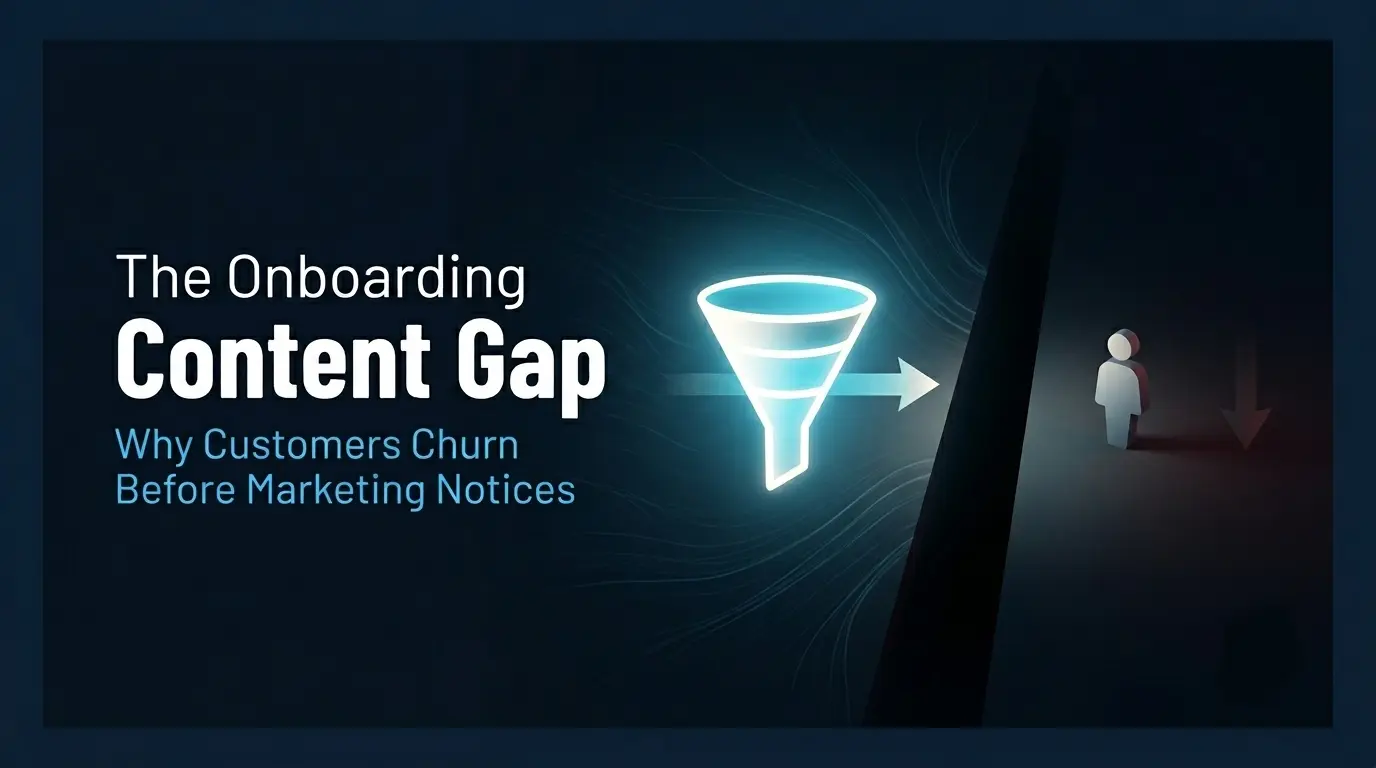
There's a moment in almost every B2B SaaS company's content program where the funnel gets drawn, and the arrows stop at the sale. Blog posts, comparison pages, case studies, email sequences all of it aims at conversion. And then the diagram ends, because closing the deal is where marketing's job ends, at least in how most content programs are structured.
That's also where churn begins.
What Is the Onboarding Content Gap?
The onboarding content gap is the period between a customer signing and that customer reaching genuine, repeatable value, during which most B2B marketing teams produce nothing specifically for that customer. The onboarding experience typically comes from customer success: a kickoff call, a PDF guide, a help center link. What it rarely includes is content engineered to answer the specific questions a new customer has in their first thirty, sixty, and ninety days.
The consequence is measurable. Over 20% of voluntary B2B SaaS churn links directly to poor onboarding, per ProfitWell. 43% of SMB customer losses happen within the first 90 days. Companies with strong onboarding education content reduce churn by 15 to 20%. Every one of those numbers is a content opportunity most marketing teams are not touching.
Why Marketing Stops at the Sale (And Why That's a Revenue Problem)
The reason content programs end at conversion is understandable. Marketing gets measured on pipeline and leads, sometimes on MQLs, occasionally on first-quarter revenue attribution. Retention sits in a different budget and on a different dashboard. The feedback loop that would tell a content team "the onboarding content is failing and customers are churning because of it" rarely makes it back to the people who write the content.
But the math for fixing this is more compelling than almost any top-of-funnel investment. Every dollar invested in customer onboarding returns approximately five dollars in additional revenue and cost savings, according to Forrester research. Time to first value matters enormously: companies that get customers to a clear first win in under seven days see 50% lower churn rates than those where the first-value moment takes two weeks or longer. Content is one of the fastest levers to move that number without hiring more customer success people.
What "Onboarding Content" Actually Means
I want to be specific here, because "onboarding content" gets used to describe everything from a welcome email to a five-hour certification course, and most of those things are not the same problem or the same opportunity.
The highest-leverage onboarding content is the content that answers the question a new customer has before they know who to ask. It is not the FAQ in the help center, which assumes the customer knows what question they have. It is the proactive, staged content that shows up at the exact moment the customer is likely to be stuck, disengaged, or confused, and gives them a reason to keep going.
The content types that consistently move the needle for B2B technology companies are: role-specific getting-started guides that address the specific workflow of the person who will actually use the product daily (not the decision-maker who bought it), milestone emails triggered by product behavior rather than time, and short-form video walkthroughs for the two or three features that drive the most value and are most commonly skipped.
That last point matters more than most marketing teams realize. Feature bloat contributes to approximately 40% of product abandonment. The customers who churn in the first ninety days often do so not because the product doesn't work for them, but because they never discovered the part that would have made it work. A two-minute video that surfaces that moment, triggered when a customer hasn't activated a key feature after two weeks, is more valuable than the most polished case study in your library.
The AEO and AI SEO Connection Nobody's Making
Here's a dimension of onboarding content that most B2B marketing teams are completely missing, and that connects directly to Nagana Media's work in AEO and AI SEO for B2B technology companies.
New customers frequently research their own tools in AI platforms after they've already purchased them. A newly onboarded customer asks ChatGPT, "how to set up [Product] integration with Salesforce" or "best practices for [Product] data exports" within days of signing. The answer they get either comes from your own help documentation and structured content, or from a competitor's comparison page, a forum thread, or a generic AI-generated response that may or may not be accurate about your product.
The companies winning in AI search for post-purchase queries are the ones publishing structured, specific, answer-first documentation that AI platforms can extract and cite. This is AEO applied to the onboarding stage: not just making your product discoverable to buyers pre-sale, but making your product guidance findable and citable during the first-value journey. Nagana Media's guide to AEO, GEO, and AI SEO for B2B technology companies at naganamedia.com covers this discipline in depth. It is, in every technical sense, the same discipline applied to a different stage of the customer relationship.
This also matters for AI search visibility at the brand level. A B2B SaaS company whose help documentation and onboarding guides appear consistently in AI-generated answers for product-specific queries builds a different kind of entity authority than one whose AI presence is limited to top-of-funnel content. The entity that shows up when buyers research the category and when customers ask how to use the product is an entity with compounding AI citation authority.
What a Minimal Onboarding Content Program Looks Like
I'm not suggesting marketing take over the customer success function. That's not the point, and it's not practical. The point is that marketing has a content skill set that customer success often doesn't, and onboarding is a content problem as much as a relationship problem.
The minimum viable version of a marketing-built onboarding content program looks like this. Three role-specific getting-started guides, one for the power user who lives in the product, one for the manager who needs to see results from it, and one for the IT or operations person who has to maintain it. These can be adapted from existing marketing content in many cases, but they need to be rewritten for someone who has already bought and is now trying to get value.
Five behavior-triggered emails, not time-triggered, tied to the product actions that most reliably predict whether a customer will stay or churn: logging in a second time within a week, activating the first core feature, inviting a second user, completing a setup step that data shows most churned customers never completed.
One video per high-value feature that customers commonly skip. Not a product tour. A short, specific "here's the thing that customers who stay the longest all use, and here's how to set it up in four minutes" video. These live in the help center and in the behavior-triggered emails, and they belong on the pages AI platforms will crawl when a new customer asks for guidance on exactly this feature.
The Conversation Marketing Needs to Have With Customer Success
None of this happens unless marketing and customer success look at the same data. Which customers churned in the first ninety days? What did they not do in the product that retained customers did? Which questions did they ask in support tickets before they cancelled?
That data exists in customer success and product analytics. Marketing rarely sees it. A monthly thirty-minute meeting between the content lead and the customer success lead, with a shared document tracking the most common early-customer questions and friction points, is usually enough to start changing what content gets built. The AEO and AI SEO opportunity follows naturally, because the content created for this purpose answers exactly the questions new customers are asking AI platforms in those first ninety days.
Frequently Asked Questions
What is the onboarding content gap in B2B SaaS?
The onboarding content gap is the absence of content specifically built for new customers between the sale and the moment they reach genuine, repeatable value from the product. Most B2B marketing content programs focus on attracting and converting buyers, then stop producing content when the sale closes. Churn, which is disproportionately concentrated in the first ninety days, starts exactly where most content programs end.
How much churn is directly linked to poor onboarding?
Over 20% of voluntary B2B SaaS churn links directly to poor onboarding, according to ProfitWell data. 43% of SMB customer losses happen within the first ninety days post-purchase. Companies with structured onboarding programs increase first-year retention by 25%, and companies with strong onboarding education content specifically reduce churn by 15 to 20%.
How does onboarding content connect to AEO and AI SEO for B2B technology companies?
New customers frequently research their own tools in AI platforms like ChatGPT and Perplexity after purchasing. "How to set up [Product] with Salesforce" or "best practices for [Product] data export" are queries that route to AI-generated answers. Companies whose help documentation and onboarding guides are structured for AI extraction show up in those answers. This is AEO applied to the post-sale stage: the same content discipline that makes a brand discoverable to pre-sale buyers also makes a brand's product guidance findable and citable during the onboarding journey.
What content types move the needle most during onboarding?
Role-specific getting-started guides tailored to the actual user rather than the buyer, behavior-triggered emails tied to product actions rather than fixed time intervals, and short-form video walkthroughs for the two or three features that drive the most long-term retention and are most commonly skipped. Feature-specific video content is particularly high-leverage because approximately 40% of product abandonment is linked to customers never discovering the features that would have made the product valuable for their use case.
Why should marketing own onboarding content rather than customer success?
Marketing does not need to own the relationship that customer success manages. But marketing has a content production capability that customer success typically lacks, and onboarding is a content problem as much as it is a relationship problem. The most effective onboarding programs combine customer success's knowledge of where customers get stuck with marketing's ability to produce structured, staged, findable content that answers those questions before a customer knows who to ask.
References
SHNO.co, Customer Onboarding Statistics 2026, ProfitWell voluntary churn and onboarding data, UserGuiding 100-plus statistics analysis: https://www.shno.co/marketing-statistics/customer-onboarding-statistics
SHNO.co, SaaS Onboarding Statistics for 2026: https://www.shno.co/marketing-statistics/saas-onboarding-statistics
Genesys Growth, B2B SaaS Churn Rate Benchmarks, Forrester 5:1 onboarding ROI research: https://genesysgrowth.com/blog/saas-churn-rates-stats-for-marketing-leaders
SERPsculpt, B2B Customer Retention Statistics 2025: https://serpsculpt.com/b2b-customer-retention-statistics/


