
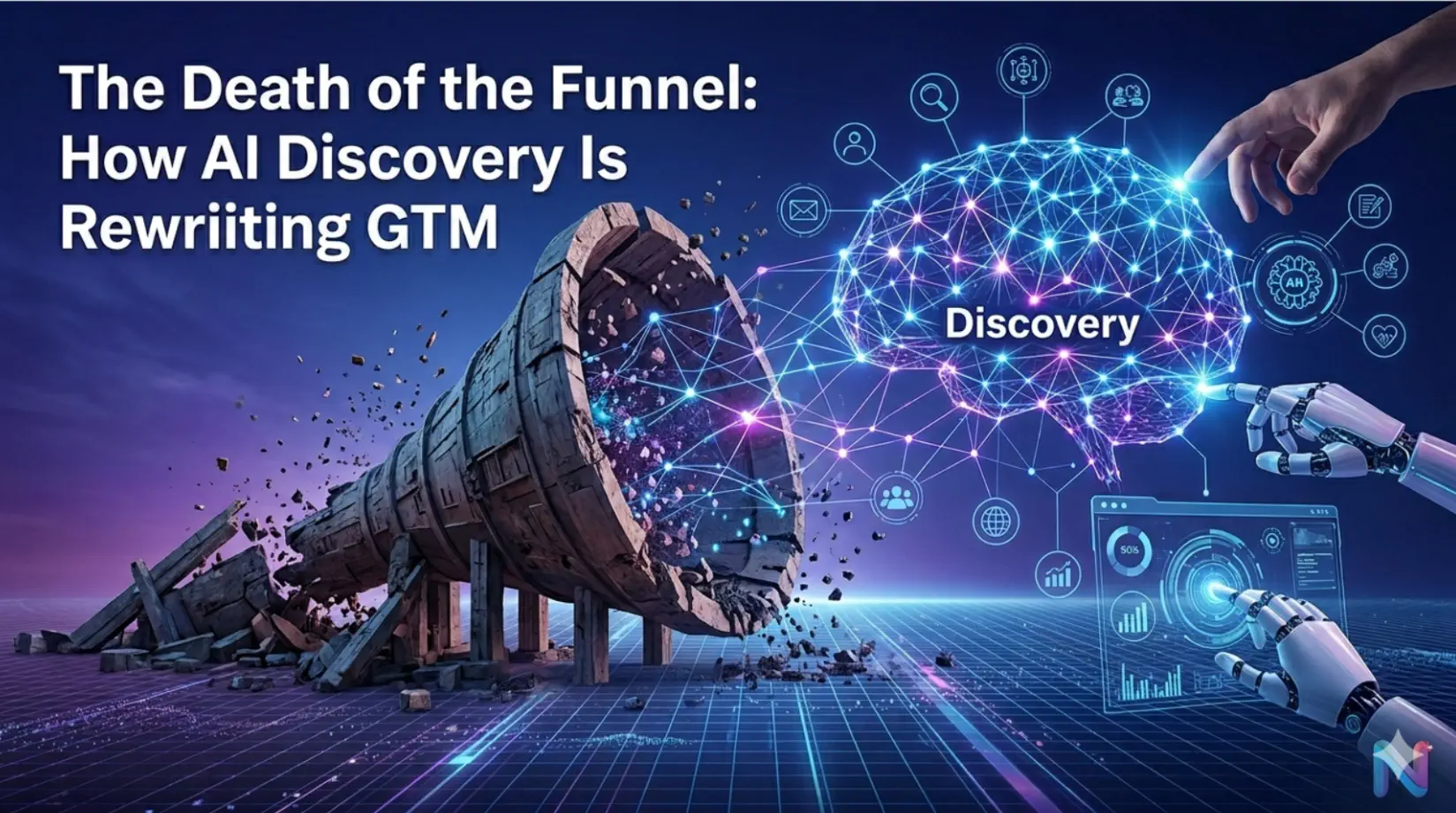
The B2B sales funnel made sense when vendors held the information and buyers needed them to release it. That world is gone.
Today, a B2B buyer researches your category in an AI tool, builds a shortlist from citations they trust, validates it through peer reviews, and arrives at your website already decided. Your funnel never saw them coming because they never entered it.
This piece covers how B2B buyers actually search today, what they see and where they see it, how brand perception forms before any sales conversation begins, and what a GTM strategy looks like when the funnel no longer describes reality.
How Does a B2B Buyer Actually Search Today?
By the time a B2B buyer sends your sales team a message, they already know who they want to buy from.
That is not a hypothesis. Buyers make first contact with vendors at the 61% mark of their journey. The winning vendor was already on their Day One shortlist 95% of the time. The shortlist was not built on your homepage. It was built in AI tools, peer communities, and third-party platforms your analytics will never see.
This is where the traditional B2B sales funnel breaks down. The funnel was designed for a world where buyers needed vendors to educate them. That information asymmetry no longer exists. A procurement manager evaluating warehouse automation software today does not start with your website.
They open Perplexity or ChatGPT, type a specific question, and receive a synthesized answer with three to four cited vendors. No form filled. No SDR involved. Brand perception forming in real time, inside a system your marketing stack cannot track.
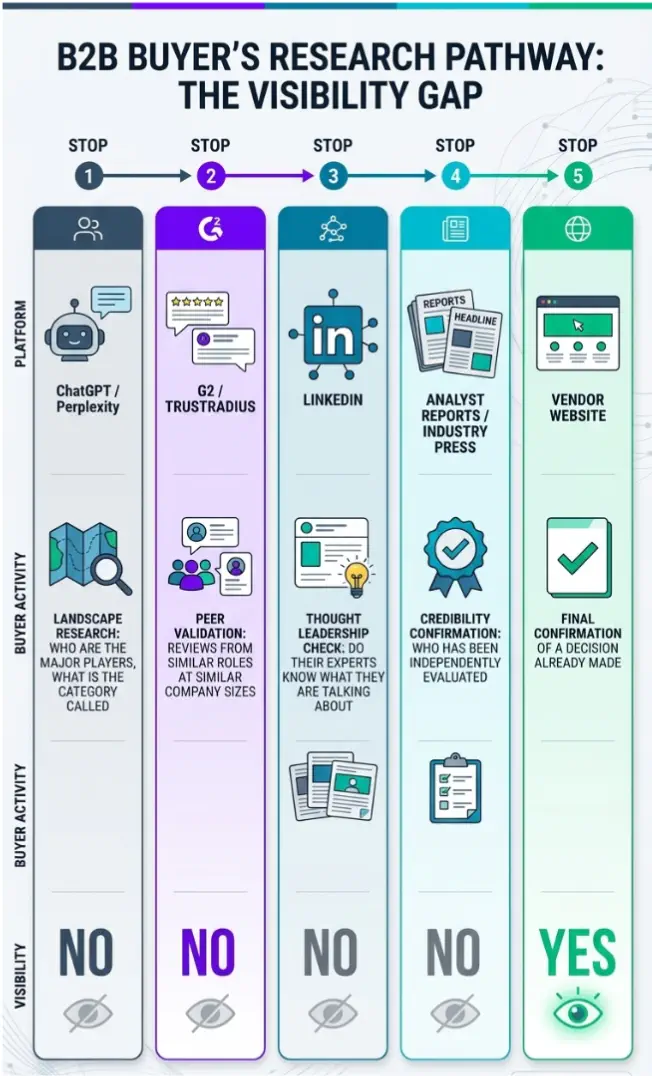
Sales enters this process at step five, and only if the vendor survived every prior filter.
The buying group makes this harder to track
On average, 13 people are involved in a B2B buying decision, with 89% of purchases involving two or more departments. Each runs their own version of the sequence above. A CFO searches for ROI benchmarks. A security architect queries compliance certifications. A department head looks for peer reviews from operators at comparable companies.
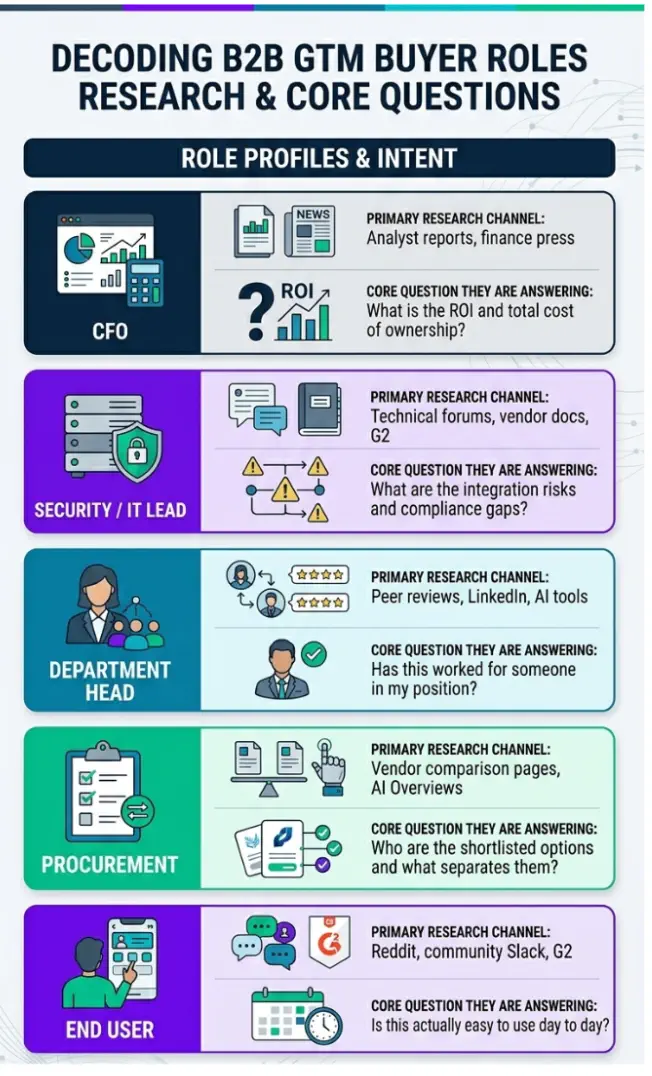
Their discovery paths never converge in a way any single analytics tool can reconstruct. By day one of the formal buying process, buyers have already placed about four out of five vendors on their shortlist, and 95% of the time the winning vendor is already on that list.
If your brand is not present and credible before that shortlist forms, you are not losing deals late in the process. You are being excluded before the process begins.
What Do B2B Buyers See When They Search, and Where Do They See It?
B2B buyers no longer scroll through ten blue links and choose where to click. They receive a synthesized answer, complete with vendor citations, before they visit a single website.
The surface where that answer appears determines which brands exist in the buyer's consideration set and which ones simply do not.
This shift has a precise name in search architecture: the zero-click result. And it has become the dominant format for B2B research queries.
83% of AI Overview searches result in zero clicks. The click-through rate for the number one organic ranking dropped from 0.73 to 0.26 after AI Overviews launched, a 64% decline in click-through value. Read that again slowly.
A brand that spent years and significant budget earning the top organic position on Google now receives less than a third of the traffic that position used to guarantee. The rules of visibility changed, and most B2B marketing teams are still playing by the old ones.
Where buyers actually encounter your brand
The discovery surface has fractured across several distinct channels, each with its own logic for what gets cited and why.
- Google AI Overviews appear at the top of search results for most informational and comparison queries. When a buyer searches "cloud ERP vendors for manufacturing companies," they receive a synthesized paragraph that names three to four providers, pulled from sources Google's system considers authoritative. 72% of buyers now encounter Google AI Overviews as part of their research process, and 90% of those buyers click through to sources featured in those AI answers. Being cited inside the Overview is what drives traffic now. Ranking below it is increasingly irrelevant.
- ChatGPT, Claude, and Perplexity function differently. Buyers use these tools for longer, more specific queries: "compare Salesforce and HubSpot for a 50-person B2B sales team with a $30K budget" or "what are the risks of switching HRIS vendors mid-year." These queries are conversational, budget-aware, and role-specific. The brands that appear in these answers are not the ones with the highest domain authority. They are the ones whose content is structured, quotable, and aligned with the precise language buyers use when they are deep in a purchase decision.
- LinkedIn operates as a parallel discovery channel. Buyers search for practitioners who have written about a vendor, look for connection-level recommendations, and assess thought leadership as a proxy for product credibility. A company with no visible subject matter experts on LinkedIn is invisible to the portion of the buying group that uses social proof to validate technical choices.
- Review platforms, particularly G2 and TrustRadius, function as the peer validation layer. They are where the shortlist gets stress-tested. A buyer who found your brand in a ChatGPT response will cross-reference it on G2 within the same research session. 40% of buyers say AI makes it easier to find information, and 80% say they trust AI tools at least sometimes, up 19 points year over year. That trust in AI-surfaced information makes the initial citation more important than ever, but peer reviews remain the confirmation mechanism that converts a cited name into a shortlisted vendor.
The concentration problem
Here is the dynamic that makes AI-era visibility so unforgiving for brands that are not already present. AI platforms cite only three to four brands per response on average, with the top 20 domains capturing 66% of all AI citations.
This is a winner-takes-most structure. A small number of brands dominate AI-generated answers across a category. Everyone else is effectively absent from the research phase entirely.
This is where Answer Engine Optimization (AEO) and Generative Engine Optimization (GEO) become operational disciplines rather than experimental ones. AEO is the practice of structuring content so that AI systems can extract, summarize, and cite it in direct response to buyer queries.
GEO is the broader work of building your brand's presence across the sources that AI systems draw from when constructing answers: authoritative publications, analyst databases, structured data on your own properties, and consistent entity signals across the web.
Neither discipline replaces traditional SEO. They extend it into the channels where buyers now spend the most consequential hours of their purchase journey.
Only 11% of B2B brands have the majority of their content AI-discovery ready, according to 10Fold's 2025 AI-First, Buyer-Ready report. The gap between brands that are visible to AI systems and those that are not is wide, and it is growing wider every month that passes without deliberate investment in structured, citable content.
If a buyer cannot find your brand in the channels where they are actually looking, your pipeline problem is not a sales problem. It is a visibility problem that sits upstream of every metric your revenue team tracks.
How Do B2B Buyers Build Brand Perception Before They Contact Sales?
Brand perception in B2B used to be built through repeated exposure: trade show presence, display advertising, cold outreach, and a well-designed website. Buyers formed impressions over months of deliberate vendor communication. That model assumed the vendor controlled the narrative.
They no longer do.
Today, a buyer forms a working impression of your brand through signals they encounter independently, in channels you do not own, before your marketing team knows they exist. By the time a prospect fills out a demo request form, their perception of your company is largely fixed. The demo is not an introduction. It is an audition for a role the buyer has already cast in their head.
The pre-contact favorite wins the deal roughly 80% of the time, and 95% of winning vendors were already on the buyer's Day One shortlist. Perception is not built during the sales cycle. It is built before it starts.
What signals actually shape perception?
Buyers do not weigh all information equally. A clear hierarchy of trust has emerged across thousands of B2B purchase journeys:
- Peer Validation & Reviews: Unbiased feedback from existing users.
- AI Citations & Expert Synthesis: Where AI tools place your brand in context.
- Analyst Reports & Press: Third-party validation from industry authorities.
- Vendor-Owned Content: Your website, blogs, and case studies.
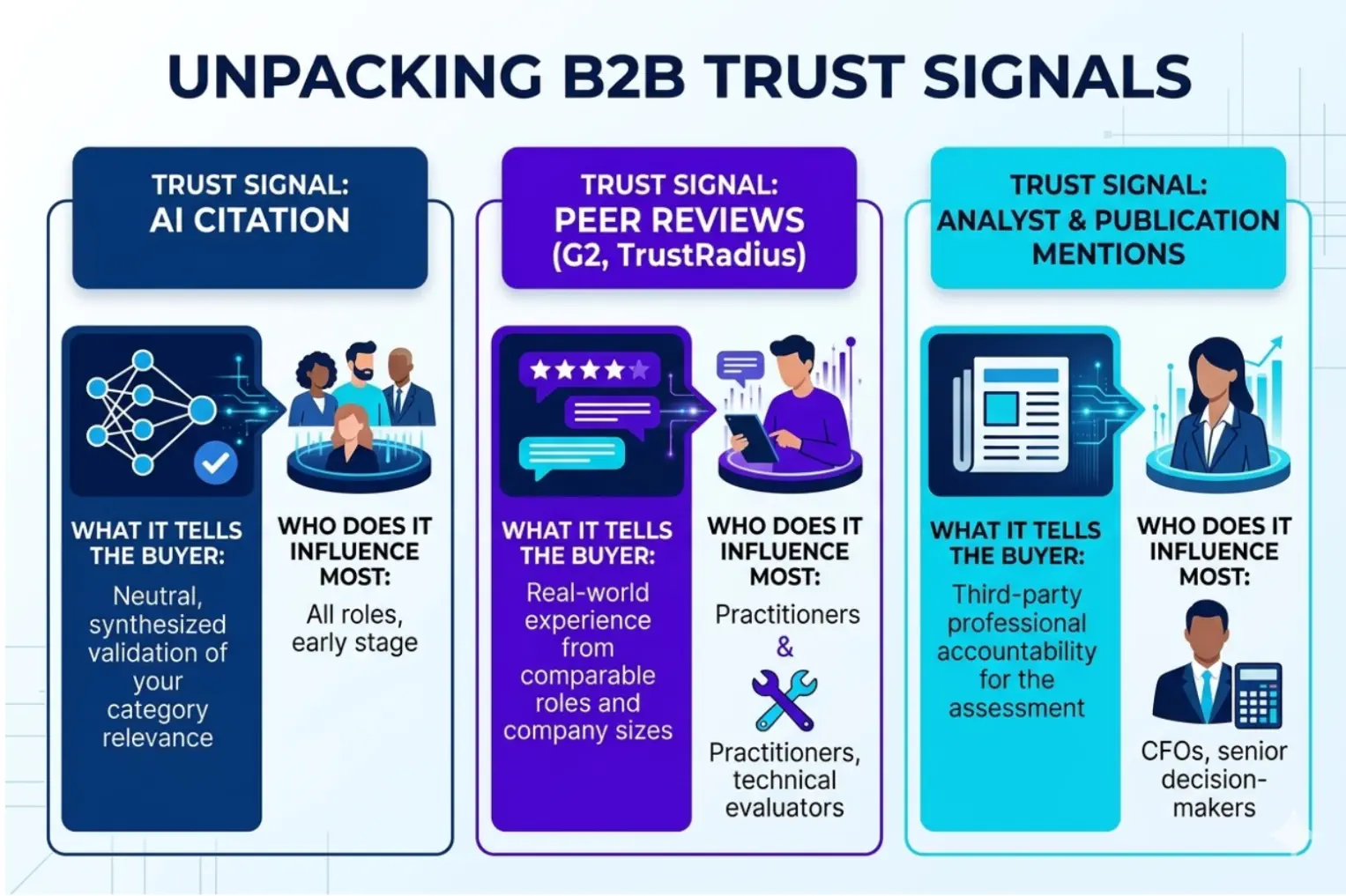
The order matters as much as the list. Vendor-owned content lands last. It is not ignored, but it is read through the lens of everything the buyer already believes from the first three sources. If those sources have built a credible picture, your website confirms it. If they have not, your website cannot rescue the perception gap on its own.
45% of B2B buyers reported using AI during a recent purchase, and buyer journeys are becoming more self-directed and digitally mediated. Self-directed journeys place peer validation at the center of the trust architecture because there is no sales rep present to provide reassurance. 79% of B2B purchases require CFO approval, which is why analyst and publication mentions carry disproportionate weight at the senior level. CFOs trust professional accountability over vendor claims and AI citations over both.
How budget and industry maturity filter perception
Perception is not formed in a vacuum. A buyer's budget and their industry's category maturity shape what signals they prioritize.
A buyer with a $15,000 annual software budget evaluating their first project management tool will lean heavily on review platforms and use AI tools to shortcut a category they are new to.
A CFO-led buying group at a mid-market manufacturer evaluating a $400,000 ERP implementation will prioritize analyst coverage, vertical reference customers, and implementation partner reputation.
Same research instinct. Completely different inputs. Almost 95% of buyers anticipate using GenAI to support their decision and purchase process. The sophistication of how buyers use AI varies by deal size and seniority. The fact that they use it does not.
The entity problem most B2B brands have not solved
Underlying all of this is a structural issue that neither a content calendar nor a paid media budget can fix alone.
AI systems cite brands they can clearly identify as entities: a consistent name, a defined area of expertise, verifiable credentials, and coherent mentions across authoritative sources. When these signals are absent or contradictory, AI systems cannot confidently include your brand in a synthesized answer, regardless of how strong your product actually is.
Only 11% of B2B brands have the majority of their content AI-discovery ready. For most companies, this is not a content quality problem. It is a content architecture problem. The information exists somewhere-it has simply never been structured in a way that makes it machine-readable, consistent, and citable.
Forrester recommends expanding the scope of SEO into Generative Engine Optimization, including building FAQs, comparison pages, and expert content that aligns with the types of prompts AI systems are likely to receive from business users. That is entity work. It is the foundational layer that determines whether your brand shows up in the AI-mediated research process, where perception is now built.
A buyer who never encounters your brand in that process does not have a negative perception of your company. They have no perception at all. In a market where the pre-contact shortlist decides 95% of deals, that absence is the most expensive problem a B2B brand can have.
What Role Does AI Play in B2B Product and Service Discovery Today?
AI is not a research aid that sits alongside the buying process. It is the buying process, at least for the phase that matters most.
94% of B2B buyers now use large language models during their purchase journey. This is not early adopter behavior confined to technology verticals. It is the default research posture across industries, company sizes, and buying group roles. The buyer who opens ChatGPT before they open your website is not an exception. They are your average prospect.
The function AI performs in discovery is specific. It compresses the landscape research that previously took days of reading into a single synthesized response. A buyer who would have spent a week reviewing analyst reports, vendor websites, and peer forums now gets a working framework for the category in minutes.
B2B buyers are adopting AI-powered search at three times the rate of consumers, with 90% of organizations now using generative AI in some aspect of their purchasing process.
The downstream implication for the GTM strategy is significant. By 2028, Gartner projects that 90% of B2B buying will be intermediated by AI agents, with $15 trillion in B2B spend flowing through AI agent exchanges.
The vendor relationship is increasingly mediated by a system that your sales team cannot charm, your brand advertising cannot reach, and your outbound sequence cannot interrupt.
What AI cannot do is replace the final validation conversation. Buyers still want a human confirmation once the shortlist is set. The role of sales has not disappeared. It has compressed into a later, shorter, higher-stakes window where the buyer arrives already informed, already skeptical of generic pitches, and already close to a decision.
Discovery belongs to AI now. The question is whether your brand shows up when it happens.
What Does a GTM Strategy Look Like When the Funnel No Longer Applies?
The funnel told sales and marketing teams where to focus energy: generate awareness at the top, nurture leads through the middle, and close at the bottom. That logic held when vendors controlled information flow. It does not hold when buyers arrive pre-informed, pre-shortlisted, and pre-skeptical of anything that feels like a pitch.
Rebuilding GTM around AI-mediated buying requires three concrete shifts.
The first is investing in content that AI systems will actually cite. Forrester is explicit on this point: content that is authentic, specific, and quotable is more likely to be cited in AI-generated responses. That means long-form expert content built around the precise questions buyers submit to AI tools. FAQ structures, direct-answer formats, comparison pages, and data-rich analysis. Not thought leadership written for human readers skimming LinkedIn. Content written to be extracted, summarized, and attributed by a machine.
The second shift is building peer validation infrastructure before you need it. Reviews on G2 and TrustRadius, published case studies with named customers, and consistent presence in analyst coverage do not happen reactively. They require deliberate investment well before a buyer's research session begins.
The third is repositioning sales entirely. Buyers are progressing through critical buying tasks in more autonomous ways, and sellers cannot rely on static collateral to carry influence in those moments, according to Gartner's 2026 sales research.
A buyer arriving from an AI-informed research process does not need to be educated about your category. They need a specific, credible answer to a specific, informed question. Sales teams built for discovery-mode conversations will struggle with buyers who arrive in validation mode.
The funnel assumed buyers needed guidance. They no longer do.
The Funnel Is Gone. Where Do You Start?
Most B2B companies reading this will recognise the problem before they recognise the solution. The buying behavior described in this piece is not theoretical. It is happening right now, in active purchase cycles, with real budgets attached. The question is not whether to respond to it. The question is where to begin.
The lowest-hanging fruit is not a content overhaul or a full GTM restructure. It is an audit of what AI systems currently say about your brand.
Open ChatGPT, Perplexity, and Google AI Overviews. Type the category questions your buyers are most likely to ask:
- "Best [your category] tools for [your target industry]."
- "How do companies solve [the problem you solve]?"
- "Compare [you] versus [your top competitor]."
If your brand does not appear in those answers, you now know exactly where your pipeline is leaking. If it does appear, read what is being said carefully. AI systems synthesize what they find. What they say about you reflects what the broader web says about you.
From there, three starting points will produce the fastest visibility gains:
- Structure your existing content for extraction. Add FAQ sections to your highest-traffic pages. Rewrite service and product pages with direct-answer openings. Use schema markup so AI crawlers can parse your expertise, your credentials, and your entity clearly.
- Activate your review presence. A G2 or TrustRadius profile with fewer than ten recent reviews is functionally invisible to both buyers and the AI systems that pull peer validation signals. A focused three-month review generation push costs almost nothing and compounds indefinitely.
- Publish one authoritative, data-referenced piece per month on the core question your buyers ask AI tools most often. Not a product page. A genuine answer to a genuine question, written with enough specificity that an AI system would trust it as a source.
Forrester describes AI-powered search as potentially the largest expansion of the media footprint since the advent of social media. The brands that move early on AI visibility will occupy citation positions that become progressively harder to displace as AI systems reinforce existing authority signals over time.
The funnel rewarded brands that could outspend competitors on awareness. The AI-mediated buying era rewards brands that can out-answer them. That is a more level playing field than most B2B marketers have seen in a decade, and the window to claim a position in it is still open.
Frequently Asked Questions
Is the B2B sales funnel completely obsolete, or does it still have a role? The funnel is not useless as a mental model for internal planning. It breaks down as a description of how buyers actually behave. Buyers do not move linearly from awareness to decision. They research independently, form preferences early, and engage sales only to confirm a choice already made. Teams that plan pipeline stages internally can still use funnel language. Teams that design buyer experiences around it will consistently misallocate budget toward channels buyers have already moved past.
How long does it take to see results from AEO and GEO investment? Longer than paid media, shorter than traditional SEO authority building. Structured content changes like FAQ schema, direct-answer page formatting, and entity consolidation can influence AI citation behavior within six to ten weeks. Review platform presence compounds over three to six months. Analyst and publication mentions take longer but carry the highest citation weight. The fastest return comes from the audit described in the conclusion: knowing where you currently stand costs nothing and tells you exactly where to focus first.
Does company size affect how urgently this applies? Smaller B2B companies arguably face more urgency, not less. Enterprise brands carry existing name recognition that partially compensates for weak AI visibility. A 20-person SaaS company competing against a Salesforce or SAP has no such buffer. If an AI system does not cite you, a buyer evaluating your category may never know you exist. Early investment in AI visibility is one of the few GTM levers where a smaller brand can claim authority before larger competitors consolidate citation positions.
What is the difference between AI SEO, AEO, and GEO in plain terms? AI SEO is the broad practice of optimizing content so AI systems surface your brand favorably. AEO, Answer Engine Optimization, focuses specifically on structuring content to answer direct questions buyers ask AI tools. GEO, Generative Engine Optimization, focuses on building brand presence across the external sources that AI systems draw from when generating responses. All three overlap. Think of AI SEO as the strategy, AEO as the on-page execution, and GEO as the off-page authority work.
Should B2B companies stop investing in traditional SEO? No. Traditional search still drives meaningful traffic, particularly for bottom-funnel queries where buyers are cross-checking information they have already gathered from AI tools. The shift is in where to place incremental investment. Optimizing for AI citation and optimizing for traditional search rankings now require separate but complementary workstreams, and most B2B content teams are only running one of them.
Sources
- Forrester: The State of Business Buying 2024
- Corporate Visions: B2B Buying Behavior Statistics & Trends
- 6sense: Buyer Experience Report 2025
- Google: AI-powered search and generative experiences
- McKinsey & Company: The State of AI
- Gartner research coverage (via Digital Commerce 360): Gartner research agentic AI marketing


