
Here's a number that should bother anyone spending real budget on trade shows and conferences. 80% of trade show leads never get a personalized follow-up, according to research from the Center for Exhibition Industry Research. Eighty percent. And 81% of trade show attendees actually have buying authority. So most of the good stuff you paid to collect just sits there, forgotten, while a competitor who followed up gets the meeting instead.
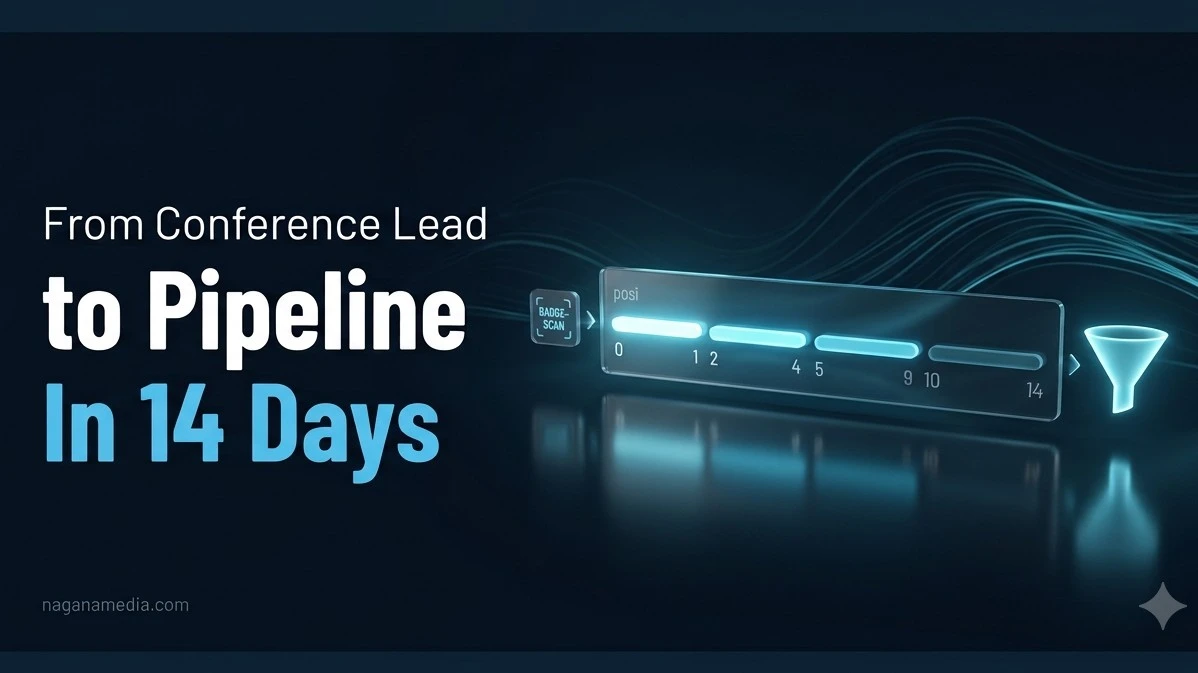
The fix isn't complicated. It's a content system, built ahead of the event, ready to fire the moment a lead comes in. Fourteen days, four stages, done right.
Why Speed Matters More Than People Think
Leads contacted within the first 24 to 48 hours are roughly 60% more likely to convert than leads contacted later. That's a real, measurable gap, and it's almost entirely about memory. A conversation at a booth is vivid for about two days. After that, it starts blurring into every other booth conversation that person had that week. Wait a week to follow up, and you're not reconnecting anymore. You're reintroducing yourself to someone who's already half-forgotten who you are.
The Segmentation That Has to Happen Before Any Content Goes Out
Not every lead deserves the same follow-up. Trying to run one sequence for everyone wastes your best content on people who aren't ready for it, and buries your fastest movers behind a slow, generic cadence.
Hot leads: had a real conversation, discussed a specific problem, asked about pricing or a demo, mentioned an actual buying timeline. These convert at 15 to 25% from a genuine on-site conversation. Send the hot-lead content same day, or the next morning at the very latest.
Warm leads: had a decent conversation, showed real interest, but no concrete timeline or specific ask. These need a couple of days of breathing room, roughly 48 to 72 hours, so your note lands after the initial flood of generic "great meeting you" emails everyone else sends immediately.
Cold or scan-only leads: badge scanned, no real conversation happened. These convert at under 2%, and they belong in a longer, lighter, content-led nurture, not a sales cadence at all.
The 14-Day Structure, Stage by Stage
Days 0 to 1: the recognition touch. This isn't a sales pitch. It's proof you were actually listening. Reference the specific thing they said, the specific problem they mentioned, not "great meeting you at the conference." Attach one piece of content directly tied to what they brought up, a one-pager, a short case study, whatever's most relevant to the exact conversation you had. Generic templates get deleted. Specific references get opened.
Days 2 to 4: the value-first follow-up. For hot and warm leads, this is where a genuinely useful asset goes out. Not another pitch. Something that helps them do their own internal thinking: a short benchmark relevant to their industry, a specific framework, a calculator if that fits your category. Treat these as conversation starters and real problem-solving tools, not disguised sales collateral. That distinction is more obvious to the reader than most marketers assume.
Days 5 to 9: the second touch, different channel. If email hasn't landed yet, don't just send another email. Add a LinkedIn connection request referencing the actual conversation or session topic, not a generic "great to connect" note. Multichannel sequencing, email plus LinkedIn, plus a call for genuinely hot leads, consistently outperforms sticking to a single channel. For your highest-value prospects, this is also the window where a physical touch, a handwritten note or a relevant piece of mail, can cut through in a way digital never quite manages anymore.
Days 10 to 14: the clear-ask close. By this point, the lead either engages or doesn't. This final touch should have one specific, low-friction ask. Not five competing options. One clear next step. If there's still no response, this is the natural point to shift the lead into a longer nurture sequence rather than continuing to burn rep time on someone who isn't ready yet.
The Operational Piece Most Teams Skip
None of this works if the lead data itself is a mess. If you're not capturing enough detail at the actual scan, industry, specific pain point discussed, urgency level, your team spends the first week just sorting through spreadsheets instead of sending anything. That sorting delay alone is often the difference between the 60%-more-likely 48-hour window and missing it entirely.
Tag every lead with event name, source, and a rough temperature rating the moment it's captured, ideally by the person who actually had the conversation, not someone reconstructing it later from a badge scan. That single habit is what makes the 14-day system executable instead of aspirational.
What "Content" Actually Means in This System
This isn't about writing five new blog posts for every event. It's about having a small, flexible library ready in advance: two or three industry-specific one-pagers, one short benchmark or calculator relevant to your category, a case study that maps to your most common booth conversation, and short video or LinkedIn-native versions of each. Built once, before the event, then deployed based on which lead segment and which day in the sequence a specific contact falls into.
Why This Also Feeds Your AI Search Visibility
Here's a connection worth making. The specific one-pagers and case studies built for this system, once slightly generalized, are exactly the kind of proof content that earns AI citations later. A benchmark stat built for a hot-lead follow-up email is the same kind of specific, attributable data point an AI model favors when assembling an answer to a buyer's research query. Content built to close a conference lead this quarter can, with minimal rework, become part of your broader AEO content library next quarter. Most teams never make that connection and end up rebuilding the same proof twice.
Frequently Asked Questions
How quickly should a B2B company follow up with a trade show lead?
Within 24 to 48 hours for hot leads, ideally the same day or the next morning. Leads contacted in this window are roughly 60% more likely to convert than leads contacted later, largely because the specific conversation is still fresh in the buyer's memory rather than blurred into a week of other booth interactions.
Why do 80% of trade show leads never get proper follow-up?
Mostly operational gaps, not a lack of intent. Poor data capture at the scan, no clear lead segmentation, and slow manual triage mean that by the time a team sorts through who's actually worth contacting, the 48-hour window that drives higher conversion has already closed. Fixing the capture process at the event itself is usually a bigger lever than fixing the follow-up emails.
How should lead segmentation affect the follow-up content sent?
Hot leads, real conversation with a specific problem and buying timeline, should get immediate, highly specific follow-up same-day. Warm leads need a short delay, 48 to 72 hours, so the note lands after the initial flood of generic emails. Cold or scan-only leads convert at under 2% and belong in a longer, lighter nurture track rather than a sales-driven cadence.
What content assets should be built before the event, rather than after?
Two or three industry-specific one-pagers, a short benchmark or calculator relevant to the category, a case study mapped to the most common booth conversation, and short video or LinkedIn-native cuts of each. Building this small library in advance means the 14-day sequence can fire immediately rather than waiting on content production after the event has already ended.
How does event follow-up content connect to AI search visibility?
The same specific proof points, benchmarks, and case studies built for post-event follow-up sequences are often exactly the kind of attributable, specific content that earns AI citations when generalized slightly for broader use. A benchmark stat built for a hot-lead email today can become part of a comparison page or FAQ content next quarter, saving the work of building similar proof content twice.
References
TofuHQ, How to Automate Post-Conference Follow-Up at Scale in 2026, SalesHive 24-to-48-hour conversion benchmark and CEIR follow-up statistics: https://www.tofuhq.com/post/how-to-automate-post-conference-follow-up-at-scale Vendelux, Trade Show Lead Generation: A B2B Pipeline Operator's Guide, lead temperature conversion rate benchmarks and scan-to-triage timing data: https://vendelux.com/event-marketing/trade-show-lead-generation Default, Event Follow-Up Email: Templates, Timing and Best Practices, multichannel sequencing and SLA-driven timing framework: https://www.default.com/post/event-follow-up-email Smartlead, Trade Show Follow-Up Email Templates That Convert, CEIR 80% no-follow-up statistic and five-touch conversion research: https://www.smartlead.ai/blog/trade-show-follow-up-email


