
I have sat in more content strategy meetings where somebody asks "what should we write next?" before anyone has answered "what are we actually trying to say?" than I care to count. It's a very easy trap to fall into. The calendar needs filling. The social queue is empty. The blog hasn't been published in three weeks, and someone is about to notice. So the conversation skips straight to topics, formats, and deadlines, and the underlying question, what does this company stand for and who exactly are they talking to, never quite gets answered.
The messaging document is the answer to that question. It doesn't replace a content strategy, but nothing in the content strategy works reliably without it.
What Is a Messaging Document?
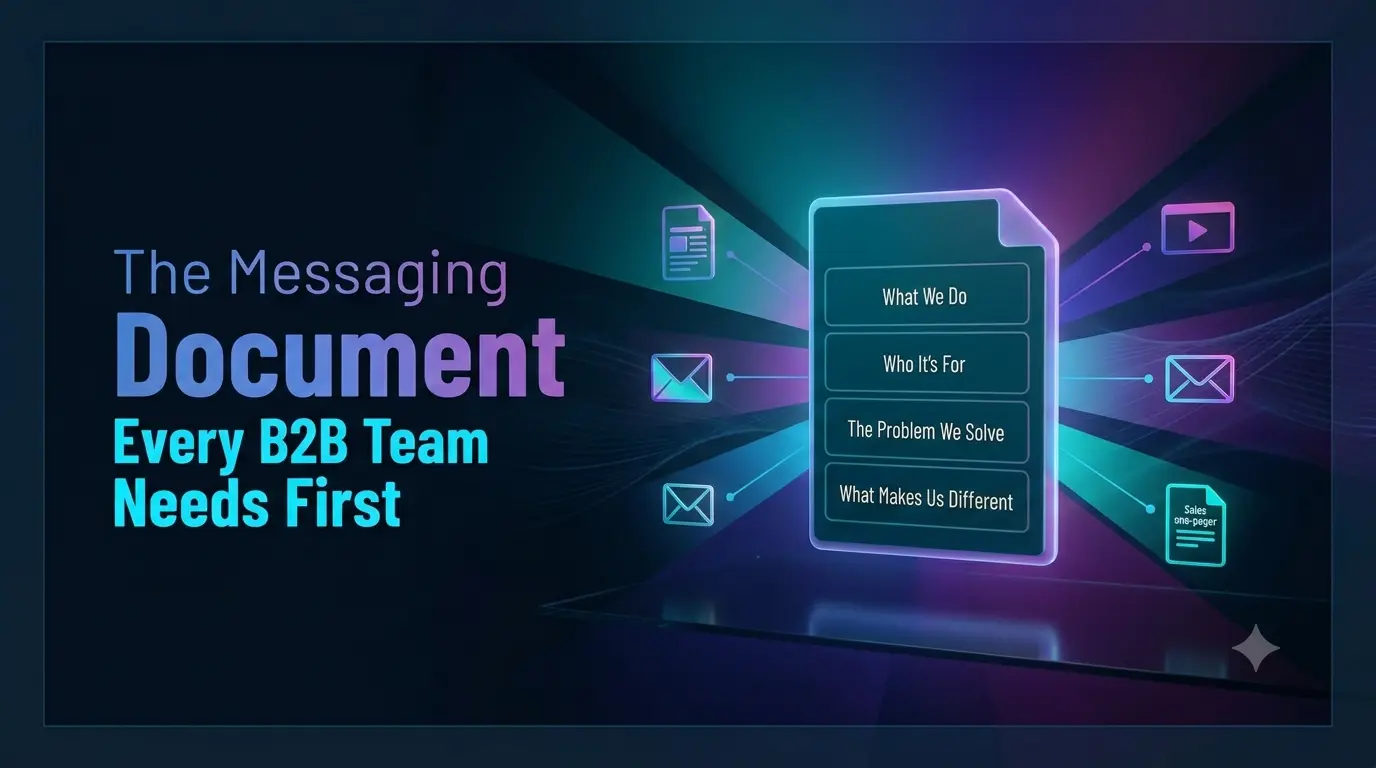
A messaging document is a single, agreed-upon reference that captures what your company does, who it does it for, why that matters to those people, and what makes your approach different from every alternative they're considering. It is not a brand manifesto or a mission statement. It's the working document your content team, your sales team, and your product team can all point to when they need to know what to say, in which order, to which audience.
The reason this needs to exist in writing, specifically, is that in its absence, everyone is working from their own mental version of the company's story, and those versions diverge quickly and quietly across teams until you have a blog that sounds nothing like the sales deck, which sounds nothing like the website, which sounds nothing like the email sequence.
Why Most Content Underperforms Before It's Even Written
CMI's 2025 research found that 42% of B2B marketers with moderate or lower content success cite a lack of clear goals as a contributing factor to that underperformance. And 45% say they lack a scalable model for content creation, while only 35% say they have one. Those numbers look like execution problems, but they're mostly upstream problems wearing execution clothes. If the team doesn't have a clear answer to "what are we saying," no production system in the world reliably produces content that resonates.
74% of B2B marketers who improved their content performance did it by refining strategy first, before adding new channels, new tools, or new team members. The messaging document is where that strategy refinement begins, because it forces the team to agree on what they're saying before anyone writes a single headline.
The Four Things It Has to Answer
A messaging document that actually works has four specific pieces. Not a style guide. Not a persona library. Four things.
What does the product actually do, in one sentence that a potential customer would recognize? Not "an AI-powered platform that transforms your go-to-market strategy," which says nothing. Something like "a content workflow tool that connects your blog to your sales team's email queue so the same research produces both." Specific enough that a stranger could describe it to a colleague after reading it once.
Who is this for, with the level of specificity that makes someone say, "That's me." Not "marketing teams at B2B technology companies." Something like "heads of content at B2B SaaS companies with a team of two to six people who are being asked to produce more without being given more budget." The more specific the description, the more clearly it excludes people who are not the right fit, which is the part that makes people who are the right fit feel found.
The specific problem you solve, in the customer's language, not yours. This is the hardest part of the document to write well, because it requires actually talking to customers rather than inferring their experience from the inside. What do they say when they describe the problem your product addresses? The exact words matter because those words are the ones they type into search engines and AI platforms when they're looking for a solution.
What makes your approach different, stated as a claim, someone could push back on. Not "the most comprehensive solution on the market." Something like "we're the only tool built for two-person content teams rather than for enterprise marketing departments" or "we publish updated competitive benchmarks every quarter rather than selling annual licenses to three-year-old data." A claim that someone could say "that's not true" about is also, necessarily, a claim that differentiates. Claims nobody could push back on differentiate nothing.
The Part That Requires the Most Honest Work
Getting the "problem statement in the customer's language" right is the piece I spend the most time on with clients, because it rarely matches what the marketing team initially writes.
Marketing teams tend to describe the problem in functional terms: the process is slow, the tools don't integrate, the reporting is opaque. Customers tend to describe it in emotional or consequence terms: "I have no idea if what we're producing is actually helping sales," "I feel like we're just making content for the sake of making content," "I'm terrified we're going to miss a deadline, and I can't even tell whether the team is on track."
The functional description is easier to write. The consequence description is harder to get to, but it's what makes someone reading the messaging document feel like the company actually understands their situation, rather than just knowing about their software stack. That distinction is the whole game in content that resonates versus content that exists.
How to Use It Once You Have It
The messaging document is not a strategy deck to be reviewed once and filed. It's a working reference that should sit next to every brief written, every blog post planned, every email campaign designed. When a new piece of content isn't landing, the first diagnostic question should be: Does this match the messaging document? When a piece of content lands really well, the follow-up question should be: what specifically did it say that the messaging document predicted would resonate?
It should also be the thing that goes to a new content hire on day one, before they write anything, because it's the fastest way to transfer the company's position from the people who built it to the people who now need to sustain it. A new writer who has internalized the messaging document is not starting from zero. A new writer who hasn't is, regardless of how talented they are.
Frequently Asked Questions
What's the difference between a messaging document and a brand voice guide?
A brand voice guide describes how to say things, tone, vocabulary, and style preferences. A messaging document describes what to say, the core arguments, audience framing, problem definition, and differentiation. Both are useful, but a brand voice guide without a messaging document produces content that sounds consistent without saying anything meaningful.
How long should a messaging document be?
Short enough that people actually use it. One to two pages for most early-stage and growth-stage B2B companies. The temptation is to make it comprehensive, capturing every nuance of every segment and every use case. The result of that temptation is a document too long to reference in real time, which means it doesn't get referenced. A single-page working version with the four core pieces serves most teams better than a forty-page architecture nobody reads under deadline.
Who should own the messaging document?
Usually, the head of marketing or the person closest to the intersection of product and customer, but it should be built with input from sales and customer success, because those teams hear the actual language customers use to describe the problem being solved. The worst messaging documents are written entirely by marketing teams who haven't talked to customers recently.
How often should it be updated?
Review it whenever something significant changes, a product pivot, a shift in ICP, a new competitive entrant that changes how you differentiate, or when content consistently underperforms, and you can't explain why by looking at execution alone. For most B2B companies, a substantive review every six to twelve months is reasonable. Small language refinements can happen continuously.
Can AI tools help build the messaging document?
They can help with structure and with surfacing patterns from existing content, but the core work, agreeing on what the company actually does and for whom and why it's different, is a human conversation that can't be delegated to a tool. AI can help you write cleaner sentences once you know what you want to say. It cannot tell you what you want to say.
References
Geisheker, B2B Content Marketing Strategy 2026, CMI research on strategic clarity and content performance: https://www.geisheker.com/b2b-content-marketing-strategy/
CommonPlaces, 2026 B2B Content Marketing Trends, CMI research on AI adoption and performance: https://www.commonplaces.com/blog/2026-b2b-content-marketing-trends
Big Moves Marketing, 8 B2B Messaging Framework Examples to Win Deals in 2026: https://www.bigmoves.marketing/blog/messaging-framework-examples


