
Here's a stat that should reorganize how you think about customer success content entirely. Roughly 68% of SaaS expansion, upsells, cross-sells, and seat growth happens at or around the renewal moment. Not in some separate "expansion motion" your team runs three months after the contract's already locked in. Right there, at renewal. Which means if your renewal content and your expansion content live in two different Trello boards, owned by two different people, you're fighting the actual shape of how this revenue shows up.
I'll flag something upfront, since I try not to pass along numbers I can't fully stand behind. That 68% figure circulates widely, usually attributed to an OpenView expansion study, but it mostly shows up in secondary write-ups rather than the primary source itself. Treat the exact number with a little skepticism. The direction, though? Extremely well supported across the board. Renewal is where expansion actually happens, whatever the precise percentage turns out to be.
Why Separating Renewal and Expansion Content Is Costing You Revenue
Companies that run renewal and expansion as one combined workflow see meaningfully higher net revenue retention than companies running them separately. Makes sense once you think about it. A renewal conversation that only defends the existing contract, no upsell content, no expansion framing anywhere in sight, treats a customer's realized value as something to protect rather than something to build on. And a customer who's gotten real value from your product is, at that exact moment, primed to hear about doing more of it. Not three months later, once the renewal paperwork's already signed and the moment's cold.
The reverse mistake is just as common, maybe more so. Chasing an upsell during renewal negotiation without first defending gross retention properly. If you're negotiating a bigger deal while quietly ignoring the fact that half your seats haven't logged in this quarter, you're building expansion revenue on a foundation that might not survive the next renewal cycle at all. Defend gross retention first. Grow net revenue retention second. In that order, not reversed.
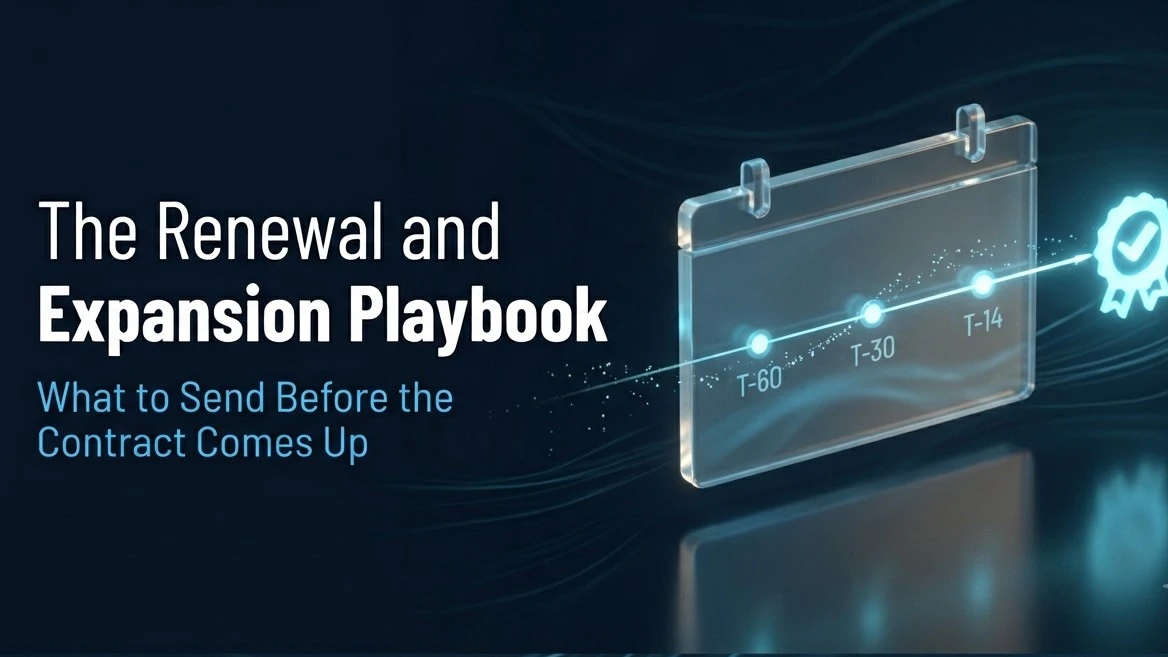
The Timeline That Actually Works: T-60, T-30, T-14
Here's the structure I keep coming back to with clients, because it maps cleanly onto how these conversations actually unfold in practice.
T-60: the value-review call. Sixty days out, before any renewal or pricing conversation starts. This is where you surface adoption gaps and put a number on realized ROI. The content need here is a customer-specific value summary, not a generic template. Specific: what they've achieved, framed in language that maps back to what they said mattered when they signed. If usage data shows gaps, this call, and the content backing it, name them directly instead of hoping nobody notices.
T-30: the bundled proposal. Thirty days out, the renewal proposal goes out, and here's the part most teams get wrong. It should bundle the renewal with an expansion or tier change whenever usage signals actually justify it, not as an afterthought bolted onto the renewal number. The content need: a combined proposal document that shows the baseline renewal and the expansion option side by side, with the expansion framed as the logical next step in a value conversation the customer's already having with themselves. Not a cold upsell pitch dropped in at the worst possible moment.
T-14: the negotiation. Two weeks out. This is where a longer contract term can be traded for better expansion pricing, when that trade genuinely makes sense for both sides. The content need here is thinner, more tactical: a one-page pricing comparison, term-length options laid out clearly, and whatever objection-handling material the account team needs to close without a full re-litigation of the entire relationship from scratch.
The Product-Qualified Signals That Should Trigger Content, Automatically
Waiting for a renewal date on the calendar to think about expansion content is reactive. The stronger approach ties specific product usage signals to specific expansion content, triggered automatically well before any renewal conversation is even scheduled.
An account hits 80% or more of seat capacity? That's a seat-expansion trigger. The content: a short, specific note showing what similar accounts unlocked after adding seats, not a generic "consider upgrading" email that could've been sent to literally anyone. An account adopts a power-user feature, webhooks, API access, whatever the advanced tier looks like in your product? That's an upsell trigger for the tier that includes deeper versions of that exact capability. One marketing automation platform built this pattern directly into their CS workflow: usage threshold hit, CSM gets an alert, proposes a tier change. Expansion ARR went from 20% to 45% of total new ARR. Not from a better sales pitch. From content and process finally showing up at the actual moment the signal appeared, instead of three months later at a scheduled QBR nobody was excited about.
What the Content Itself Actually Needs to Say
Every piece in this playbook needs one thing threaded through it that most renewal content quietly skips: a direct, specific tie between what the customer already achieved and what expanding would compound. Not "renew because your contract's ending," which, sure, is true, but persuades nobody. Something closer to "here's what you got from year one, and here's specifically what doubling down would unlock," backed by their own usage numbers, not a generic case study borrowed from a completely different customer in a different industry.
This is also, worth saying, where a lot of B2B teams accidentally build some of their best AI-citable proof content without realizing it. A customer-specific ROI summary with real numbers is exactly the kind of specific, attributable material that earns trust, and increasingly gets surfaced when a prospective buyer runs a comparison query through an AI platform. The renewal deck you built for one customer's internal advocate can, with names changed and permission granted, become the anonymized proof point that helps close the next one. Content built for retention is doing double duty as content built for acquisition. Most teams never make that connection, and it's sitting right there.
Frequently Asked Questions
What's the right timeline for renewal and expansion content before a contract comes up?
A three-stage cadence works well for most B2B SaaS companies: a T-60 value-review call with a specific ROI summary, a T-30 bundled proposal combining the renewal number with an expansion option when usage justifies it, and a T-14 negotiation stage with tactical pricing and term comparisons. Running these as one connected sequence, rather than two separate workflows, is what actually drives higher net revenue retention.
Should expansion be pitched during the renewal conversation, or does that risk the renewal itself?
Bundle them, but in the right order. Defend gross retention first, meaning the renewal itself needs to be solid on its own, adoption gaps addressed, ROI clearly shown, before expansion enters the conversation. Once that foundation exists, expansion framed as the natural next step in an ongoing value conversation converts far better than a separate upsell pitch run months later, cold, with no connective tissue back to what the customer already knows works.
What product usage signals should automatically trigger expansion content?
Three of the most reliable: an account crossing roughly 80% of seat capacity, adoption of a power-user feature that signals readiness for a higher tier, and reaching a specific value milestone tied to your product's core metric. Each signal should map to a specific, pre-built content asset, not a generic upsell email, so the CSM or account manager has something ready to send the moment the signal fires rather than scrambling to write something from scratch.
How does renewal and expansion content connect to AI search visibility?
Customer-specific ROI summaries built for renewal conversations, once anonymized with permission, are exactly the kind of specific, attributable proof that AI platforms favor when assembling a comparison or recommendation answer for a prospective buyer. Content built purely for retention purposes can, with minimal rework, become genuinely strong AEO material. Most teams never make that connection and end up building the same kind of proof twice.
Is the widely cited 68%-of-expansion-happens-at-renewal statistic reliable?
Treat the precise figure with some caution. It circulates widely, generally attributed to an OpenView expansion study, but mostly appears in secondary aggregator content rather than a clearly sourced primary report. The underlying direction, that renewal is the natural trigger point for expansion conversations rather than a separate motion entirely, is well supported across the broader literature, even if the exact percentage shouldn't be treated as a precisely verified figure.
References
Digital Applied, SaaS Renewal Management: 2026 CRM Expansion Playbook, T-60/T-30/T-14 timeline framework and renewal-expansion combined workflow data: https://www.digitalapplied.com/blog/saas-renewal-management-2026-crm-expansion-playbook Directive Consulting, The 2026 Blueprint for Scalable B2B SaaS Marketing, product-qualified expansion signals and marketing automation platform case study: https://directiveconsulting.com/blog/blog-b2b-saas-marketing-guide-2026/ Arise GTM, The Complete B2B SaaS Go-To-Market Playbook for 2026, lifecycle system design and NRR benchmark context: https://arisegtm.com/blog/b2b-saas-go-to-market-playbook-2026 Userpilot, Customer Success Renewal Playbook for SaaS Companies, renewal playbook structure and expansion stage sequencing: https://userpilot.com/blog/customer-success-renewal-playbook/


