
I keep a small, embarrassing list of things I used to recommend confidently that turned out to be wrong, or at least not worth the time they took. Schema markup for AI visibility is now near the top of that list, and I want to start there, because if you've spent the last year adding structured data hoping it would move your AI citations, you're not behind. You were following sound, reasonable advice that the data has since complicated.
What Is AI SEO for HR Tech?
AI SEO for HR tech is the practice of structuring content so that platforms like ChatGPT, Perplexity, and Gemini can find, trust, and cite HR technology and HCM vendors when HR leaders and benefits administrators ask these tools for recommendations. The reason this matters specifically for HR tech: buyers in this category research heavily before ever talking to a salesperson, and the research increasingly starts with a conversational query, not a Google search.
The Schema Surprise
Here's the finding that reorganized how I think about this whole category. Schema markup has no measurable impact on AI visibility. Adding it produced no significant uplift across AI Overviews, AI Mode, or ChatGPT, according to research from SE Ranking published in late 2025.
I don't say this to suggest schema is useless; it still matters for plenty of traditional SEO purposes, and there's a reasonable argument that consistent structured data helps with broader entity clarity over time. But if your HR tech content strategy has been "add more schema and wait," that specific lever isn't the one doing the work. Something else is.
What's Actually Doing the Work
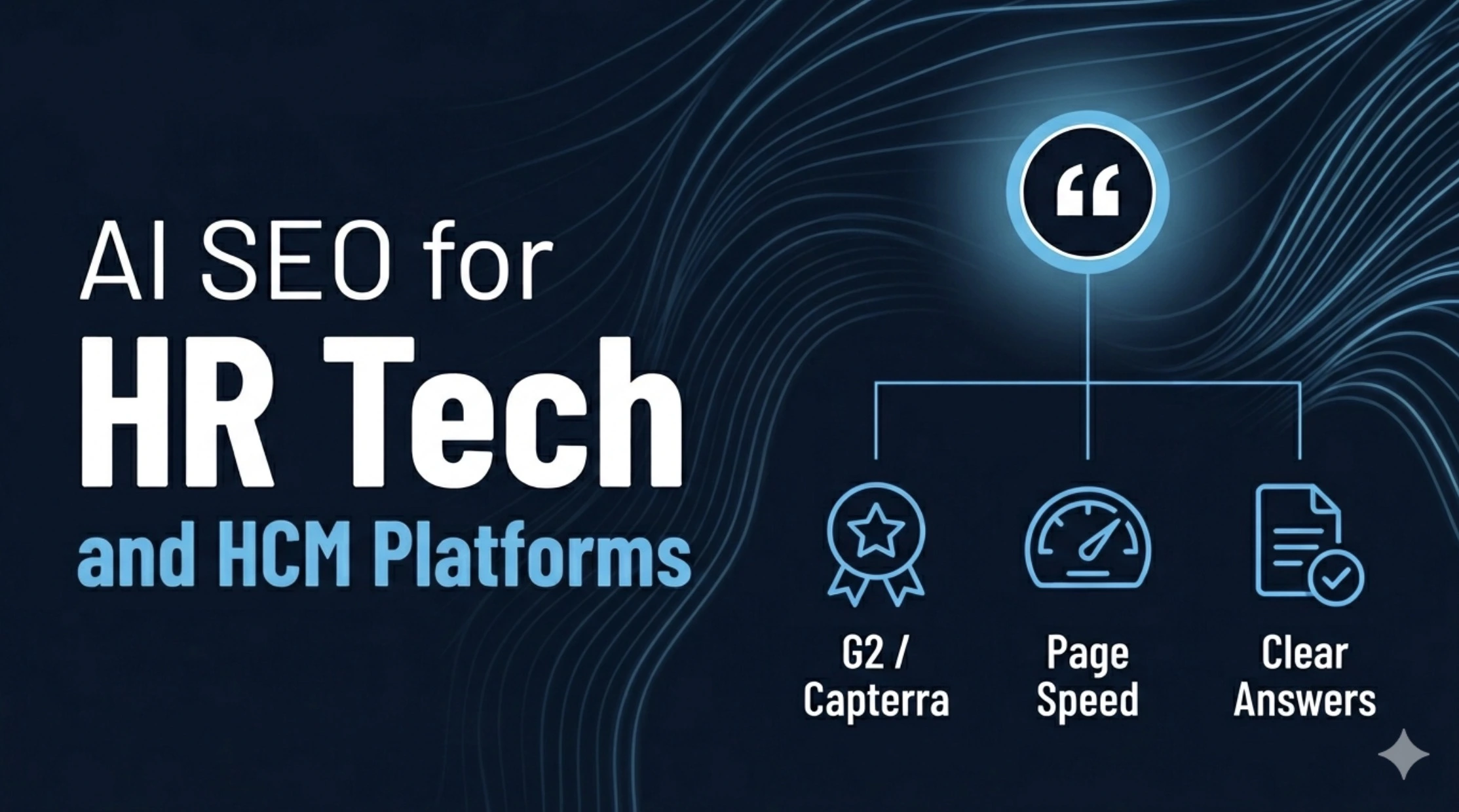
Three things kept surfacing across the research, and none of them are exotic or expensive to act on. Domains with a real presence on review platforms, G2, Capterra, and Trustpilot, have three times higher odds of being chosen by ChatGPT as a source compared to sites without that presence. For HR tech specifically, this tracks with something I've noticed working in this space for a while: HR buyers trust peer review more than almost any other B2B category, because they're the ones who'll have to defend the choice to their own leadership if it goes badly. A strong G2 profile isn't just a sales asset anymore. It's an AI citation asset too.
Page speed matters more than I expected it to. Pages with a first contentful paint under 0.4 seconds average 6.7 citations, while slower pages, over 1.13 seconds, drop to 2.1. That's roughly a three-times difference, attributable almost entirely to load speed. For HR tech platforms running content-heavy resource centers, this is worth an actual technical audit, not just a vague "we should look into performance sometime."
And the writing itself matters in a specific, almost old-fashioned way. ChatGPT favors content using definite language rather than vague hedging, content with a real question posed and answered, a healthy mix of fact and informed opinion rather than pure marketing copy, and sentence structures that are simple rather than dense. Early-discovery content with five to seven concrete statistics earns roughly a 20% higher citation likelihood than content light on numbers.
What This Looks Like for an HR Tech Company Specifically
Most HR tech buyers are researching one of a handful of recurring questions: which platform handles multi-state compliance well, which one integrates cleanly with their existing payroll provider, which one their peers actually recommend rather than just tolerate.
A page that buries the answer to "does this support multi-state compliance" three paragraphs into marketing copy is exactly the kind of vague, hedged content that underperforms in this research. A page that opens with a direct, specific answer, "Yes. This platform supports automated compliance tracking across all 50 states, with real-time updates when state-level requirements change," gives an AI model something concrete to lift and reuse.
The same logic applies to integration pages. "Seamlessly integrates with your existing systems" is the kind of sentence that sounds fine and does nothing. "Connects directly with ADP, Gusto, and Workday, with setup typically completing in under two business days" is a sentence a model can actually cite, because it's specific enough to be verifiably true or false.
The Review Platform Piece Deserves Its Own Moment
I want to come back to the G2 and Capterra point because I think it gets underweighted in HR tech specifically. This is a category where the buyer is often making a decision that affects every employee at their company, payroll, benefits, time off, performance reviews. That's a lot of downstream risk for one person to own. Peer validation isn't a nice add-on here. It's load-bearing.
If your G2 profile is thin, outdated, or hasn't had a new review in eight months, that's not just a missed marketing opportunity. Given the three-times citation odds difference, it's a structural gap in your AI visibility that no amount of blog content will fully compensate for. A focused push to get five or ten current, detailed reviews onto your G2 and Capterra profiles is, realistically, one of the highest-leverage things an HR tech marketing team could do this quarter.
What I'd Actually Prioritize, In Order
If I were starting from scratch with an HR tech client this month, here's the order I'd work in, based on everything above.
First, the review platform push is foundational, a trust signal that everything else builds on, and it has the clearest, most direct citation odds data behind it. Second, a real audit of page speed on the handful of pages that matter most, the integration pages, the compliance pages, the comparison pages. Three times the citations for sub-0.4-second load times is too large a gap to leave on the table for a technical fix.
Third, a rewrite pass on the existing content that's currently buried in hedged, vague language, replacing "industry-leading compliance support" with the actual specific claim underneath it, with a number or a named capability attached.
And only after those three, more new content. Not because new content doesn't matter, but because publishing more vague pages onto a foundation that's already missing trust signals and load speed is building on sand.
Frequently Asked Questions
Does schema markup help HR tech companies get cited by AI platforms?
Based on late 2025 research from SE Ranking, schema markup showed no measurable uplift in AI citations across AI Overviews, AI Mode, and ChatGPT. It may still serve other SEO purposes, but it shouldn't be treated as a primary lever for AI visibility specifically.
Why does G2 and Capterra presence matter so much for HR tech AI visibility?
Domains with profiles on review platforms like G2, Capterra, and Trustpilot have three times higher odds of being selected by ChatGPT as a citation source compared to domains without that presence. For HR tech specifically, where buyers are making decisions that affect their whole workforce, peer validation carries unusual weight, making review platform presence a meaningful AI visibility lever, not just a sales asset.
How much does page load speed actually affect AI citation rates?
Significantly. Pages with a first contentful paint under 0.4 seconds average 6.7 citations from ChatGPT, while pages slower than 1.13 seconds average only 2.1, roughly a three-times difference attributable to speed alone. For HR tech platforms with content-heavy resource sections, a technical performance audit can be a higher-leverage investment than additional content production.
What kind of writing style actually gets cited by AI platforms in the HR tech space?
Content using definite, specific language rather than vague hedging, structured around a clear question and direct answer, with a healthy mix of factual statements and grounded perspective rather than pure marketing copy. Content with five to seven concrete statistics shows roughly 20% higher citation likelihood than content without specific numbers.
Should HR tech companies prioritize new content or fixing existing pages first?
Fixing existing high-traffic pages, particularly compliance, integration, and comparison pages, generally offers faster returns than new content production. Replacing vague claims with specific, verifiable statements and addressing technical issues like load speed and review platform presence builds the foundation that makes new content more effective once it's published.
References
Position.digital, 150+ AI SEO Statistics for 2026: https://www.position.digital/blog/ai-seo-statistics/ SE Ranking, November 2025 research on AI citation factors, schema markup, page speed: cited via Position.digital, 2026 Growth Memo, February 2026, on AI citation language preferences: cited via Position.digital, 2026


