
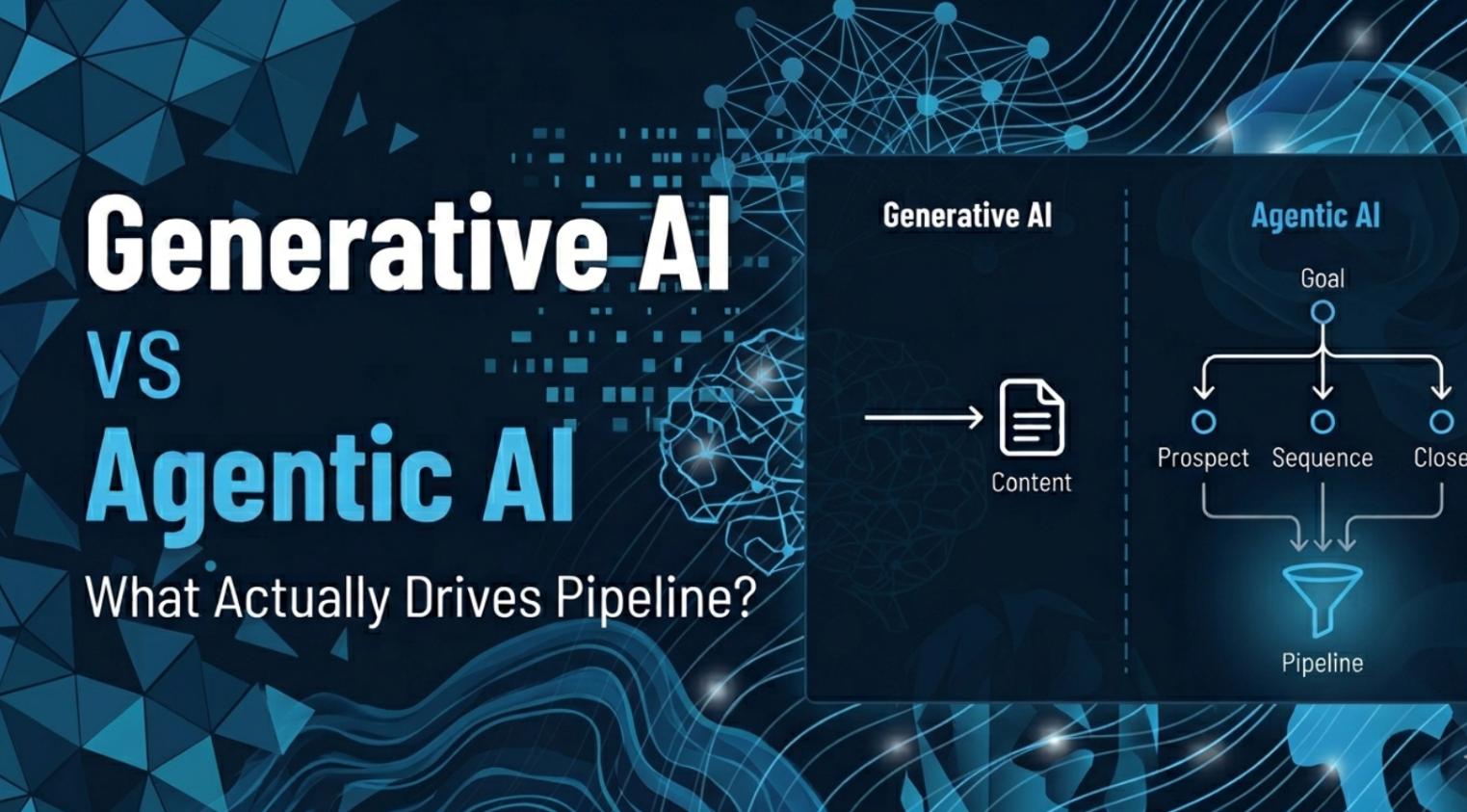
95% of generative AI pilots at companies are failing to drive revenue acceleration. That number comes from MIT's NANDA initiative, published in December 2025, based on 150 executive interviews, 350 employee surveys, and analysis of 300 public AI deployments. Only 5% of generative AI programs achieve what their sponsors promised: measurable pipeline impact.
Most B2B technology companies have been sold a tool when they needed a workflow.
Generative AI gives your team a brilliant assistant. It writes faster, summarizes better, and ideates on demand. The output is impressive in a demo. In a revenue report, it often disappears. Agentic AI is the difference. Not because it is smarter, it frequently runs on the same underlying models, but because it acts. It takes a goal, breaks it into steps, executes them across systems, and adapts when conditions change. Without waiting for a human to approve each move.
By 2027, 50% of enterprises using generative AI will deploy autonomous AI agents, doubling from 25% in 2025 (Deloitte). By the end of 2026, 40% of enterprise applications will include task-specific AI agents (Gartner). The market is not debating which is better anymore. It is figuring out how to run both without confusing one for the other.
That confusion is expensive. Understanding where generative AI ends and agentic AI begins is the difference between a content team that produces faster and a GTM engine that runs itself.
What Is the Real Difference Between Generative and Agentic AI?
Generative AI responds. Agentic AI acts. Generative AI produces content, summaries, code, and answers when prompted. Agentic AI receives a goal and executes the steps required to achieve it, across multiple tools, multiple data sources, and multiple decision points, without being told what to do at each stage.
The simplest way to hold this distinction: generative AI is a very capable employee who needs a brief for every task. Agentic AI is a very capable employee who can take a quarterly objective and figure out the brief themselves.
In practice, the difference shows up like this.
Your content team uses ChatGPT to write a prospecting email. They prompt it, review the output, edit it, paste it into their sequencing tool, and send it. Generative AI handled the writing. A human handled everything else. Total time saved: maybe twelve minutes per email.
Your GTM team deploys Apollo's Nova agent with a defined ICP and a sequencing goal. The agent identifies prospects, pulls enrichment data, writes personalized emails referencing each prospect's recent company activity, loads them into sequences, monitors engagement, and triggers follow-up tasks when an email is opened three times without a reply. Agentic AI handled the entire workflow. A human set the goal and reviewed the results. Total time saved: the entire SDR work week, for that campaign.
MIT's research identifies the core problem as the "Gen AI Paradox": most organizations have adopted generative AI tools, but only a small percentage leverage them for function-specific, high-impact applications. The vast majority stall, delivering little to no measurable impact on the P&L.
The Gen AI Paradox has a simple explanation. Generative AI improves individual tasks. Agentic AI changes the economics of entire workflows. Companies measuring generative AI ROI at the task level will find modest gains. Companies deploying agentic AI at the workflow level will find the 171% average ROI that Landbase's 2026 research documents across production deployments.
Three functional differences determine pipeline impact:
- Generative AI requires prompts. Agentic AI requires goals. Every generative AI output starts with a human describing what they want. Every agentic AI workflow starts with a human defining what they want to achieve. The prompt is a task brief. The goal is an outcome brief. That shift from task delegation to outcome delegation is where pipeline impact begins.
- Generative AI produces content. Agentic AI executes workflows. A generative AI tool writes a case study. An agentic AI system identifies which prospects have recently viewed three or more pages on your website, pulls their LinkedIn activity to identify a relevant conversation hook, writes a personalized email referencing both signals, adds them to the appropriate sequence, and flags the account for SDR review if engagement crosses a threshold.
- Generative AI is additive. Agentic AI is multiplicative. Generative AI makes each person faster. Agentic AI changes how many people you need to achieve a given pipeline outcome. That is the productivity equation B2B technology companies are only beginning to run.
Where Generative AI Actually Wins
This is not an argument that generative AI is worthless. It is an argument that most companies are using it for the wrong jobs and measuring it with the wrong metrics.
Generative AI wins decisively in three pipeline-adjacent categories.
- Content at scale with quality control. A generative AI tool that produces eight first-draft blog posts per week, reviewed and edited by a single skilled content strategist, produces output that would have required three writers twelve months ago. The cost reduction is real. The quality ceiling, with good editorial oversight, is maintainable. For B2B technology companies building topical authority through content volume, generative AI is the production engine. The human is the quality layer.
- Sales enablement documentation. RFP responses, proposal first drafts, competitive battle cards, and objection handling guides. These are documents that require structured thinking and accurate information - both of which a well-prompted generative AI tool handles competently - but they live as static artifacts consumed by humans. The ROI is in hours saved per document, not in workflow transformation.
- Research synthesis and signal surfacing. Generative AI reads faster than any human. Feeding it a prospect's annual report, recent press releases, and LinkedIn activity to produce a briefing document before a discovery call is a legitimate use case with measurable time savings. It does not change the pipeline. It improves the conversation that happens in it.
A 2025 Google Cloud study found 88% of agentic AI adopters achieved positive ROI, compared with 74% of organizations using generative AI more broadly. The 14-point gap is meaningful at scale. Generative AI produces a positive ROI for most organizations that deploy it thoughtfully. Agentic AI produces positive ROI for more of them, more reliably, and at higher rates.
Where Agentic AI Actually Drives Pipeline
Agentic AI earns its GTM reputation in three specific workflow categories. These are not theoretical use cases. They are production deployments with documented outcomes.
- Autonomous prospecting and outbound sequencing. Clay's Claygent pulls company news, product launches, and buying signals for hundreds of prospects simultaneously and generates context-specific outreach. Apollo's Nova scores prospects and writes personalized sequences that adapt based on engagement signals. These workflows replace not a writing task but an entire SDR research and outreach cycle. The pipeline impact is measurable in days, not quarters. McKinsey research demonstrates 13 to 15% revenue growth and 10 to 20% ROI improvements for B2B sales organizations using AI at the workflow level. WiserNotify data indicates 50% increases in lead generation and 47% higher conversion rates.
- Dark funnel intent detection and account prioritization. 6sense processes 1 trillion daily intent signals to identify which accounts are actively researching your category before they raise their hand. Its AI agents surface next-best actions, draft outreach, and update CRM records in real time. The pipeline impact is not in faster execution. It is in reaching accounts during their active research window, rather than three months after they made a shortlist that did not include you.
- Revenue intelligence and deal execution. Gong analyzes every sales conversation and surfaces deal risks, coaching recommendations, and follow-up triggers without a rep filing a single call note. Seismic combined Gong intelligence with first-party data to grow pipeline by 40% and save sellers more than 40 hours per month. That 40-hour saving is not a productivity metric. It is 40 hours of selling time that was previously consumed by CRM data entry, call note transcription, and manual follow-up management.
Companies report an average ROI of 171% from agentic AI deployments, with US enterprises achieving 192%, which exceeds traditional automation ROI by three times. The companies achieving that ROI share one characteristic: they deployed agentic AI at the workflow level, not at the task level. They did not ask their agents to write faster. They asked them to run the workflow.
The Practical GTM Stack for 2026
Most B2B technology companies do not need to choose between generative and agentic AI. They need to stop deploying one in the job description of the other.
Here is the stack that works:
- Generative AI layer: content production, sales enablement documentation, research synthesis, and personalization at scale within human-reviewed workflows. Tools: ChatGPT, Claude, Gemini, Jasper. Measured by: time saved per output, content volume produced, and quality consistency.
- Agentic AI layer: prospecting workflows, intent signal processing, outbound sequencing, deal intelligence, CRM automation. Tools: Clay, Apollo, 6sense, Gong, ZoomInfo. Measured by: pipeline generated, deal velocity, SDR capacity freed, conversion rate improvement.
- Integration layer: the CRM and data infrastructure that connects both. Salesforce or HubSpot as the system of record. Without clean, unified data underneath both layers, neither produces its promised ROI.
89% of surveyed CIOs consider agent-based AI a strategic priority. 88% of senior executives plan to increase AI-related budgets in the next 12 months, specifically because of agentic AI's capabilities (PwC, May 2025). The budget is moving toward agentic AI because the ROI case is clearer. But the generative AI layer does not disappear; it feeds the agentic layer with better content, better research, and better inputs.
The B2B technology teams winning in 2026 are running both. They are using generative AI to produce the content that earns AI citations and builds brand authority. They are using agentic AI to identify who is reading that content, research those prospects, and reach them before a competitor's SDR knows they exist.
That is not a tool adoption story. It is a GTM architecture story.
Frequently Asked Questions
What is the difference between generative AI and agentic AI?
Generative AI produces content, summaries, code, and answers when prompted by a human. Agentic AI receives a goal and autonomously executes the multi-step workflow required to achieve it, across multiple tools and data sources, without requiring human input at each stage. Generative AI is additive; it makes individuals faster. Agentic AI is multiplicative; it changes the economics of entire workflows. In B2B GTM terms: generative AI writes a prospecting email when asked. Agentic AI identifies the prospect, researches their context, writes the email, loads it into a sequence, monitors engagement, and triggers follow-up autonomously.
Which drives more pipeline, generative AI or agentic AI?
Agentic AI drives more direct pipeline impact. A 2025 Google Cloud study found 88% of agentic AI adopters achieved positive ROI compared to 74% using generative AI. Landbase's 2026 research puts average agentic AI ROI at 171%, three times the ROI of traditional automation. MIT's NANDA initiative found 95% of generative AI pilots fail to drive measurable revenue acceleration when deployed at the task level. The distinction is deployment model: generative AI deployed at the task level produces modest productivity gains. Agentic AI deployed at the workflow level produces a pipeline.
Can generative AI and agentic AI work together in a B2B GTM stack?
Yes, and for most B2B technology companies, the optimal GTM stack runs in complementary layers. Generative AI handles content production, sales enablement documentation, and research synthesis. Agentic AI handles prospecting workflows, intent signal processing, outbound sequencing, and deal intelligence. The generative AI layer produces the content that builds brand authority and earns AI citations. The agentic AI layer identifies who is engaging with that content, researches those prospects, and executes outreach before a competitor knows they exist. The integration layer, a clean CRM with unified data, is what makes both layers compound.
Why do most generative AI programs fail to show pipeline impact?
MIT's NANDA initiative identified the cause: most organizations use generative AI for individual task improvement rather than workflow transformation. Writing faster, summarizing better, and ideating on demand all produce modest individual productivity gains that rarely show up in pipeline reports. The companies that achieve measurable revenue impact from AI deploy it at the workflow level, replacing entire sequences of human tasks rather than accelerating individual ones. Agentic AI is purpose-built for workflow deployment. Generative AI, used as a task accelerator, will consistently underperform against pipeline expectations.
What is the ROI difference between generative AI and agentic AI for B2B technology companies?
Agentic AI produces higher and more consistent ROI for B2B technology companies. Google Cloud's 2025 study found 88% positive ROI for agentic AI adopters versus 74% for generative AI users. Average agentic AI ROI across production deployments is 171%, with US enterprises reaching 192%, three times the ROI of traditional marketing automation (Landbase, 2026). Generative AI produces real productivity gains, particularly in content production and sales enablement, but the ROI is additive rather than transformative. The companies achieving transformative pipeline impact are those that deploy agentic AI at the workflow level with a clean data infrastructure underneath.
References
- MIT NANDA Initiative, December 2025 - 95% of generative AI pilots failing to drive revenue acceleration, Gen AI Paradox: https://fortune.com/2025/08/18/mit-report-95-percent-generative-ai-pilots-at-companies-failing-cfo/
- Landbase, April 2026 - 171% average agentic AI ROI, 192% US enterprise, 3x traditional automation: https://www.landbase.com/blog/agentic-ai-statistics
- Google Cloud, 2025 - 88% agentic AI adopter ROI vs 74% generative AI: https://nevermined.ai/blog/agentic-commerce-growth-statistics
- Gartner, 2026 - 40% of enterprise applications to include task-specific AI agents by the end of 2026: https://onereach.ai/blog/agentic-ai-adoption-rates-roi-market-trends/
- Deloitte, 2025 - 50% of generative AI enterprises to deploy autonomous agents by 2027: https://onereach.ai/blog/agentic-ai-adoption-rates-roi-market-trends/
- PwC, May 2025 - 88% of senior executives increasing AI budgets due to agentic AI: https://onereach.ai/blog/agentic-ai-adoption-rates-roi-market-trends/
- McKinsey / SparxIT - 13-15% revenue growth, 10-20% ROI for B2B sales AI at workflow level: https://serpsculpt.com/how-many-b2b-companies-are-using-ai-to-drive-growth/
- Adobe AI and Digital Trends 2026 - enterprise agentic AI deployment, data fragmentation challenges: https://business.adobe.com/resources/digital-trends-report.html
- ZoomInfo Customer Impact Report, 2025 - Seismic Gong deployment: 40% pipeline growth, 40 hours saved per seller per month
- Master of Code, March 2026 - AI-enabled workflows tripling profit contribution 2022-2024: https://masterofcode.com/blog/ai-agent-statistics


