
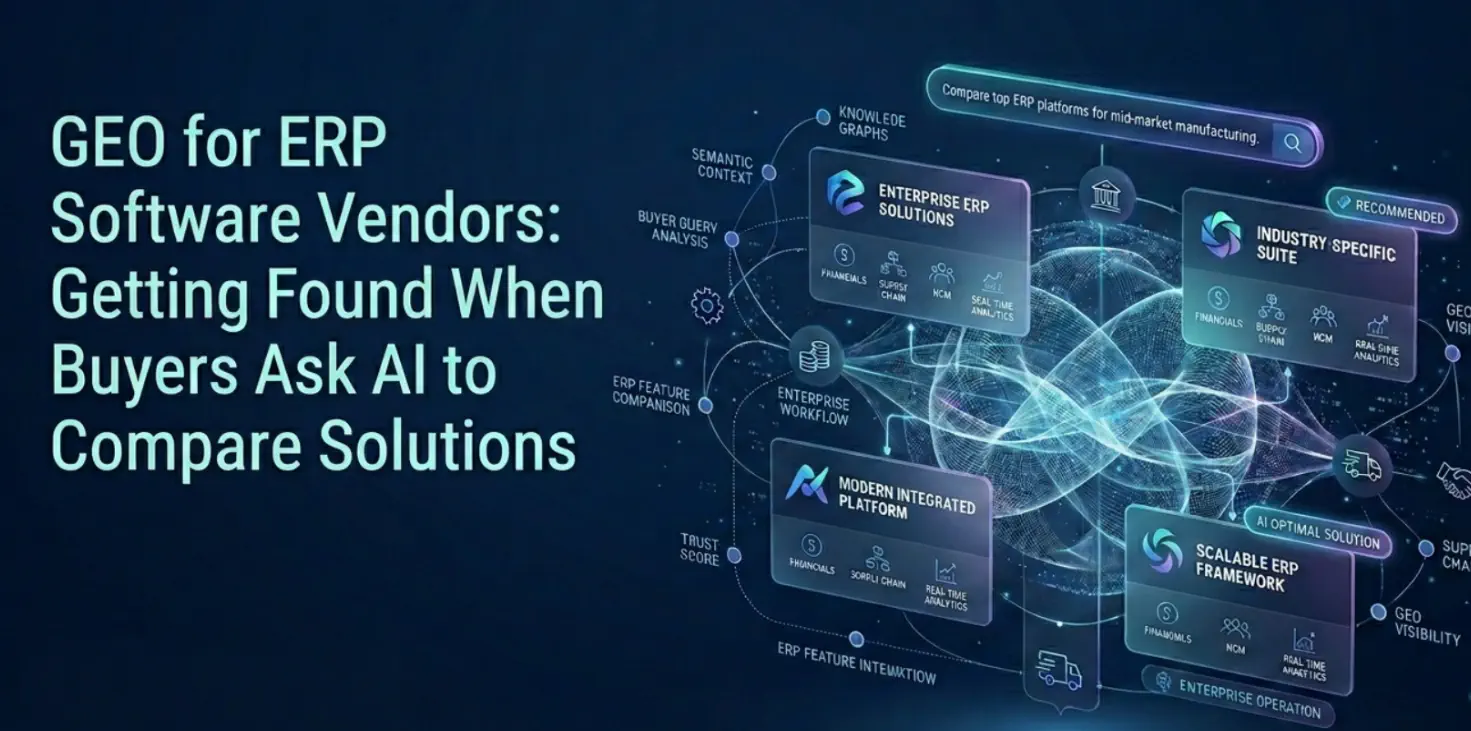
GEO for ERP Software Vendors: Getting Found When Buyers Ask AI to Compare Solutions
When a VP of Operations types "compare mid-market ERP solutions for pharmaceutical manufacturing" into ChatGPT, three vendors get named. Maybe four. SAP is almost certainly one of them. Oracle is probably another. The third and fourth depend entirely on which mid-market vendors have built the right GEO foundation - not which ones have the best product.
That is the ERP AI citation problem in one scenario. And it is playing out millions of times a day across the full spectrum of ERP buyer queries.
ERP software buyers are among the most research-intensive in all of B2B technology. The average ERP selection process takes 6 to 12 months, involves multiple stakeholders, and generates dozens of research queries across traditional search, peer communities, analyst reports, and now AI platforms.
Fewer than 10% of sources cited in ChatGPT, Gemini, and Copilot rank in the top ten Google organic search results for the same query. An ERP vendor winning on Google is not automatically winning in AI search. The two surfaces operate from almost entirely different source pools.
Ahrefs analysis of 26,283 ChatGPT source URLs found that "best of" list pages represented 43.8% of all cited page types. When software companies were recommended by ChatGPT, 34% of responses included that company's own comparison list as a source. For ERP vendors, this has a specific and actionable implication: your own comparison content, written with specificity and structured for AI extraction, is one of your highest-leverage citation assets.
85% of AI Overview citations come from content published within the last two years, and recently updated content appears 4.3 times more often in AI answers than older material. In a category where vendor websites often carry product pages written five years ago, content freshness is a GEO differentiator that mid-market ERP vendors can exploit immediately.
Why Mid-Market ERP Vendors Struggle Most in AI Search
The ERP AI citation landscape has a structural imbalance that mid-market vendors need to understand before they can fix it.
SAP and Oracle dominate AI citations for generic ERP queries because they dominate every other signal AI platforms use to evaluate category authority: domain strength, third-party editorial coverage, analyst report frequency, and community mention volume.
AI platforms default to domains with massive, diverse link profiles because they serve as a proxy for verification. For a query as broad as "best ERP software," the giants will win that citation battle every time.
Mid-market ERP vendors cannot out-cite SAP on generic queries. They should not try. The GEO opportunity for mid-market ERP is vertical specificity - owning the AI citation for "best ERP for pharmaceutical manufacturers," "ERP for mid-market discrete manufacturing," and "ERP for food and beverage compliance." The giants are too generic to be the precise answer for any of these queries.
A focused site covering a specific B2B niche in depth can out-cite a higher-authority domain in LLM responses if the content is more contextually aligned with the query. That principle is the entire GEO strategy for mid-market ERP vendors. Domain authority matters as a baseline. Topical depth in a specific vertical wins the citation for that vertical's buyers.
Three patterns explain why most mid-market ERP companies are invisible in AI search despite active marketing programs:
- Horizontal positioning in a vertical world. Most mid-market ERP vendors claim to serve manufacturing, distribution, healthcare, and professional services simultaneously. AI platforms responding to a pharmaceutical manufacturing ERP query do not have sufficient signal to surface a vendor that describes itself as serving every industry. Vertical specificity is the GEO prerequisite for this category.
- Comparison pages that describe rather than answer. An ERP comparison page listing features in a table satisfies a human reader scanning for information. An AI platform seeking a citable answer to "How does Vendor A differ from SAP Business One for manufacturing?" needs a direct, extractable response in the first two sentences of the relevant section. Most ERP comparison pages are not built for extraction.
- Analyst and review platform gaps. AI-powered search engines track brand mentions regardless of whether they include clickable links. When your brand appears alongside established authorities in articles, research, and industry content, AI systems map these relationships to evaluate credibility. ERP vendors with incomplete G2 profiles, no Gartner Peer Insights presence, and minimal analyst mention coverage are invisible to the co-occurrence signals AI platforms use to validate category authority.
Three GEO Moves for ERP Software Vendors
These moves are designed specifically for mid-market ERP vendors competing against larger players for vertical-specific AI citations.
Move 1: Own vertical-specific comparison content with answer capsules
The single highest-leverage GEO move for an ERP vendor is building vertical-specific comparison pages with AEO-structured answer capsules. Not a generic "ERP comparison" page. A page dedicated to "ERP for pharmaceutical manufacturers: what to look for and how leading solutions compare."
The answer capsule for that page looks like this: "Pharmaceutical manufacturers need ERP systems with native 21 CFR Part 11 compliance, batch traceability, and serialization support built into the core platform, not added as a module.
Vendors with these capabilities built in reduce compliance documentation time by 60 to 70% compared to ERP systems requiring third-party compliance add-ons."
That is citable by ChatGPT. It answers the exact question a pharmaceutical IT director asks when researching ERP options. It contains regulatory specificity (21 CFR Part 11), operational outcomes (60 to 70% documentation time reduction), and a selection criterion differentiating built-in from bolted-on compliance. Build one of these for each of your top three vertical markets.
Move 2: Build a best-list presence across the platforms AI cites most
43.8% of all ChatGPT cited page types are "best X" list pages. For ERP vendors, the most valuable citations come from appearing on vertically-specific best-of lists: "best ERP for manufacturing," "best mid-market ERP for distribution."
Target the sites AI platforms cite most heavily for ERP queries: G2, Capterra, Software Advice, TrustRadius, and Gartner Peer Insights. Complete every profile field on each platform with outcome-specific, vertically-focused language. Request reviews specifically from clients in your primary verticals. A cluster of pharmaceutical manufacturing reviews on G2 is a direct citation signal for pharmaceutical ERP queries.
Then build or earn placement on independently published best-of lists. A mention in a reputable industry publication's "best ERP for manufacturing" roundup carries AI citation weight that your own website content cannot replicate.
AI-powered search engines track brand co-occurrence alongside established authorities. Focus on earning brand mentions in authoritative contexts within your target verticals.
Move 3: Publish vertical benchmark data as AI citation anchors
AI-generated citations influence up to 32% of sales-qualified leads at some enterprises. The content generating those citations is almost always specific, data-backed, and verifiable. For ERP vendors, vertical benchmark data is the highest-leverage citation asset available.
What does that look like in practice? An ERP vendor serving food and beverage manufacturers publishes: "Food and beverage manufacturers using our ERP reduce month-end close from 12 days to 4 days on average, based on data from 60 client deployments over three years. Batch recall time improves from 72 hours to under four hours with native lot traceability - verified across FDA-regulated production environments."
That data is citable. It is specific to a vertical. It contains a named outcome (month-end close reduction), a timeframe (three years), a sample size (60 clients), and a regulatory context (FDA-regulated). No competitor can copy it. No AI platform will skip it in favor of a generic claim because it answers the vertical buyer's question more precisely than anything else available.
The GEO Foundation: What ERP Vendors Need in Place First
Before any of the above moves produce results, three foundational elements must be confirmed:
- Entity consistency across all review and analyst platforms. Your company name, ERP category description, primary verticals served, and core differentiation claim must be identical across G2, Capterra, Gartner Peer Insights, TrustRadius, LinkedIn, and your website. AI platforms cross-reference these sources to validate entity claims. Inconsistency between how you describe yourself on G2 and how you describe yourself on your website is a citation disqualifier.
- AI crawler access confirmed in robots.txt. GPTBot, OAI-SearchBot, ClaudeBot, PerplexityBot, and Google-Extended must all be whitelisted. ERP vendor websites frequently have restrictive robots.txt configurations that inadvertently block AI crawlers. Check this before any content optimization begins.
- Core pages rendering server-side. Many ERP vendor websites use JavaScript-heavy frameworks rendering content client-side. AI crawlers often cannot execute JavaScript and may see blank pages where your content should be. Server-side rendering for comparison pages, product pages, and vertical solution pages is the infrastructure requirement that everything else depends on.
If you want to learn more about your AI visibility, get a Free AI SEO Audit with Nagana Media experts’ eye.
Frequently Asked Questions
What is GEO for ERP software vendors?
GEO for ERP software vendors is the practice of optimizing brand presence and content across multiple platforms so AI systems - ChatGPT, Perplexity, Google AI Overviews, and Gemini - cite and recommend the ERP vendor when buyers research solutions for their specific vertical or use case. Unlike traditional SEO, which optimizes for keyword rankings, GEO for ERP vendors focuses on vertical-specific citation authority: owning the AI answer for "best ERP for pharmaceutical manufacturing" or "ERP for mid-market food and beverage" rather than competing against SAP and Oracle on generic queries, no mid-market vendor can win.
Why do mid-market ERP vendors go uncited in AI search?
Mid-market ERP vendors go uncited in AI search for three main reasons. First, horizontal positioning - claiming to serve every industry equally gives AI platforms no vertical-specific signal to cite for targeted buyer queries. Second, comparison pages built for human readers rather than AI extraction, where content describes rather than directly answers the buyer's specific question. Third, gaps in third-party review and analyst platform coverage - AI platforms rely heavily on co-occurrence signals from G2, Gartner Peer Insights, and industry publications to validate category authority before citing a vendor.
How can mid-market ERP vendors compete with SAP and Oracle in AI search?
Mid-market ERP vendors compete with SAP and Oracle in AI search through vertical specificity rather than category breadth. A focused site covering pharmaceutical ERP in depth can out-cite a higher-authority domain for pharmaceutical ERP queries if its content is more contextually specific. The strategy is to build vertical-specific comparison pages with AEO-structured answer capsules, earn placement on best-of lists for specific verticals, and publish proprietary client benchmark data that no competitor can replicate. Generic ERP queries belong to the giants. Vertical-specific ERP queries are the mid-market GEO opportunity.
What content types earn the most AI citations for ERP vendors?
The content types earning the most AI citations for ERP vendors are: vertical-specific comparison pages with answer capsules in the first two sentences of each section (43.8% of all ChatGPT citations come from best-of and comparison page types), original client benchmark data with named verticals and quantified outcomes, G2 and Gartner Peer Insights profiles with outcome-specific language, and independently published best-of list appearances on authoritative industry sites. Content updated within the last two years is 4.3 times more likely to appear in AI Overview citations than older content, making regular refresh schedules a GEO maintenance requirement.
How long does GEO take to show results for ERP software companies?
Entity consistency fixes - aligning descriptions across G2, Capterra, LinkedIn, and the website - can improve AI recognition within two to four weeks as platforms re-index updated profiles. New vertical-specific comparison pages with AEO structure can appear in Perplexity citations within hours of indexing.
Best-of list placements and analyst mentions take longer to build, typically 60 to 90 days to appear as consistent co-occurrence signals in AI citation patterns. Full vertical citation authority in one specific ERP niche typically builds over three to six months of sustained GEO implementation, combining content, review platform optimization, and earned media in the target vertical.


