
Blended B2B win rates fell to 19% in 2025, down from 29% the year before, according to a GTM benchmark analysis covering companies across deal sizes. That's not one company's problem. That's a market-wide compression, driven by longer buying cycles and more cautious procurement. Which makes it a strange time for so many win/loss programs to exist purely as a quarterly report that gets read once, nodded at, and filed.
What Does a Win/Loss Analysis Process Actually Involve?
Structured interviews with buyers who recently chose you and buyers who recently chose someone else, run consistently enough to surface patterns rather than one-off anecdotes. Good win/loss isn't about assigning blame for a specific lost deal. It's about identifying the recurring reasons a category of deal gets won or lost, which is a completely different exercise than a single sales rep's post-mortem on why one prospect went quiet.
The distinction matters because a program built around blame produces defensive answers and gets abandoned within two quarters. A program built around pattern recognition, run by someone outside the deal itself, produces the kind of honest feedback that actually changes something.
Why Do Most Win/Loss Programs Fail to Change Anything?
Because the insight stops at the report. A quarterly win/loss summary gets presented to leadership, generates a round of nodding, and then sits in a shared drive until the next quarter's version replaces it. Nobody owns the step between "we learned this" and "we built something different because of it."
Here's a genuinely useful test for whether your program is actually working. If your top loss reason last quarter was a missing enterprise SSO integration, and your product team shipped it, did your win rate against the specific competitor who kept beating you on that gap actually improve the following quarter? If the answer is no, or if nobody can even answer the question because nobody tracked it, the program is producing information without producing change.
What Makes Win/Loss Data Different From Every Other Feedback Source?
It's the only feedback loop where you're hearing directly from someone who evaluated you against a real, named alternative and made an actual purchase decision, not a hypothetical one. A satisfaction survey tells you how a current customer feels. A win/loss interview tells you exactly what a buyer said in the room, what your marketing claimed that didn't hold up under evaluation, which competitor argument actually landed, and which of your own sales team's talking points fell flat when tested against a real decision.
That specificity is exactly what most B2B content is missing. Content teams write comparison pages and objection-handling material based on internal assumptions about what buyers care about. Win/loss data replaces the assumption with an actual transcript of what a buyer said mattered.
How Should the Interviews Actually Be Structured?
Short enough to get a real response rate, specific enough to produce usable detail. A 20 to 30 minute conversation, ideally conducted by someone the buyer doesn't associate with the deal itself, a dedicated win/loss function, a product marketer, or a third party – tends to produce more honest answers than the account executive who was in the room asking "so, why didn't we win this?"
The questions that produce the most usable content material aren't generic satisfaction questions. They're specific: what did you search for when you first started looking for a solution, which companies made your shortlist and why, what's the one thing that almost changed your mind, and what would have made the decision easier. That last question in particular routinely surfaces a content gap nobody on the internal team had identified.
What Should Actually Happen to the Findings?
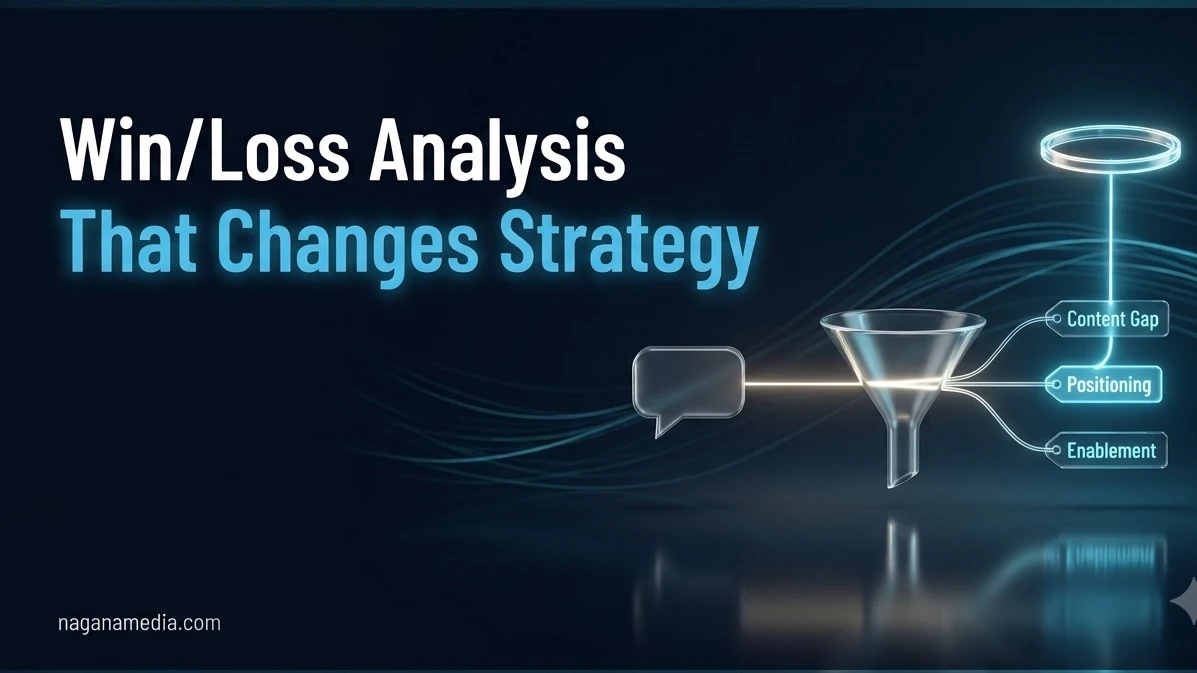
This is where most programs quietly break down, and it's worth building a specific, repeatable handoff rather than hoping insight travels on its own. Every recurring loss reason should map to one of three outcomes: a content gap to fill, a positioning claim to revise, or a sales enablement asset to build. Not all three, generally. Picking the right one, specifically, is the actual skill.
If buyers consistently say they didn't understand how your platform differs from a specific named competitor, that's a comparison page gap, not a sales training issue, since the confusion is happening before a rep ever gets on a call. If buyers say a rep made a claim during the sales process that turned out not to be accurate, that's a sales enablement and messaging governance issue, not a content gap. If buyers say they chose a competitor because of a specific proof point, a benchmark stat, a named customer result, that the competitor had and you didn't, that's a signal to go build the equivalent proof, not just adjust the pitch.
How Do You Actually Turn This Into Content, Concretely?
Take the recurring objections and build content that answers them before a prospect ever has to raise them in a call. If "we weren't sure this would scale past 500 users" shows up repeatedly in loss interviews, that's not a note for sales training. That's a specific page: a named case study describing exactly how a customer scaled past that threshold, with real numbers.
If a specific competitor comes up constantly in comparison shopping and your content has no honest, direct comparison page addressing that matchup, win/loss data is the single most reliable source for what that page should actually say, because it's built from what real buyers weighed against each other, not from a generic feature checklist your product team assembled internally.
This same material, incidentally, does double duty. The specific, named objections and comparisons that come out of win/loss interviews are exactly the kind of concrete, verifiable content that earns AI search citations, because they answer the precise comparison questions a buyer researching your category is typing into an AI platform right now.
What Cadence Actually Works for This?
Continuous collection, quarterly synthesis. Trying to interview every closed deal produces too much noise and burns out whoever's running the program. A reasonable target is 8 to 12 structured interviews per quarter, weighted toward your two or three most competitive matchups, with a standing process to log a lighter-touch version, even just a one-question CRM field, on every closed deal so the sample size stays workable without requiring a full interview each time.
Frequently Asked Questions
What is the difference between win/loss analysis and a customer satisfaction survey?
A win/loss interview captures what a buyer said during an actual purchase decision against real, named alternatives, including specific objections raised and specific competitor claims that influenced the outcome. A satisfaction survey measures how an existing customer currently feels, which is a related but fundamentally different signal, since it doesn't capture the comparative decision-making process at all.
Why do most win/loss programs fail to change anything about a company's strategy?
The insight typically stops at the quarterly report. Nobody owns the specific step of translating a recurring loss reason into a content gap, a positioning revision, or a sales enablement asset, so the same findings often repeat quarter after quarter with no measurable change in win rate against the competitors named in the interviews.
How many win/loss interviews should a B2B company run per quarter?
8 to 12 structured interviews per quarter is a workable target for most mid-market B2B companies, weighted toward the two or three most competitive matchups. This should be paired with a lighter-touch data point, even a single structured CRM field, logged on every closed deal so the overall sample size stays meaningful without requiring a full interview for every opportunity.
How does win/loss data connect specifically to content strategy?
Recurring objections and named competitor comparisons that surface in win/loss interviews are a more reliable source for what a comparison page or case study should say than internal assumptions about buyer priorities. This content is built from what real buyers actually weighed during a live decision, not a feature checklist assembled by the product team.
Should the same person who worked the deal conduct the win/loss interview?
No, generally. A buyer is more likely to give an honest, specific answer to someone they don't associate with the deal itself, whether that's a dedicated win/loss function, a product marketer, or a third-party interviewer. The account executive who ran the deal tends to get politer, less specific answers, which undermines the entire point of the exercise.
References
Unkover, Win/Loss Analysis: A 7-Step Guide for SaaS Teams (2026), win rate benchmarks by deal size and institutional memory framework: https://unkover.com/blog/win-loss-analysis/
Clozd, What is Win-Loss Analysis? The Ultimate 2026 Guide, win rate ratio benchmarks and interview structure guidance: https://www.clozd.com/guides/win-loss-analysis
Development Corporate, Win/Loss Analysis for Series B SaaS CEOs: The Readiness Gap Nobody's Closing, 2025 Ebsta x Pavilion GTM benchmark and market-wide win rate compression data: https://developmentcorporate.com/saas/win-loss-analysis-for-series-b-saas-ceos-the-readiness-gap-nobodys-closing/
Aventi Group, How to Conduct a Win-Loss Analysis in B2B SaaS, competitive intelligence integration and interview question design: https://aventigroup.com/blog/how-to-conduct-a-win-loss-analysis-to-refine-product-marketing/


