
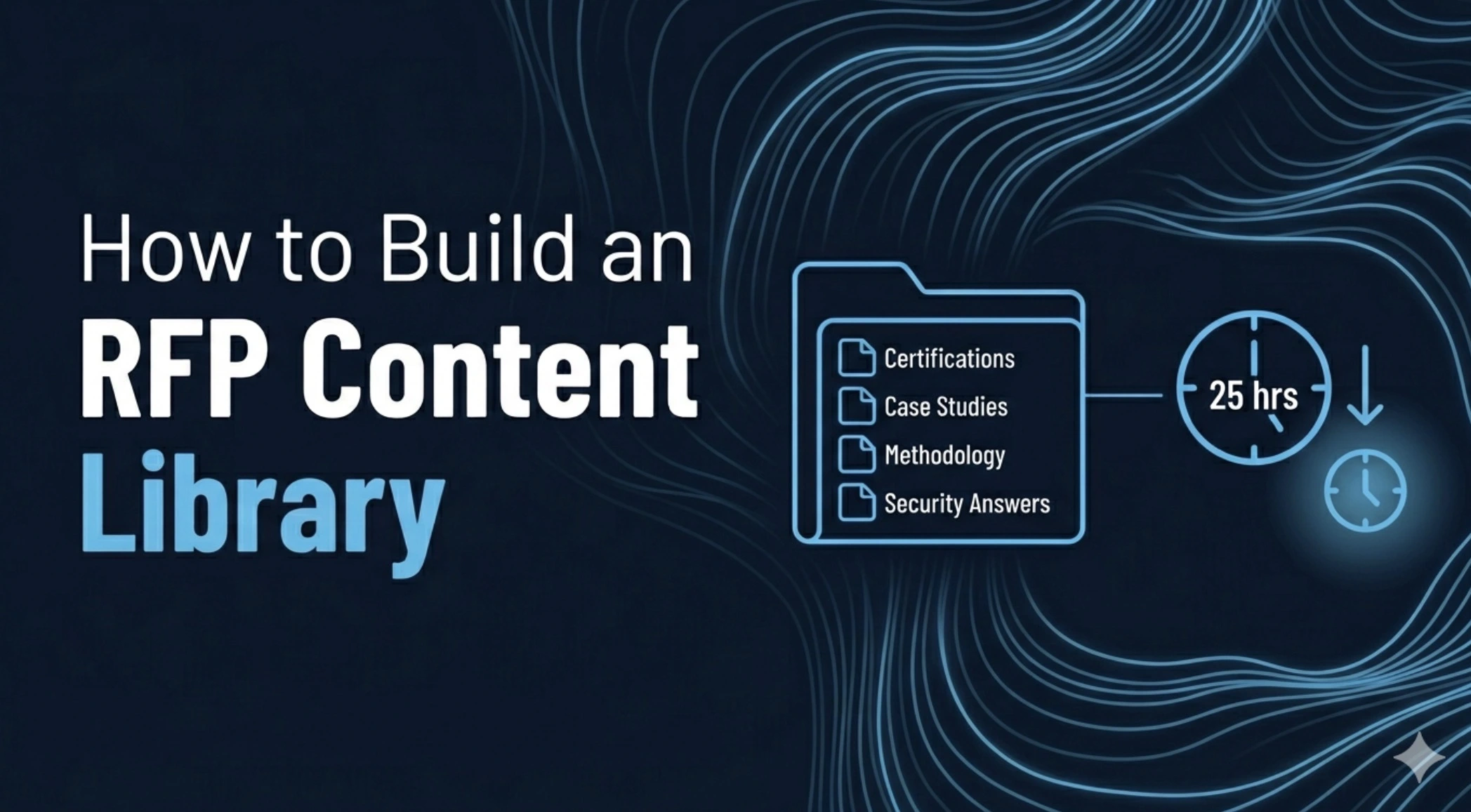
The average B2B RFP response takes about 25 hours to put together. Most of those hours go toward answering questions your team has already answered, somewhere, for somebody else, at some point in the last two years. That's the whole problem in one sentence, and it's also the whole solution, once you see it clearly.
What Is an RFP Response Content Library?
An RFP response content library is a structured, maintained set of pre-approved answers, company background, certifications, case studies, and technical specifications that a proposal team pulls from instead of rewriting the same information for every new request. The word "maintained" matters more than the word "library." A library full of outdated answers is worse than no library at all, because it's fast and wrong instead of slow and wrong.
The Number That Should Change How You Think About This
50% of RFP responses get rated generic or off-target by the evaluators reading them. Half. And that's not a writing-quality problem, mostly. It's usually a time problem wearing a writing-quality costume. When a team has 25 hours to answer 80 questions, generic is what happens when there's no time left to make the answer specific to this buyer.
Here's the part that should actually motivate the fix: average RFP win rate sits at 45%, up from 43% the year before. Teams using dedicated proposal software and a maintained content library are hitting 60% or higher. That's not a marginal gain. That's the difference between losing more deals than you win and winning more than you lose.
The Real Reason Libraries Fail (It's Not What You Think)
Ask most proposal teams why their content library doesn't work, and they'll say "it's too small" or "we need more templates." That's usually wrong. The actual reason most libraries fail is staleness, not size.
Outdated answers with expired certifications, old product names, or pricing that changed eight months ago erode trust faster than no answer at all. An evaluator who catches one stale detail starts wondering what else is stale. That's the real cost of an unmaintained library: it doesn't just fail to help, it actively damages credibility on the documents where credibility matters most.
So before you build anything bigger, here's the actual fix: a library half the size that's reviewed quarterly beats a library twice the size that nobody's touched since last year.
What Actually Goes Into a Working Library
Keep this simpler than most advice you'll find on this topic. Four categories cover almost everything.
- Company background and certifications. This is the most stable content in the library and the easiest to get wrong through neglect. Team size, years in business, security certifications, and compliance attestations. Update this the moment anything changes, not on a schedule, because a stale certification claim is one of the fastest ways to lose credibility with a technical evaluator.
- Case studies and proof points. Three to five strong, current examples beat fifteen tired ones. Tag each by industry and use case so your team can pull the right one fast instead of defaulting to whichever case study they remember best.
- Standard methodology and implementation language. The five-phase rollout plan, the support model, the onboarding process. This content barely changes between proposals, which is exactly why it belongs in the library instead of being rewritten from memory every single time.
- Technical and security questionnaire answers. The repetitive, line-by-line stuff: data handling, uptime guarantees, integration specs. This is the highest-volume, lowest-creativity part of any RFP, and it's where a good library saves the most actual hours.
The Part Everyone Skips: Who Owns It
Here's where most libraries quietly die. Nobody owns it. It gets built once, during a big proposal push, and then six people edit pieces of it over the next year with no review process, and eighteen months later, it's a mess nobody trusts.
Assign a named owner to each content category. Not "the proposal team," a person. Set a quarterly review cadence as the minimum, not the ideal, the minimum. And build a lightweight approval step so new or edited content gets a check before it goes live, especially anything touching certifications, pricing, or legal language.
This isn't bureaucracy for its own sake. 63% of proposal teams report regularly working overtime, and 88% report high stress, with team happiness scores sitting around 6.8 out of 10. A library that's actually maintained reduces overtime, because the team isn't reconstructing the same answers under deadline pressure every single time. A library that's not maintained adds work, because now someone has to fact-check the library itself before they can trust it.
Personalization Still Has to Happen. The Library Just Removes the Busywork.
A content library doesn't write a winning proposal by itself, and treating it like it does is how you end up back at that 50% generic-rating problem, just faster. The executive summary, the requirements response matrix, and the implementation plan still need to be tailored to this specific buyer, this specific RFP, this specific set of priorities.
What the library does is free up the hours that would've gone toward rewriting the certifications page for the ninth time, so your team spends those hours on the parts that actually require thinking: understanding what this particular evaluator cares about and making sure the proposal speaks directly to that.
A Realistic Starting Point
Don't try to build the whole library in one sitting. Pull your last five RFP responses and identify the three sections that were rewritten almost identically each time. That's your starting library. Write each one once, properly, get it approved, tag it, and store it somewhere your team will actually go looking.
Then, every time you respond to a new RFP, ask one question before writing anything: Does this already exist in the library, just needing customization, or is this genuinely new? Most of the time, for most questions, the answer is the first one. That's the 60 to 80% content reuse rate that well-run proposal teams report, and it's not because they're cutting corners. It's because they stopped answering the same question from zero, every single time, for years.
Frequently Asked Questions
How big should an RFP response content library be to start?
Smaller than most teams assume. Four core categories, company background and certifications, case studies, standard methodology language, and technical questionnaire answers, cover the majority of what gets reused across proposals. A focused library that's actually maintained outperforms a large one that's gone stale.
How often should an RFP content library be reviewed?
Quarterly at minimum, with immediate updates whenever something changes, certifications, pricing, product names, rather than waiting for the next scheduled review. Stale content, expired certifications or outdated product names specifically, damage credibility faster than having no content at all for that section.
Does a content library replace the need to personalize each RFP response?
No, and treating it that way is how proposals end up in the 50% generic-or-off-target category. The library removes the busywork of rewriting stable information from scratch. The executive summary, requirements matrix, and implementation plan still need direct tailoring to the specific buyer and their stated priorities.
Who should own the RFP content library?
A named individual per content category, not a team in the abstract. Diffuse ownership is the most common reason libraries decay, since edits happen piecemeal with no consistent review, and within a year, nobody fully trusts what's in there.
What's a realistic content reuse rate for a well-maintained RFP library?
60 to 80% reuse is a realistic and commonly reported figure for teams with a properly maintained library. The remaining 20 to 40% is the genuinely new, buyer-specific content, the executive summary framing, the parts of the proposal that actually need to be written fresh for this particular opportunity.
References
- Bidara, RFP Statistics 2026: Average Win Rate Is 45%: https://www.bidara.ai/research/rfp-statistics
- SiftHub, Proven RFP Content Management Methods: A Step-by-Step Guide: https://www.sifthub.io/blog/rfp-content-management
- SiftHub, RFP Response Template: A Sample Framework to Win More Bids: https://www.sifthub.io/blog/rfp-response-template
- Thalamus AI, 12 RFP Trends in 2026, Strategic Proposals Proposal Happiness Index 2025: https://blogs.thalamushq.ai/rfp-trends-expected-in-2025-how-ai-will-shape-response-management/


