
I want to start with a scene that's become common enough that I don't think it needs much setup anymore. A director of IT at a mid-market company needs new endpoint security software. Five years ago, that search started with a Google query and a scroll through ten blue links. Today, it starts with a question typed into ChatGPT: "what's the best endpoint security platform for a 200-person company with a hybrid workforce?" Whatever three or four names come back in that answer become the shortlist. Everyone else, however good their product actually is, doesn't get considered.
That's the entire premise behind Answer Engine Optimization, and it's worth understanding properly rather than treating it as a buzzword sitting next to SEO on a slide.
What Is Answer Engine Optimization, in Plain Terms?
AEO is the practice of structuring content and building brand presence so that AI systems – ChatGPT, Claude, Perplexity, Google AI Overviews – cite your company when a buyer asks a relevant question. That's the definition. Every decision inside an AEO program should trace back to it.
The distinction from SEO is worth sitting with, because the two disciplines optimize for genuinely different outcomes. SEO gets you a ranking position that a human clicks on. Success is measured by organic traffic. AEO gets you cited inside a generated answer, which builds brand awareness before a website visit ever happens, sometimes without one happening at all. A useful way to see the difference: SEO runs Google, search results, user clicks your page, website visit. AEO runs: user asks AI, AI generates an answer, your brand gets cited in the response, awareness gets created before any website visit occurs.
Neither replaces the other. A company with strong SEO and no AEO presence is optimizing for a smaller and smaller share of how buyers actually discover vendors now. A company chasing AEO tactics with no underlying SEO foundation is building on sand, since AI systems still lean heavily on the same signals – crawlability, indexing, domain authority – that traditional search has always rewarded.
Why Does This Matter Specifically for B2B, Right Now?
65% of B2B buyers now use AI tools at some point during vendor research. That's not a niche behavior anymore. It's closer to the default. And the average B2B brand, before any deliberate AEO work, scores somewhere between 18 and 22 on a 100-point AI visibility scale, according to research tracking this specifically. Most companies are, in practical terms, close to invisible in the exact moment a buyer is narrowing down who to call.
The stakes are higher in B2B than in most consumer categories for a specific reason. B2B purchases involve longer research cycles, more stakeholders, and more comparison shopping before anyone talks to a sales rep. A buyer evaluating marketing automation platforms doesn't ask one question and decide. They ask several, over days or weeks, refining as they go. Each of those questions is a separate opportunity to be cited, or to be quietly excluded while a competitor gets named instead.
What Kinds of Questions Are B2B Buyers Actually Asking AI Tools?
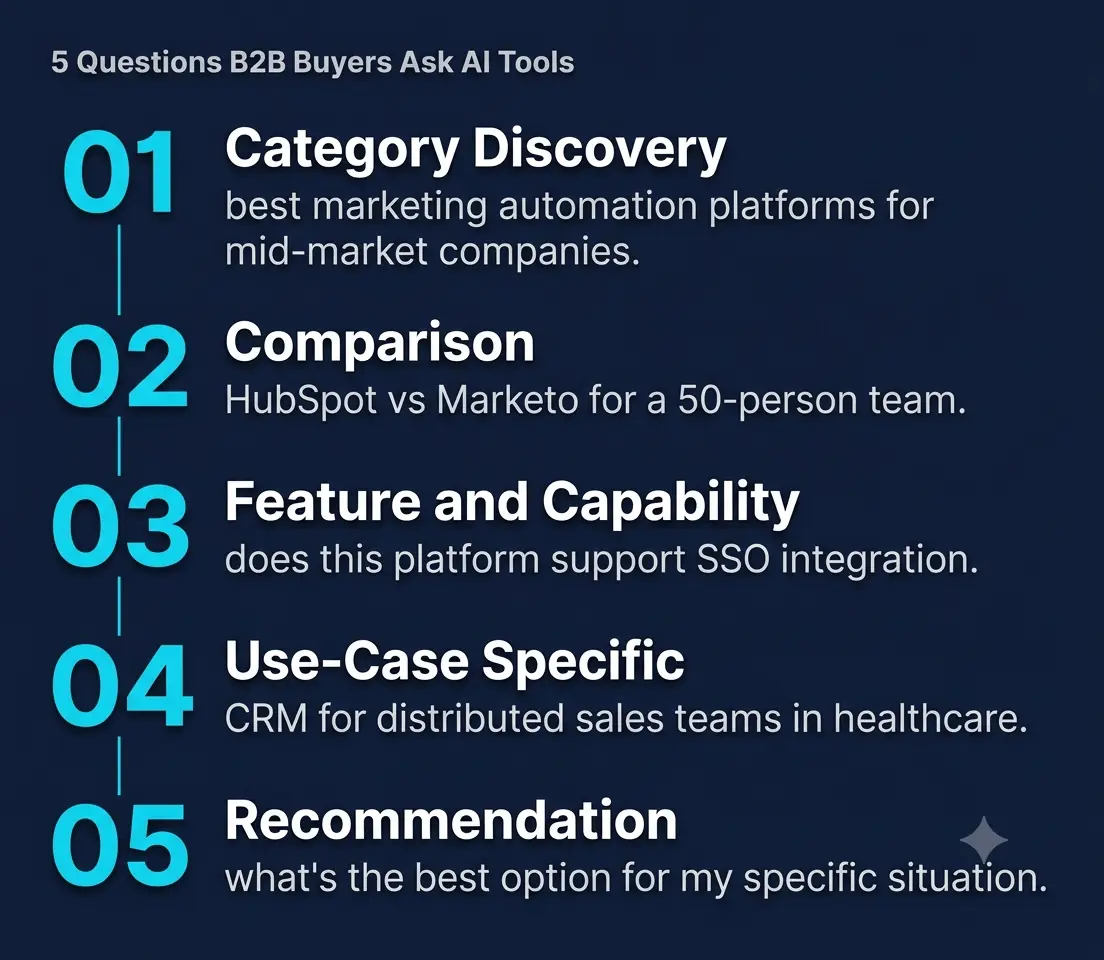
There are five recurring categories worth knowing, because they shape what content actually needs to exist.
Category discovery questions, like "what are the best marketing automation platforms for mid-market B2B companies," shape the initial consideration set. If your brand isn't cited here, buyers entering the research phase may never learn you exist at all, regardless of how strong your product actually is once someone finally evaluates it directly.
Comparison questions, "HubSpot vs Marketo for a 50-person sales team," are where a lot of real decision-making happens. Buyers running these queries have usually already identified two or three names and are trying to differentiate between them.
Feature and capability questions, asking whether a specific platform supports a specific integration or compliance requirement, tend to have high commercial intent, because the person asking is deep enough into evaluation to know the exact technical question that matters to them.
Use-case questions, framed around a specific scenario, "CRM for a distributed sales team selling into healthcare," reward companies with genuinely specific, vertical-relevant content over companies with only generic category pages.
And recommendation questions, where a buyer asks an AI system to name the single best option for their specific situation, are the highest-stakes query type of all, since only a small number of brands typically get named in any single answer.
How Do AI Systems Actually Decide Who to Cite?
This is where a lot of AEO advice gets vague, so I want to be specific. AI systems evaluating a page for citation look for a cluster of signals working together, not any single trick.
Clear, direct definitions matter. A page that opens with a specific, extractable statement, "Answer Engine Optimization is the practice of structuring content so AI answer engines cite your brand when buyers ask relevant questions," gives a model something concrete to lift and attribute. A page that opens with three paragraphs of scene-setting before it gets to the actual answer gives the model nothing to grab onto quickly.
Consistent messaging across related content matters too. If your positioning shifts noticeably between your homepage, your blog, and your G2 profile, that inconsistency reads as uncertainty to a system trying to establish what your company actually does.
Proof that connects the topic to a real buyer need matters more than most companies assume. A generic definition of a category earns less citation trust than a definition paired with a specific example of a real buyer situation the content addresses.
Third-party corroboration is, in my experience, the most underweighted factor by B2B marketing teams. Reddit, G2, Capterra, and TrustRadius all meaningfully influence AEO, because AI systems treat authentic third-party discussion as more trustworthy than a vendor's own self-description. A glowing case study on your own site is marketing. The same claim showing up independently in a Reddit thread or a G2 review is evidence.
I've watched this play out with a client selling into DevOps teams. Their own product pages made a reasonable claim about deployment speed. Nobody outside the company had said the same thing anywhere else online. Once a handful of genuine customer reviews on G2 independently mentioned the same deployment speed improvement, in their own words, with their own numbers, the same claim started showing up in AI-generated comparison answers within about six weeks. The claim didn't change. Where it lived, and who was saying it, did.
Where Should a B2B Company Actually Start With AEO?
Start by running your own version of the buyer questions your prospects are actually asking. Not guessed questions. Real ones, pulled from sales call transcripts, support tickets, and the objections your reps hear on a weekly basis. Run fifteen to twenty of these through ChatGPT, Perplexity, and Google AI Overviews and log what comes back. Are you cited at all? Who is, if not you? What does the answer say about the category?
This single exercise usually reveals more than any generic AEO checklist, because it shows you exactly where the gap is for your specific buyer, not a hypothetical one. A company selling into healthcare IT will have a completely different gap than a company selling into financial services, even if both are technically "B2B SaaS."
From there, prioritize fixing the content gaps that showed up in your own audit before building anything new. If a competitor is consistently cited for a comparison query you're absent from, that's a specific, addressable page to build, not a vague directive to "improve AI visibility."
What Does an AEO-Ready Page Actually Look Like?
Take a concrete example. A company selling contract lifecycle management software wants to earn citations for "best CLM software for legal teams at mid-market companies." The version that fails opens with a company mission statement, spends two paragraphs on the founding story, and finally mentions the product's actual capabilities halfway down the page.
The version that works opens with a direct answer in the first two sentences: what the platform does, specifically who it's built for, and one concrete outcome a similar customer achieved, with a number attached. It follows with named capabilities rather than vague category language, contract redlining with version tracking, not "streamlined contract workflows." It includes a structured comparison section naming two or three real alternatives honestly, since AI systems weigh content that engages with genuine comparison more heavily than content that pretends no competition exists. And it closes with a clearly formatted set of common questions a legal ops buyer would actually ask, each with a direct, self-contained answer.
That structure serves a human skimming the page just as well as it serves a model extracting a passage to cite, which is generally a good sign that the content is built around genuine usefulness rather than around gaming a system.
How Is AEO Success Actually Measured?
Traffic metrics alone won't tell the story, since a citation doesn't always produce a click the way a traditional search result does. The metrics that matter more: how often your brand gets mentioned in AI-generated responses to your priority buyer questions, whether that mention includes a direct citation with a link or just a name-check inside the answer, how you compare to named competitors in the same responses, and whether branded search volume for your company is trending upward, since AI-influenced awareness tends to show up there even when the original AI interaction never gets tracked directly.
Voice search visibility is worth watching too, since AI search and voice queries increasingly rely on the same underlying answer engine logic. A page built well for one tends to perform reasonably well for the other.
Frequently Asked Questions
What is the simplest definition of Answer Engine Optimization?
AEO is the practice of structuring content and brand presence so AI systems like ChatGPT, Claude, Perplexity, and Google AI Overviews cite your company when a buyer asks a relevant question. Unlike SEO, which optimizes for a clicked search result, AEO optimizes for being the source an AI-generated answer references directly.
How is AEO different from traditional SEO for a B2B company?
SEO measures success through organic traffic and ranking position. AEO measures success through citation frequency inside AI-generated answers, which can create brand awareness before a website visit ever happens. The two disciplines share a technical foundation; crawlability and indexing still matter for both, but they optimize for different outcomes and require different content decisions.
Why do B2B companies need to take AEO seriously now specifically?
65% of B2B buyers now use AI tools at some point during vendor research, and this is becoming the default research behavior rather than an edge case. The average B2B brand scores 18 to 22 out of 100 on AI visibility benchmarks before any deliberate AEO work, meaning most companies are close to invisible at the exact moment buyers are forming their shortlist.
What role do third-party sites like G2 and Reddit play in AEO?
A significant one. AI systems weigh authentic third-party discussion – on platforms like Reddit, G2, Capterra, and TrustRadius – more heavily than a company's own self-description, because independent validation is harder to fake than marketing copy. A strong, active presence on these platforms is one of the higher-leverage AEO investments most B2B companies underinvest in.
What's the fastest way to find AEO content gaps?
Run fifteen to twenty real buyer questions, pulled from actual sales calls and support tickets rather than guessed, through ChatGPT, Perplexity, and Google AI Overviews. Log whether your brand appears, who does if you don't, and what the AI-generated answer actually says about the category. This audit consistently reveals more specific, addressable gaps than any generic AEO checklist.
References
Pedowitz Group, What Is Answer Engine Optimization (AEO): The B2B Marketer's Practical Guide, 65% B2B buyer AI usage statistic and average AEO score benchmark: https://www.pedowitzgroup.com/blog/what-is-aeo-blog
Hunter and Bard, B2B Answer Engine Optimization (AEO): The Executive Guide, SEO versus AEO comparison framework: https://hunterandbard.com/resources/blog/seo-is-no-longer-enough-b2b-guide-to-aeo
PartnerStack, Answer Engine Optimization: The Ultimate 2026 Guide for B2B SaaS Teams, third-party platform influence on AEO citation: https://partnerstack.com/resources/guides/answer-engine-optimization-the-ultimate-2026-guide-for-b2b-saas-teams
SMA Marketing, Answer Engine Optimization: A Practical Guide, B2B SaaS comparison-shopping content framework: https://www.smamarketing.net/blog/answer-engine-optimization-guide
AEO Ranks, AEO for B2B SaaS: Complete Answer Engine Optimization Guide 2026, brand perception and citation accuracy distinction: https://aeoranks.com/aeo-for-b2b-saas/


