
Here's a test you can run right now. Pick your most important buyer-intent query, the one you most want to show up for, and run it in ChatGPT. Then run it in Perplexity. If you get the same result both times, either you're doing everything right, or you got lucky. If you don't, and you probably won't, that gap is the entire subject of this article.
What Is Perplexity-Only AEO Strategy?
A Perplexity-only AEO strategy is content optimization built specifically around how Perplexity retrieves, verifies, and cites sources, rather than a generic AI search approach applied across every platform the same way. The reason this needs its own strategy and not just a footnote in a broader AEO plan: Perplexity is architecturally a different kind of system than ChatGPT, and the differences change what gets cited.
The Architecture Difference, Plain and Simple
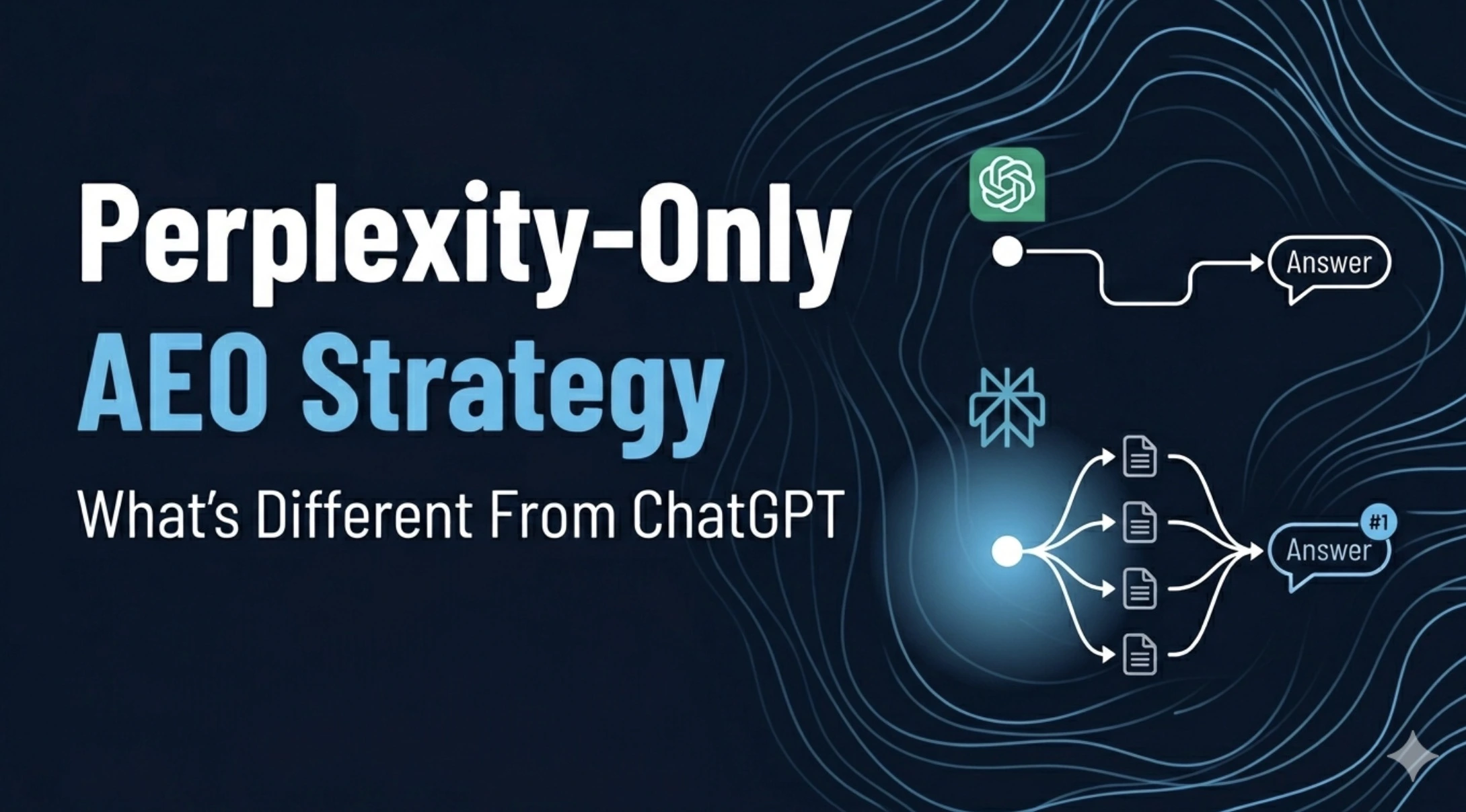
ChatGPT is generation-first. It answers from its trained knowledge by default, and only searches the web when it decides to, or when you tell it to. Perplexity is retrieval-first. Every query, by design, triggers a live web search across an index of more than 50 billion pages, and the answer gets built from what it finds, with citations attached as a structural requirement, not an optional add-on. That single difference cascades into almost everything else worth knowing.
Citations Aren't Optional on Perplexity. That Changes the Math.
Perplexity ties every claim in a response to a specific source in 78% of complex research questions. ChatGPT does this in 62% of the same kind of questions. That ten-plus point gap means the bar for "getting cited" is functionally higher on Perplexity, because there's no path to an answer that doesn't involve picking sources. Here's what that means for content strategy. On ChatGPT, a brand can sometimes get mentioned because the model learned about it during training, no current webpage required. On Perplexity, you don't get mentioned unless something on the live web, right now, today, supports the claim being made. If your content is thin, outdated, or vague, ChatGPT might still mention you from old training data. Perplexity won't. It has nothing current to cite. In independent testing, Perplexity hit 92% factual accuracy on real-time queries against ChatGPT's 87%, with a citation error rate close to half of ChatGPT's. That accuracy bar exists because Perplexity is, structurally, checking its work in public every single time.
Freshness Isn't a Nice-to-Have. It's the Whole Game.
Because Perplexity searches live every time, content that's visibly current has a real, measurable advantage. A visible "2026" date signal improves citation rates by roughly 30%. Not because Perplexity has some preference for the number 2026. Because it's reading freshness as a proxy for reliability, and a page with no date, or a date from three years ago, reads as a worse bet than a page that's obviously been maintained. This means the update cadence that might be "good enough" for general SEO isn't good enough here. If your highest-value page hasn't been touched in fourteen months, that's not just a ranking problem on Google. On Perplexity specifically, it's a direct citation problem, because the model is actively weighing how current your information looks every time it decides what to retrieve.
Where the Citations Come From, And Why Reddit Keeps Showing Up
If you've ever wondered why Perplexity results lean so heavily on forums and community discussion, here's the actual mechanism. Perplexity's retrieval favors content with specific statistics, visible methodology, named sources, and structural clarity, particularly content that's been recently published or updated. Reddit threads, especially detailed ones with real debate happening, often score well on exactly those traits: specific, current, and multiple voices cross-referencing each other. The takeaway for B2B brands isn't "go post on Reddit and hope." It's narrower than that. If your category has active discussion happening anywhere, public forums, comparison communities, review sites, that conversation is part of the source pool Perplexity is drawing from when it builds an answer about your category. Ignoring it doesn't make it go away. It just means you're not part of the conversation the model is already reading.
What "Optimizing for Perplexity" Actually Looks Like
Three things matter more here than anywhere else, and none of them are exotic.
- Build detailed, named comparison content. "X vs Y: Complete 2026 Comparison" style pages, specifically, work because they match exactly what Perplexity's retrieval is looking for: structured, comparative, dated, sourceable. A vague "why choose us" page does nothing here. A page that names the comparison directly and backs every claim with a number does a lot.
- Keep your highest-value pages updated on a real schedule, monthly, for anything you actually care about ranking for. Not a full rewrite every time. Just enough that the freshness signal stays alive: a new stat, an updated benchmark, a current date visibly on the page.
- Show your sources, literally. If you cite a stat, link to where it came from. Perplexity's whole model is built around verifiability, and content that makes verification easy is content that's easier for the model to trust and reuse. Vague claims with no backing are exactly what this system is built to route around.
The Traffic You Get Is Smaller. It's Also Better.
Users who click through from a Perplexity citation visit an average of 13 pages on that site, compared to 11.8 from a standard Google referral. That's not a massive gap on paper, but it tells you something real: someone who clicked from Perplexity already did the comparison work inside the answer engine. They're not browsing. They've decided this source is worth a deeper look, and they're following through on that decision. Perplexity converts at 10.5%, the second-highest conversion rate among AI referral platforms, despite making up only around 8% of total AI referral traffic volume. Lower volume, higher intent. That's not a consolation prize. For B2B specifically, where one good lead matters more than a hundred bounces, that's close to the ideal trade.
The One-Sentence Version, If You Only Remember One Thing
ChatGPT rewards being known. Perplexity rewards being current, specific, and sourced, right now, on the live web, every single time someone asks. Build for both, but don't pretend the same content will win both the same way.
Frequently Asked Questions
Is Perplexity worth optimizing for separately if ChatGPT has far more total users?
Yes, because the traffic quality difference offsets the volume gap. Perplexity converts at roughly 10.5%, the second-highest rate among AI referral sources, and users who click through tend to visit more pages per session than standard search referrals. For B2B brands with longer sales cycles and higher deal values, that high-intent, lower-volume traffic is often worth more than a larger volume of less-decided visitors.
How often do I need to update content to stay competitive on Perplexity specifically?
Monthly updates to your highest-priority pages is a reasonable baseline. A visible date signal alone, like "2026," can improve citation rates by around 30%, and Perplexity's retrieval is checking freshness every time it searches, not periodically. A page that hasn't been touched in over a year is at a structural disadvantage on Perplexity even if it still ranks fine on Google.
Does Perplexity actually read Reddit and forum content as a citation source?
Yes, and it does so more than most B2B brands expect. Perplexity's retrieval favors content with specific data, named sources, and structural clarity, traits that detailed forum discussions often have. This doesn't mean a brand needs a Reddit strategy from scratch, but it does mean ignoring where your category is being discussed publicly leaves part of the citation pool uncontested.
What's the single biggest content mistake for Perplexity specifically that wouldn't matter as much on ChatGPT?
Vague, unsourced claims. ChatGPT can sometimes surface a brand from training data even without a strong current web presence. Perplexity cannot do that by design, since every answer requires a live, citable source. A page full of confident but unsupported statements is close to invisible to Perplexity's retrieval, even if the same page performs adequately elsewhere.
Should comparison pages be formatted differently for Perplexity than for general SEO?
The core principles overlap, but specificity matters more here. Comparison pages with a clear, named title pattern, like "Platform X vs Platform Y: 2026 Comparison", that include specific data points and visible dates perform especially well on Perplexity because they match its retrieval preferences almost exactly: structured, comparative, current, and source-backed.
References
- Averi.ai, B2B SaaS Citation Benchmarks Report 2026: https://www.averi.ai/how-to/chatgpt-vs.-perplexity-vs.-google-ai-mode-the-b2b-saas-citation-benchmarks-report-(2026
- Tech Insider, Perplexity vs ChatGPT 2026, 92% vs 87% search accuracy testing: https://tech-insider.org/perplexity-vs-chatgpt-2026/
- AuthorityTech, ChatGPT vs Perplexity vs Google AI Overviews, B2B pipeline 2026: https://authoritytech.io/blog/chatgpt-vs-perplexity-vs-google-ai-overviews-b2b-pipeline-2026
- Neuronad, ChatGPT vs Perplexity 2026 comparison: https://neuronad.com/chatgpt-vs-perplexity/
- Nexos AI, Perplexity vs ChatGPT comparison in 2026: https://nexos.ai/blog/perplexity-vs-chatgpt/


