
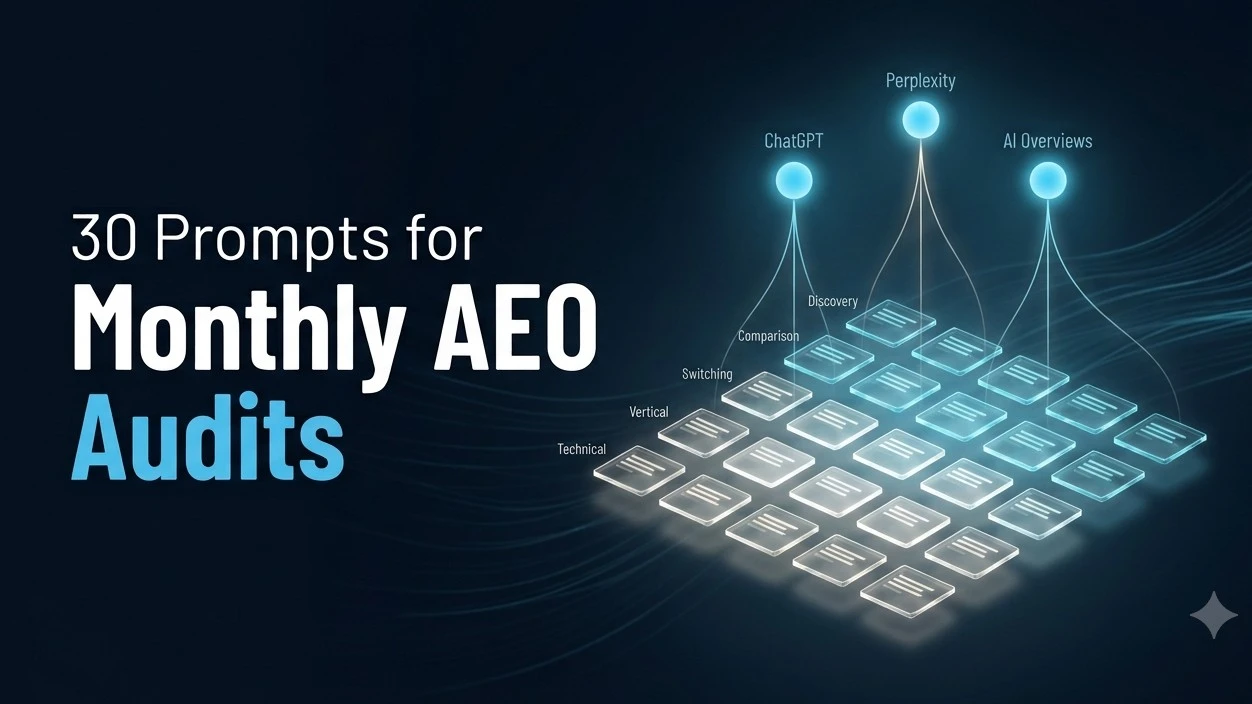
A brand cited consistently on ChatGPT can be completely absent from Perplexity, running the same query. This is the single most important thing to understand before building an AEO audit process, because it means a monthly check on one platform tells you almost nothing about your overall AI search visibility. You need a defined set of prompts, run consistently across multiple platforms, tracked over time. Most B2B teams have never built this, and the good news is that building it does not require an expensive tool.
What a Prompt Library Actually Is and Why 30 Is the Right Number
A prompt library is a fixed, documented set of queries that represents how your actual buyers ask questions when researching your category, run consistently across the same AI platforms every month so you can track directional change over time. Thirty prompts is a workable starting size for most B2B technology companies: large enough to cover the real range of buyer question types, small enough to run manually in under two hours if you do not yet have a paid tracking tool.
The prompt count matters more than people initially realize because of how tracking tools bill. Many platforms count a prompt once per platform tracked, not once per question. A library of 30 distinct questions tracked across three platforms consumes 90 tracked slots in most commercial tools, which is worth knowing before you commit to a paid tier based on the wrong math.
The Five Categories Every Prompt Library Needs
- Category one: category discovery prompts (6 prompts). These are the broad, top-of-funnel questions a buyer asks when they are still forming their understanding of the category, not yet comparing named vendors. "What is the best [category] software for [company size]" and "how do I choose a [category] platform" are representative examples. These prompts test whether your brand appears at all when a buyer is still forming their shortlist.
- Category two: named comparison prompts (8 prompts). "X vs Y" and "X vs Y vs Z" queries for your two or three most common competitive matchups. These are high-intent, late-stage prompts, and they are also the prompts where AI platforms most directly decide which vendor gets recommended over another. Include both direct two-way comparisons and any three-way comparisons that come up often in real sales conversations.
- Category three: alternative and switching prompts (5 prompts). "Alternatives to [Competitor]" and "why switch from [Competitor] to [Category]" queries. These target buyers who are actively dissatisfied with an incumbent and are the highest-commercial-intent prompts in most B2B categories, because the buyer has already identified a problem and is actively looking for a replacement.
- Category four: use-case and vertical-specific prompts (7 prompts). "Best [category] for [specific industry]" and "[category] software for [specific company size or use case]" queries. This is where most B2B companies have the least existing content and the most first-mover opportunity, because generic category content rarely serves a specific vertical or use case well.
- Category five: technical and integration prompts (4 prompts). "Does [category] support [specific integration]" and "[category] software with [specific technical requirement]" queries. These map directly to procurement-stage buyer questions and are often the prompts where specific, well-documented vendor content has the clearest advantage over vague competitor claims.
The 30 Ready-to-Use Prompt Templates
Replace the bracketed placeholders with your actual category, competitors, and vertical focus before running these monthly.
Category discovery (6):
- What is the best [category] software for [company size] companies?
- How do I choose a [category] platform?
- What should I look for when evaluating [category] software?
- What are the top [category] platforms in [current year]?
- Is [category] software worth the investment for a [company size] company?
- What questions should I ask a [category] vendor before buying?
Named comparisons (8):
- [Your Brand] vs [Competitor A]
- [Your Brand] vs [Competitor B]
- [Competitor A] vs [Competitor B] for [specific use case]
- [Your Brand] vs [Competitor A] vs [Competitor B]
- Which is better for [specific use case], [Your Brand] or [Competitor A]?
- [Competitor A] vs [Competitor B] pricing comparison
- Is [Competitor A] or [Your Brand] better for [specific company size]?
- [Your Brand] vs [Competitor A] for [specific industry]
Alternatives and switching (5):
- Best alternatives to [Competitor A]
- Why do companies switch from [Competitor A]?
- Is there a better option than [Competitor A] for [specific need]?
- What are people saying about [Competitor A] in [current year]?
- Should I switch from [Competitor A] to a newer platform?
Use-case and vertical-specific (7):
- Best [category] software for [specific industry, e.g. healthcare, manufacturing]
- [Category] platform for [specific company size] companies
- Best [category] software for [specific department or team function]
- [Category] tools for [specific regulatory environment, e.g. HIPAA, SOC 2]
- How does [category] software work for [specific business model, e.g. multi-location, franchise]?
- Best [category] software for teams under [specific budget]
- [Category] platform recommendations for [specific geography]
Technical and integration (4):
- Does [category] software integrate with [common named tool, e.g. Salesforce, Slack]?
- [Category] software with [specific technical requirement, e.g. API access, SSO]
- Which [category] platforms support [specific compliance framework]?
- Best [category] software for teams already using [common named tool]
How to Run the Audit Manually Without a Paid Tool
Open ChatGPT, Perplexity, and Google AI Overviews in separate tabs. Run each of the 30 prompts on each platform, once per month, on the same day each cycle to keep the comparison consistent. For each result, log three things: whether your brand appears at all, where in the answer it appears relative to competitors, and what specifically the answer says about your brand. A shared spreadsheet with columns for prompt, platform, date, cited (yes/no), position, and summary of what was said is sufficient to start. This takes roughly ninety minutes to two hours per month for the full 30-prompt library across three platforms.
What to Do With the Data Once You Have a Few Months of It
A single month of data tells you where you stand. Three or more consecutive months tell you whether you are gaining or losing ground, which is the only version of this data that is actually actionable. Look specifically for prompts where you were absent last month and present this month, or the reverse, and try to connect that change to any specific content you published or updated in between. This is how you build a working, evidence-based understanding of which content investments are actually moving AI citation, rather than guessing.
Prioritize fixing the prompts in categories three and four first if your team has limited content capacity. Switching-intent prompts and vertical-specific prompts are both high commercial intent and typically the least contested by existing content, which means they are usually the fastest path to a measurable citation improvement.
Frequently Asked Questions
How many prompts should a B2B company track for a monthly AEO audit?
Thirty is a solid working number for most B2B technology companies: enough to cover category discovery, named comparisons, switching intent, vertical-specific use cases, and technical integration questions, while still being manageable to run manually in under two hours if a paid tracking tool is not yet in place. Companies with limited content resources can start smaller, with ten to fifteen prompts focused on the highest-commercial-intent categories, and expand the library as the process becomes routine.
Why does a brand need to track the same prompts across multiple AI platforms rather than just one?
Citation behavior varies significantly by platform. A brand that appears consistently in ChatGPT responses for a given prompt can be completely absent from the same prompt run in Perplexity or Google AI Overviews. Tracking only one platform gives a false sense of overall AI search visibility. A minimum viable audit tracks the same prompt set across at least three platforms, typically ChatGPT, Perplexity, and Google AI Overviews, to get an accurate picture.
Can a monthly AEO audit be run without paying for a dedicated tracking tool?
Yes, particularly for a library of 30 prompts or fewer. Running each prompt manually across ChatGPT, Perplexity, and Google AI Overviews, and logging the results in a shared spreadsheet, takes roughly ninety minutes to two hours per month and is a reasonable starting point for most B2B teams. Paid tools become more valuable once a team is tracking 50 or more prompts across four or more platforms, where manual tracking becomes too time-consuming to sustain consistently.
What should a B2B team log for each prompt during a monthly AEO audit?
At minimum: whether the brand appears in the answer at all, the brand's position relative to named competitors if multiple vendors are mentioned, and a brief summary of what the answer specifically says about the brand. Tracking this consistently over several months allows a team to correlate citation changes with specific content updates, which is what makes the audit data actionable rather than just descriptive.
Which prompt category typically offers the fastest path to measurable AI citation improvement?
Vertical-specific and use-case prompts, along with switching-intent prompts targeting named competitors, typically offer the fastest improvement path. These prompt categories tend to have less existing competitive content than broad category discovery prompts, meaning that a single well-structured, specific piece of content can move the needle more quickly than trying to compete for a heavily contested general category term.
References
- My Web Audit, AEO Prompt Strategy for Agencies, prompt slot counting mechanics and per-platform tracking cost structure: https://www.mywebaudit.com/blog/aeo-prompt-strategy-for-agencies
- AI Labs Audit, AEO Checklist 2026, platform-specific citation variance and ten-prompt starting audit methodology: https://ailabsaudit.com/blog/en/aeo-checklist-2026-actions
- Airefs, 12 Best AEO Tools in 2026, prompt tracking tier structures and platform coverage comparison across commercial tools: https://getairefs.com/blog/best-aeo-tools/
- StackMatix, Best AEO Tools for AI Visibility 2026 Complete Guide, weekly and monthly tracking cadence recommendations: https://www.stackmatix.com/blog/aeo-tools-complete-guide


