
I know this scenario because I have lived on both sides of it. A rep is deep in a late-stage deal, the prospect asks for a reference from a company in their specific industry, and the answer that comes back from marketing is some version of "we don't have one for that vertical, let me see what I can find." The rep loses momentum. The deal cools by a few degrees. And marketing spends the next two weeks trying to schedule an interview with a customer who is, understandably, busy.
53% of sellers say missing the right customer evidence is actively slowing down their sales process. That is not a content gap. It is a collection process gap, and it is fixable without ever cold-emailing a customer asking them to "hop on a quick call for a testimonial."
Why the Traditional Case Study Process Fails Structurally
The traditional approach treats customer proof as an event: identify a good customer, request their time, schedule an interview, write a polished narrative, route it through legal for approval, publish it. Each step in that sequence has its own failure points. Customers want to protect their competitive advantages and are reluctant to share specifics. Champions who agreed to participate move to new companies before the piece is finished. Legal approval alone can take anywhere from a day to over a month. By the time a traditional case study is published, the specific deal that needed it has often already closed or died.
The deeper problem is that this process produces proof in the wrong shape for how it actually gets used. Traditional case studies are polished and broad, built to represent a customer's overall success. But the go-to-market questions that come up in real deals are specific and situational: does this work for a company our size, has anyone in our industry solved this exact problem, how does this compare to what we're currently using. A broad, polished case study answers none of those questions precisely, which is why sales teams keep needing something new even when a case study library technically exists.
The Reframe: Customer Evidence, Not Case Studies
The fix that is actually working for B2B teams in 2026 is treating customer proof as an ongoing, always-on collection process rather than a discrete production project. Instead of asking "do we need a case study," the operating question becomes "what customer evidence do we have on hand right now, for this specific situation," with evidence defined broadly: a specific quote, an ROI statistic, a Gong call excerpt, a G2 review passage, a Slack message a customer sent unprompted.
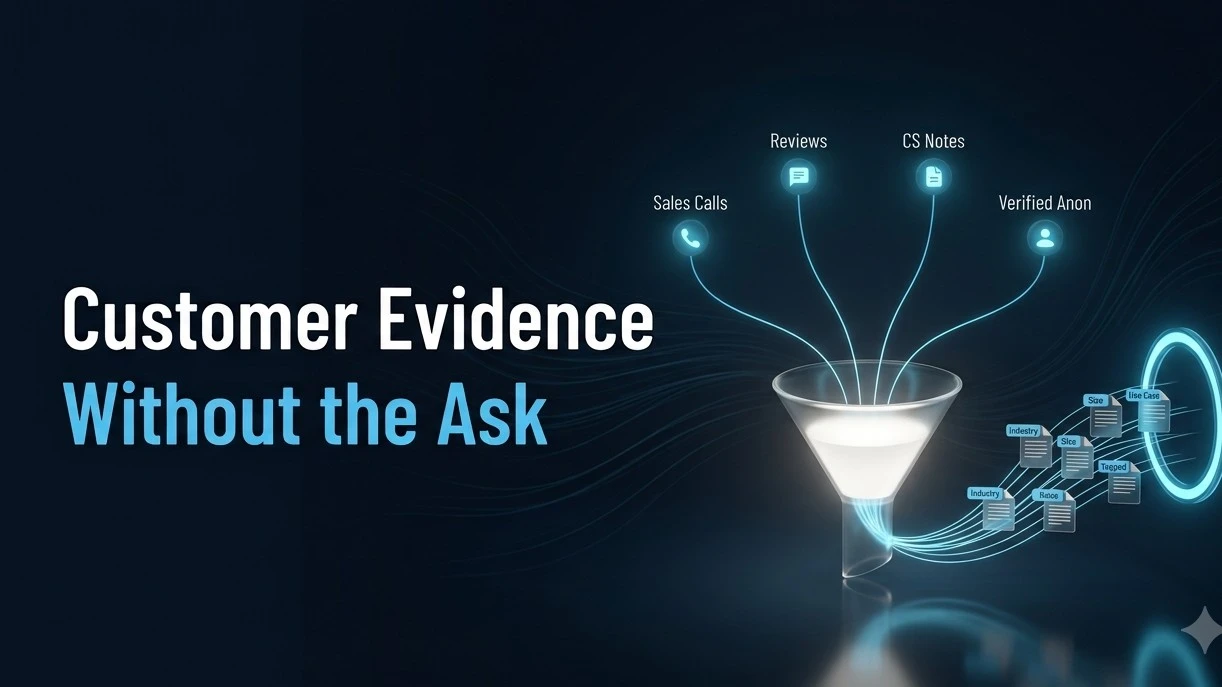
This reframing changes where the content comes from. A formal case study requires scheduling a dedicated interview. Customer evidence can be captured continuously from conversations already happening: sales calls, support tickets, renewals, QBRs, review submissions. None require a customer to set aside dedicated interview time. They require someone on your team to notice when something usable was just said and capture it.
The Four Sources That Generate Evidence Without a Single Extra Ask
- Sales call recordings. Conversation intelligence tools capture the moments where an existing customer, brought onto a call as a reference or mentioned by a rep, says something specific and quotable about a result. These moments happen constantly and are almost never captured systematically. A monthly pass through recent call recordings, specifically searching for customer-said proof points, produces a steady stream of usable material without a single additional customer interaction.
- Review site submissions. G2, TrustRadius, and Capterra reviews are customers volunteering specific, detailed proof entirely on their own initiative, often including exact numbers and named use cases. Most companies treat these reviews as a rating to display and never mine the actual text for quotable, specific claims that could be repurposed into other content. A quarterly review of new submissions, pulling out any review with a specific number or a named result, is one of the highest-yield, zero-additional-ask sources available.
- Support and success team conversations. Customer success managers hear specific outcome statements constantly, in QBRs, in renewal conversations, in casual check-ins, that never make it anywhere near a marketing team. A simple internal habit, a Slack channel where CS and support teams drop any customer statement that sounds like it belongs in marketing content, turns an existing conversation into a continuous evidence pipeline with no added burden on the customer.
- Anonymous but verified proof. For customers unwilling to be named publicly, particularly common in cybersecurity, financial services, and healthcare, a third party can confirm the outcome without publishing the customer's identity. This unlocks evidence from an entire category of customers who would otherwise contribute nothing to your public proof library, simply because attribution was the sticking point rather than the willingness to share results.
Building the System That Makes This Sustainable
The technical infrastructure does not need to be sophisticated to start. A single, well-organized, searchable document or lightweight internal tool, tagged by industry, company size, use case, and competitor mentioned, turns scattered evidence into something a rep can query in under a minute during a live deal. The specific tagging structure matters more than the tool itself: a rep who needs proof for a mid-market fintech deal should be able to filter directly to that combination rather than scrolling through everything the company has ever collected.
Sales reps can query this library directly, or increasingly, teams are building simple internal AI assistants that let a rep ask a natural-language question like "give me proof points from mid-market healthcare customers" and get back exactly the relevant evidence, pulled from the tagged library, in seconds rather than a Slack message to marketing and a wait.
The Governance Layer That Prevents This From Becoming a Liability
Every piece of evidence collected this way needs a lightweight but real approval and usage-rights record: who said it, whether they consented to it being used publicly, in what channel, and whether that consent has an expiration date. Skipping this step to move faster creates real legal and trust risk down the line, particularly for named quotes and specific customer results.
The workable middle ground most B2B teams land on is a tiered consent system: broad blanket consent captured at contract signing for anonymous or aggregated statistics, and specific opt-in consent requested only when a particular quote or story is being considered for a named, public use. This keeps the continuous collection process light while still protecting the customer relationship and the company's legal standing when a specific piece of evidence gets used publicly.
Why This Matters More for AI Search Visibility Specifically
Published case studies and named customer evidence have become the primary proof layer that AI platforms cite when recommending solutions to buyers researching a category. When a buyer asks ChatGPT or Perplexity for a recommendation, the model favors content with specific, measurable, attributable results over generic marketing claims, precisely because specific customer evidence is verifiable in a way that a company's own claims about itself are not.
A continuous, always-on evidence collection system produces exactly the kind of content that earns these citations: specific numbers, named industries, named use cases, distributed across many smaller pieces of proof rather than concentrated in a handful of polished, infrequently updated case studies. The always-on approach is not just more sustainable operationally. It produces a larger, more current, and more AI-citable body of proof than the traditional case study pipeline ever could on its own.
Frequently Asked Questions
What is the difference between traditional case studies and continuous customer evidence collection?
Traditional case studies are produced as discrete projects: identify a customer, schedule an interview, write a polished narrative, route through legal approval. Continuous customer evidence collection treats proof as an ongoing byproduct of conversations that are already happening: sales calls, support interactions, review site submissions, captured and organized systematically rather than requested through a dedicated customer interview process. The continuous approach produces more proof, faster, without requiring additional customer time.
How can a B2B company get customer proof without scheduling formal interviews?
Four sources generate usable evidence with no additional customer ask: sales call recordings reviewed periodically for quotable moments, review site submissions on G2, TrustRadius, and Capterra mined for specific claims customers volunteered on their own, internal Slack or documentation habits where customer success teams capture outcome statements from renewal and QBR conversations, and anonymous-but-verified proof for customers unwilling to be named publicly. None of these require the customer to set aside dedicated time for an interview.
How should a company organize customer evidence so sales reps can actually use it?
A searchable library tagged by industry, company size, use case, and named competitor is the minimum viable structure. Reps should be able to filter directly to the specific combination relevant to a live deal, such as mid-market fintech customers who switched from a specific competitor, rather than scrolling through an undifferentiated collection. Some teams add a natural-language query layer on top of this tagged library so reps can ask a direct question and retrieve relevant evidence in seconds.
What consent process is appropriate for continuously collected customer evidence?
A tiered approach works best for most B2B companies: broad consent for anonymous or aggregated statistics captured at contract signing, and specific opt-in consent requested only when a particular quote, story, or named result is being considered for public use. This keeps the continuous collection process lightweight while protecting the customer relationship and the company's legal standing whenever a specific piece of evidence is actually published.
Why does continuously collected customer evidence perform better for AI search visibility than traditional case studies alone?
AI platforms favor specific, measurable, attributable proof over generic marketing claims when selecting sources to cite in response to a buyer's question. A continuous evidence collection system produces a larger volume of specific, current, named proof points distributed across many pieces of content, rather than concentrating proof in a small number of infrequently updated, broadly written case studies. This larger and more current body of specific evidence gives AI models significantly more citable material to draw from.
References
- UserEvidence, 7 Best B2B Case Study Software Tools for Customer Marketers in 2026, 53% seller evidence gap data and anonymous verified proof capability: https://userevidence.com/blog/b2b-case-study-software-tools/
- UserEvidence, Case Studies Had Their Run, In 2026 It's Going to Be All About Customer Evidence, always-on evidence framework and 58% AI research starting point data: https://userevidence.com/blog/case-studies-had-their-run-in-2026-its-going-to-be-all-about-customer-evidence/
- Column Five Media, B2B Marketing Case Studies: 15 Winning Examples 2026, AI tools for vendor discovery adoption data and AI citation proof layer analysis: https://www.columnfivemedia.com/great-b2b-marketing-case-studies/
- LeadsuiteNow, B2B Case Studies for Lead Generation in 2026, case study repurposing framework and content multiplication strategy: https://leadsuitenow.com/blog/b2b-case-study-lead-generation-2026


