
"Most teams still treat release notes like leftover work. The feature ships. The team celebrates. Then someone scrambles to write a vague update three days later and dumps it into a blog feed nobody reads." That is Userorbit's characterization of the state of B2B SaaS release notes in 2026, and it is accurate for the majority of companies shipping product weekly.
The same session that ships the feature should produce a release note structured for three simultaneous audiences: the customer who needs to know what changed and why it matters, the AI assistant that will be asked "does this tool support X yet?" and must find the answer in your changelog, and the marketing team that can turn a well-structured product update into six pieces of derivative content without writing anything new.
What Is a Release Note That Functions as Marketing Content?
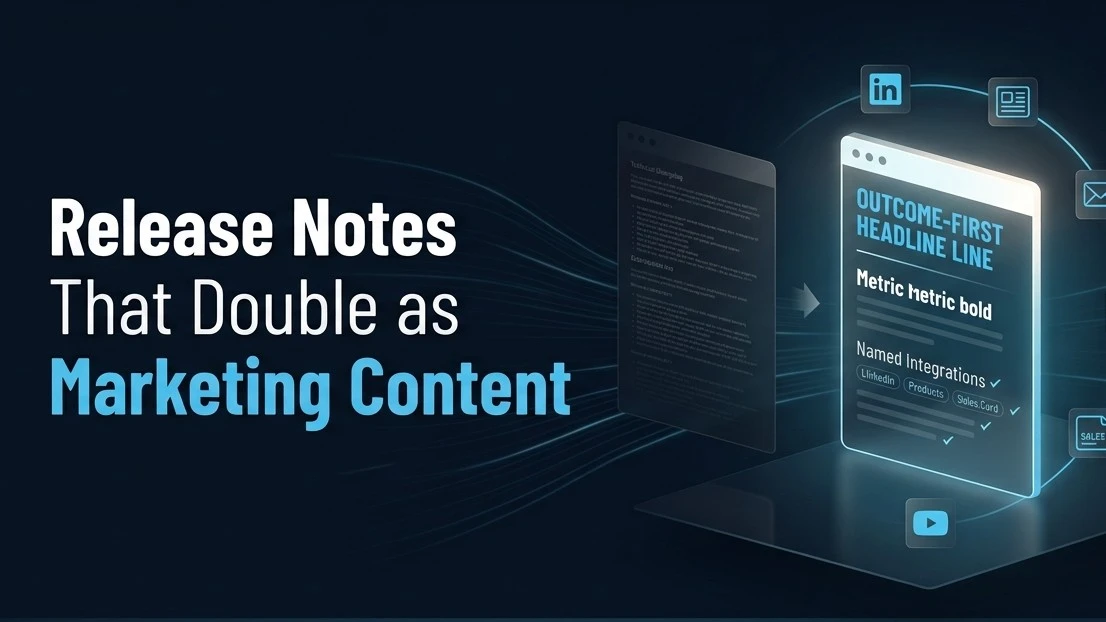
A release note doubles as marketing content when it meets three criteria that most do not. It opens with a user outcome rather than an engineering description. It contains at least one specific metric or named capability that makes the claim verifiable. It is published in a location that AI crawlers can read, with a URL, a page title, and structured description that reflects the feature's actual function.
"v2.4.1: Fixed race condition in authentication token refresh" is a changelog entry that engineers can track and that serves zero marketing function. "Enterprise teams can now add new user seats without contacting support, reducing provisioning time from 2 business days to under 5 minutes" is the same update expressed for a buyer audience. Both are accurate. Only one is a marketing asset.
Well-crafted release notes boost user engagement by up to 300% according to current B2B SaaS product documentation research. That engagement translates directly into feature adoption, which translates to retention. The feature that ships and that customers do not notice because the release note describes it in engineering terms is the feature that does not improve renewal rates.
The Architecture That Serves All Three Audiences
The structure that makes a release note readable, marketable, and AI-searchable without being any longer than it needs to be:
- Title: Outcome-first, under 10 words. "Bulk user provisioning now takes minutes, not days" serves the customer, the marketer pulling quotes, and the AI model trying to answer "can this platform handle bulk user provisioning." "v2.4.1: Provisioning update" serves none of them.
- First sentence: Direct statement of what changed and who benefits. No setup, no context about why the team worked on this. "Enterprise administrators can now bulk-add users via CSV import, with roles assigned automatically from your existing directory." That sentence is complete without what follows. What follows is supporting detail, not the answer.
- Second paragraph: One specific metric or named improvement. "Previously, adding 50 users required a support ticket with a 2-business-day SLA. The new flow completes in under 5 minutes for any batch size." This is what makes the note both trustworthy to the reader and citable by an AI model. Specific, verifiable, comparative.
- Third element: A named integration or compatibility detail where relevant. "Works with Okta, Azure AD, and Google Workspace directories." Named integrations in release notes are citation anchors for AI models answering "does this platform integrate with X" queries. They are also the most commonly missing element in B2B SaaS release notes.
- Tags and category labels. Labeling updates as "Performance," "Enterprise," "Integration," or "Security" enables AI tools to search changelogs by category when answering questions like "what security updates has this platform shipped in the last 6 months." Without tagging, the content exists but is not navigable.
The AI Crawler Problem Nobody Addressed Until 2026
AI assistants and agents now read changelogs to answer questions like "does this tool support X yet?" and "was that bug fixed?" If release notes only exist as rendered HTML in a JavaScript-heavy widget, AI tools cannot read them reliably.
69% of AI crawlers cannot execute JavaScript. A release note published inside a dynamically-loaded changelog widget is partially or entirely invisible to the models answering buyer questions about your product's capabilities. The same update published as a static, indexed page with a descriptive URL, readable heading hierarchy, and structured text is citable.
The minimum viable setup: every release note should have its own URL, even if it lives under a /changelog/ path. The URL should include descriptive keywords, not just version numbers or dates: /changelog/bulk-user-provisioning-csv-import is findable; /changelog/2026-05-15 is not.
The Brand Voice Question
Three recognizable approaches exist in the market. Linear and Stripe use clean, technical precision, exact version numbers, exact changed behaviors, no personality. This works for developer-centric audiences who expect precision and distrust marketing inflection in documentation. Slack, Notion, and Discord use brand voice, personality-forward updates that reflect the product's character and become readable as standalone content.
The hybrid approach, which Announcekit and other changelog platform operators recommend as the 2026 best practice, leads with one or two personality-forward sentences acknowledging the user's experience, then transitions into a clear bulleted list of what actually changed. This earns the engagement benefits of brand voice while preserving the utility that technical buyers need. For most B2B SaaS products serving mixed audiences of technical and business users, this is the structure that serves the most readers without alienating either group.
The key constraint: the personality should be in the framing, not in the facts. "Good news for operations teams managing large accounts: you can now" is personality. Replacing a specific metric with a vague claim to make it sound friendlier is not.
The Six Derivative Assets a Well-Written Release Note Produces
A release note structured with the outcome-first architecture above produces derivative content without any additional expert time or original research:
A LinkedIn text post using the metric from the second paragraph as the hook. A customer success email notifying affected users of the change. An update to the relevant product page reflecting the new capability. An addition to the FAQ section of the pricing page if the feature was requested during sales conversations. A one-line addition to the competitive battlecard if the feature closes a gap against a named competitor. An update to the integration page for each named directory or system in the release note.
None of these require rewriting. They require lifting the content from a well-structured release note and placing it in a different context. Teams that structure release notes for extractability produce six to eight downstream marketing and sales touchpoints per release. Teams that treat release notes as documentation produce one changelog entry that nobody shares.
Frequently Asked Questions
What is the difference between a release note and a changelog in B2B SaaS?
A changelog is typically a technical, version-specific log written for developers and power users who need to track exact code-level changes, integrations, and API updates. A release note is written for a broader customer audience and focuses on user outcomes rather than technical specifications. The distinction matters for release note content strategy: the target audience is not engineers reading documentation but customers evaluating whether their product is improving and marketing teams building derivative content from product updates.
How should the first sentence of a B2B SaaS release note be written?
Lead with the user outcome or capability change, state who benefits, and include what changed specifically, all in one sentence. "Enterprise administrators can now bulk-add users via CSV import, with roles assigned automatically from your existing directory" meets all three criteria. The setup for why the team worked on this, the historical context, and the engineering description come later or not at all. Buyers and marketing teams both need the outcome first.
Why do most B2B SaaS release notes fail to serve as marketing content?
Three structural failures account for most of the gap: opening with engineering description rather than user outcome, omitting specific metrics or named integrations that make claims verifiable and citable, and publishing in JavaScript-heavy widgets that AI crawlers cannot read. The same update restructured with an outcome-first title, one specific metric, named integrations where relevant, and a static indexed URL serves marketing, customer success, and AI search visibility simultaneously.
How can release notes improve AI search visibility for B2B SaaS products?
AI assistants increasingly answer buyer questions about whether a specific platform supports a specific capability by searching changelog and documentation content. A release note published on a static, indexed URL with the capability described in plain language, including named integrations, specific use cases, and measurable improvements, is citable by these systems. The same update buried in a JavaScript widget or described only in version number notation is not.
What is the right cadence for publishing B2B SaaS release notes?
Teams on continuous deployment who ship multiple times weekly should batch release notes rather than publishing per-commit. One weekly or bi-weekly summary that groups related changes under user-facing outcome categories performs better for reader engagement and AI indexability than daily micro-updates. Teams on scheduled release cycles should publish release notes within 24 hours of a release, not three days later when the internal celebration is over and nobody remembers what shipped.
References
- Userorbit, Best Changelog Software and Release Notes Tools for SaaS Teams 2026, release notes as operational guilt versus activation asset
- ReleasePad, SaaS Release Notes 2026, AI agents reading changelogs, machine-readable requirement
- AnnounceKit, Best App Release Notes 2026, brand voice architecture and hybrid approach
- Infrasity, Product Release Notes 101, 300% engagement lift from well-crafted release communication
- Kalungi, 10 Tips to Write Effective B2B SaaS Release Notes, audience-first structure


