
63% of B2B AI-adopting marketers name webinar repurposing as their primary AI use case in 2026. The statistic is not surprising when you trace what happens to a typical 60-minute webinar: one live session, attended by roughly half the registrants, and then a recording that sits gated in a resource library accumulating dust while the team plans the next one.
The loss in that gap is structural, not creative. The session itself usually has the goods. The system around it does not.
What Does "Webinar Content Dies" Actually Mean?
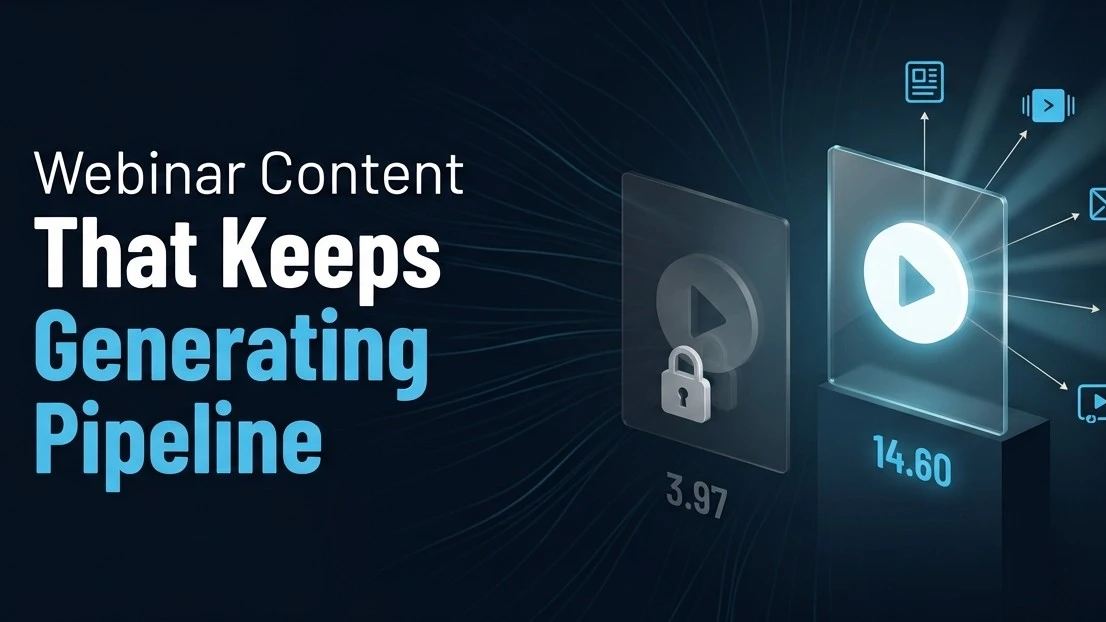
Replays generate 2.4 times the unique viewers of live sessions, per ON24's 2026 benchmark data. 50% of webinar attendees now watch on-demand rather than live. Despite this, 62% of teams gate their replays. Livestorm's benchmark data shows gated replays average 3.97 on-demand views; public replays average 14.60. That is a 368% difference in viewership attributable almost entirely to the friction of a gate.
This is the structural loss. The session captured real expert thinking. The follow-up system either locks it behind a form that kills organic discovery, buries it in a resource library with no ongoing promotion, or treats it as a one-off event rather than a content asset with a 90-day pipeline window.
Webinars that keep generating pipeline do not do this because the speakers were better. They do it because someone designed the post-event system deliberately.
The Replay Decision Is the Highest-Leverage Post-Event Choice
Gating replays captures email addresses. Public replays generate 368% more views, enable social sharing, and allow Google indexing so people find the session searching for the topic months later. The trade-off favors public replay for almost every B2B technology company whose goal is pipeline influence rather than raw email capture.
The buyers who would fill out a form to watch a webinar replay are a small subset of buyers who would watch a public replay and potentially reach out six weeks later after their existing contract expires. The latter group is more valuable and more numerous. They also do not appear in your replay registration data, which is partly why the pipeline attribution from webinars is chronically underreported.
One structural workaround: publish the replay publicly on a dedicated indexed URL, then gate a related companion asset, a summary PDF, a structured Q&A document, an implementation checklist derived from the session. The replay builds authority and organic discovery. The gate captures intent from buyers who want to go deeper.
The 10-Asset Extraction Framework
One 60-minute webinar contains enough material for a month of content across channels. Most teams extract one or two assets and move on. The extraction framework below runs systematically from the session transcript, requires no additional expert time, and produces assets with demonstrably different distribution surfaces.
- From the Q&A section alone: The live Q&A typically generates the most specific, practitioner-level exchanges in the session. Extract five to eight questions that surfaced during the session and write direct answers in blog FAQ format. This produces the most AEO-relevant content from the session because buyer questions in a live Q&A map closely to buyer queries in ChatGPT. A structured page with these Q&A pairs, published with FAQPage schema, is a direct AI citation candidate for buyers asking the same questions months later.
- From the key argument or framework presented: Most webinars present one central argument, model, or process. This translates to a LinkedIn carousel naturally, one slide per step or principle, five to eight slides total. The carousel format performs differently on LinkedIn than a video clip or text post, reaching people who prefer visual learning and enabling save-and-share behavior that extends distribution.
- From specific statistics cited during the session: Each statistic with sufficient standalone context becomes a LinkedIn text post. "X% of B2B teams are doing Y, and here's what that costs them" is a post format that performs consistently on professional audiences. Three to five of these emerge from most sessions without additional research.
- From the session recording itself: Two to three short clips, 60 to 90 seconds each, focused on the moment with the most quotable insight or the clearest demonstration of a concept. These perform differently from carousels and text posts and reach a separate segment of your audience on LinkedIn and YouTube.
- From the full transcript: One blog post structured as a narrative summary of the session's argument, with the original examples recontextualized for text reading. This earns SEO and AI search visibility for the topic cluster the session covered.
- From the attendee questions: An email newsletter edition that answers the three most common attendee questions from the session, with a link to the public replay. This serves both the registrants who missed the live session and the newsletter list who were not registered.
That is nine or ten distinct assets, each with a different primary distribution channel, each reaching a portion of the target audience that the live session itself did not reach.
The 90-Day Pipeline Window
Webinar-influenced pipeline should be tracked in a 90-day window, not 30 days and not the week after the event. The buyer who watched your replay four weeks after the live event and booked a demo six weeks after that is a webinar-influenced deal. Last-touch attribution never captures this. Multi-touch attribution with a 90-day window captures most of it.
Livestorm's benchmark data shows that tracking webinar-influenced and webinar-sourced pipeline in a 90-day window consistently reveals that webinars generate more pipeline than teams think they do, specifically because the on-demand discovery that happens weeks after the live event goes invisible in standard last-click reporting.
The practical setup: tag every webinar registration with a UTM parameter, connect the registration form to your CRM, and configure a 90-day pipeline influence window that tracks all accounts where at least one contact registered for the webinar. Then close the loop with sales: which of your open deals have contacts who attended a webinar in the last 90 days, and how many of those deals mention the webinar's topic in discovery call notes?
What AI Search Visibility Adds to This Framework
A webinar transcript is one of the richest sources of citation-ready content that most B2B technology companies never use for AEO purposes.
The Q&A pairs derived from the session answer the same questions buyers are asking in AI platforms. Structured and published with a direct answer-first format, they are strong candidates for AI citation in the topic cluster the webinar covers. The session recording itself, if published to YouTube with a structured description, a timestamped chapter list, and a full transcript in the description, is crawlable by AI systems in ways that an embedded private recording behind a form gate is not.
ReleasePad's observation applies here: AI assistants and agents now read public web content to answer questions. A public webinar replay with a structured description and searchable transcript answers buyer questions that a gated recording never can.
Frequently Asked Questions
Why do most B2B webinars fail to generate ongoing pipeline after the live event?
The primary cause is a post-event system that treats the webinar as a one-time event rather than a content asset. Gating the replay limits organic discovery to 3.97 average views versus 14.60 for public replays. Extracting only one or two derivative assets leaves the majority of the session's content potential unexploited. Not tracking pipeline in a 90-day window makes webinar ROI appear lower than it actually is by missing on-demand views and delayed conversions.
Should B2B technology companies gate or not gate webinar replays?
The data favors public replays for companies whose primary goal is pipeline influence rather than email list growth. Public replays generate 368% more views, enable organic search indexing, and allow social sharing that extends reach to buyers who were not in the original registrant pool. The compromise position, public replay with a gated companion asset, captures both: organic discovery from the replay and intent signals from buyers who engage further with the companion download.
How many content assets should one 60-minute B2B webinar generate?
Ten to fifteen assets is achievable without additional expert time, derived from the session transcript and recording. The asset map covers LinkedIn carousels, text posts, short video clips, a blog post, a FAQ page, an email newsletter edition, and a YouTube video with a structured description. Each format reaches a different audience segment and performs differently across distribution channels. Most B2B teams generate one or two assets and leave the remainder untapped.
What is the correct attribution window for measuring webinar pipeline impact?
90 days. Standard 30-day attribution windows miss the pipeline generated by on-demand replay views and the delayed conversion behavior common in complex B2B buying cycles. A buyer who watched a replay in week three, re-engaged with follow-up content in week six, and booked a demo in week ten is a webinar-influenced deal that last-touch attribution will attribute to the demo page.
How do webinar Q&A sessions connect to AEO and AI search visibility?
Live Q&A generates the most specific, buyer-language questions in the session. These questions map closely to the queries buyers run in ChatGPT and Perplexity about the same topic. A structured FAQ page derived from session Q&A, published with FAQPage schema and direct answer-first format, is a strong AI citation candidate for buyers researching the topic cluster weeks or months after the session. This is AEO derived from content you have already produced rather than requiring new research.
References
- Geisheker, B2B Webinar Strategy 2026, ON24 benchmark data, replay 2.4x live viewers, 10-asset extraction framework
- Livestorm, Webinar Benchmark Report 2026, 368% more views for public vs gated replays, 90-day pipeline tracking
- Contrast, Webinar Statistics 2026, attendance rate and AI repurposing data
- Wave Connect, Webinar Statistics 2026, 69% CTA conversion rate and on-demand behavior data


