
There is a reliable cycle to content calendar planning at B2B technology companies, and if you have been in the room for more than one quarter, you recognize every phase of it. Phase one: marketing builds a thoughtful, well-reasoned calendar. Phase two: sales has an urgent need for a competitive one-pager about a deal that is closing Thursday. Phase three: the CEO mentions on a Tuesday afternoon that they would like a blog post about a thing they read about on a plane. Phase four: it is November, nothing from the original calendar shipped, and somehow the team is both exhausted and behind.
This is not a laziness problem. It is a structural problem, and it happens to smart, organized marketing teams at good companies all the time.
What Is a Content Calendar Framework?
A content calendar framework is not a spreadsheet with topics and deadlines. Any team can make that spreadsheet in forty minutes and watch it become fiction by week three. A content calendar framework is the set of rules that governs how new requests are evaluated, prioritized, and either absorbed or declined, so the original plan does not die every time something urgent enters the picture.
The difference matters because the urgent things will always enter the picture. That is not a solvable problem. What is solvable is having a structure that handles urgent requests without detonating everything else.
Why Most Content Calendars Fold Under Pressure
The problem is not that sales requests are unreasonable. Most of them are not. A competitive asset for a hot deal is a legitimate need. The problem is that content calendars are typically built as if the content team lives in a sealed room where no new information arrives between planning sessions. Every slot is filled. There is no slack. The calendar is essentially a bet that nothing unexpected will happen, which in B2B technology is roughly equivalent to betting that it will not rain in Seattle.
When an urgent request arrives, and the calendar has no room, one of two things happens. Either the team says no, and sales is frustrated. Or the team says yes and something from the plan gets bumped, and then bumped again, and eventually abandoned. Most teams default to the second option because it feels more collaborative, and then wonder why the strategic content never ships.
The Framework That Holds Up
Three structural habits separate content calendars that survive a quarter from ones that do not.
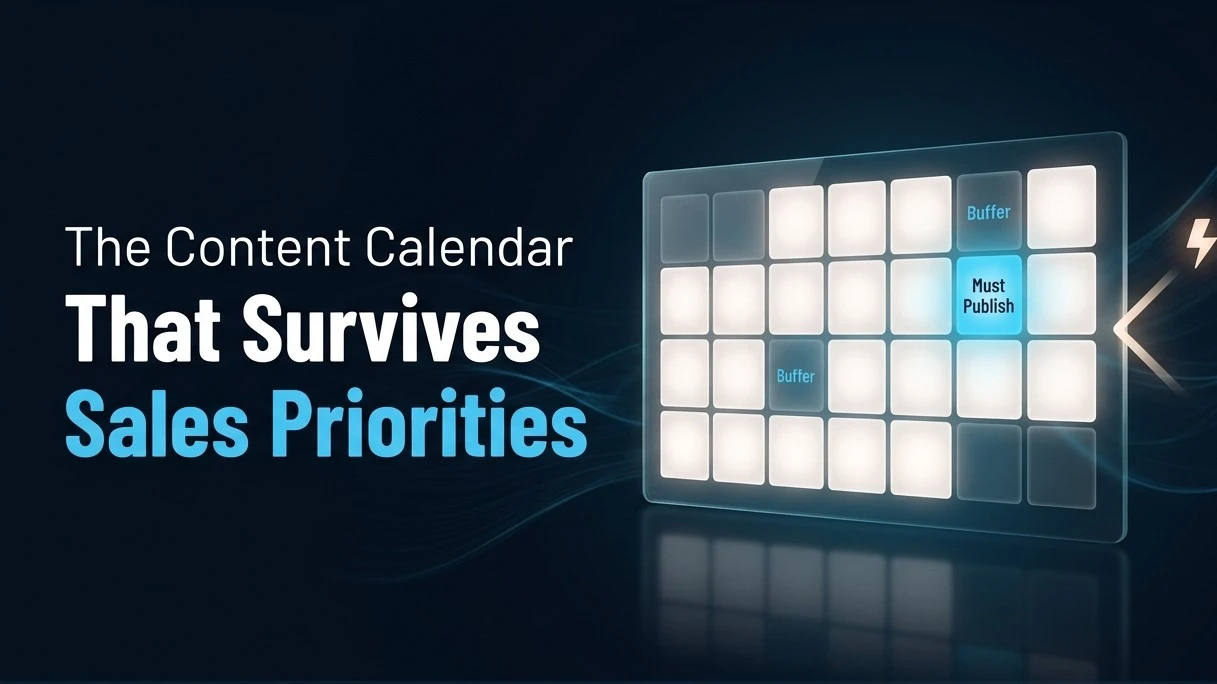
- Reserve 20 to 25 percent of capacity as an uncommitted buffer. If your team can produce twelve pieces of content in a month, plan ten. Not twelve. The two unplanned slots are not laziness. They are operational margin for the competitive asset that shows up Thursday, the CEO blog that appears Tuesday, and the customer story that needs to be written before the conference in three weeks. Teams that try to run at 100% capacity cannot absorb anything unexpected. Teams that run at 80% can absorb two or three urgent requests without derailing their strategic work. This is the single most resisted advice in content planning, because it feels like leaving capacity on the table. It is not. It is the price of shipping your strategic content at all.
- Separate "must publish" from "should publish" in the calendar structure. Every piece of planned content gets categorized as either load-bearing or optional at the start of the quarter. Load-bearing content is the SEO piece targeting the keyword you actually care about, the AEO article your AI search visibility strategy depends on, the case study the sales team has been requesting for six months. Optional content is the topical piece about an industry trend, the thought leadership blog that would be nice to publish but does not anchor anything specific. When an urgent request arrives, optional content gets bumped first. Load-bearing content does not move without a deliberate conversation and a specific reason. This sounds obvious until you are in the third week of a quarter and someone suggests moving the most important content piece because a sales request came in. The categorization makes the decision easier because the stakes of moving it are explicit.
- Give sales a formal intake path instead of an always-open channel. This one sounds bureaucratic and is actually the most liberating thing a content team can implement. The intake path does not have to be complicated: a shared form or Slack channel where sales submits requests with the deal context, the deadline, and the existing content they have already tried. Every request gets a response within 24 hours: yes, with a timeline; no, with an explanation and an alternative; or "we have this already and here is the link." The intake path does two things. It makes implicit demands explicit, so the team can see the full volume of requests and prioritize intelligently. And it stops the ad hoc hallway conversation from becoming an implicit commitment before anyone has looked at the calendar.
The GEO and AI Search Connection That Makes This More Urgent
Here is why the content calendar problem has higher stakes in 2026 than it did in 2021. AI search visibility is built on consistency and topical depth. A content program that ships ten strategic articles across a quarter builds measurably more AEO and GEO traction than the same program that ships four strategic articles and six reactive pieces for sales.
The AI platforms that decide whether to cite your brand are not impressed by volume. They are impressed by consistent, specific, well-structured coverage of the topics you are trying to own. A content calendar that gets derailed every quarter by urgent requests does not build that coverage. It builds a patchy, reactive content footprint that does not develop the topical authority AI models look for when they decide who to cite.
Running the buffer system and the must-publish categorization is not just a planning hygiene habit. It is the operational discipline that makes AI search visibility strategies actually work, because strategic content actually ships.
The Conversation Worth Having Before Next Quarter
Before planning the next calendar, get marketing and sales in a room for thirty minutes with one question on the agenda: what does sales actually need from content, not what they ask for, but what would move deals. The honest answer is usually a shorter list than the ad hoc request stream suggests, and a more specific one. If sales needs two competitive assets, three updated case studies, and one objection-handling guide, build those into the calendar as load-bearing pieces and protect them. Then the rest of the calendar is strategic content that is not competing with reactive requests, because the reactive needs are already accounted for.
That conversation, once per quarter, beats a year's worth of trying to juggle urgent requests against strategic plans without either side knowing what the other actually needs.
Frequently Asked Questions
What is a content calendar framework for B2B marketing teams?
A content calendar framework is the set of rules that governs how new content requests are evaluated, prioritized, and handled so that a planned content strategy does not collapse every time an urgent sales request arrives. Unlike a basic content calendar, which is a list of topics and deadlines, a framework addresses the operational question of what happens when reality diverges from the plan, which in B2B technology marketing happens every single quarter.
How much buffer capacity should a B2B content calendar reserve for urgent requests?
20 to 25 percent of monthly capacity is the working range that holds up under normal B2B sales pressure. On a team that can produce twelve content pieces per month, planning ten gives the team two unplanned slots to absorb urgent competitive assets, leadership requests, and other legitimate reactive needs without detonating the strategic content plan. Teams that plan at 100% capacity cannot absorb any urgent requests without moving or abandoning planned content.
How should marketing handle sales requests that arrive outside the planning cycle?
A formal intake path, a shared form or channel where sales submits requests with deal context, deadline, and existing content already tried, is more effective than an always-open ad hoc channel. The intake path makes all requests visible simultaneously, allows prioritization against the existing plan, and ensures every request gets a response within 24 hours rather than an implicit commitment followed by a difficult conversation about timeline later.
How does a well-maintained content calendar support AEO and AI search visibility?
AI search visibility is built on consistent topical depth. An AEO strategy that depends on publishing eight to ten articles in a topical cluster over a quarter does not produce results if four of those articles get bumped for reactive requests and only four ship. The buffer system and must-publish categorization are not just planning preferences. They are the operational requirements for an AI search strategy that actually has consistent content behind it.
How do you stop the CEO or leadership from derailing a content plan?
The categorization system helps here. If leadership suggests bumping a load-bearing content piece, the conversation is about what that piece anchors, not about whether leadership's idea is good. The explicit stakes make the trade-off visible. Many leadership requests can be absorbed into the buffer capacity without displacing strategic content, which is the right answer to propose when the topic actually has merit.
References
eMarketer, B2B SEO and GEO 2026, on AI search visibility requiring content consistency: https://www.emarketer.com/content/b2b-seo-geo-2026
Fountain City Tech, GEO for B2B Practitioner's Guide, on content structure and topical authority for AI citation: https://fountaincity.tech/resources/blog/geo-for-b2b-companies-practitioner-guide/
AuthorityTech, B2B AEO Strategy, on consistent topical coverage driving citation rates: https://thesmarketers.com/blogs/b2b-aeo-strategy-ai-citations/


