
Quarterly planning usually starts with a blank document and a list of new topics. It should start with a list of everything you have already published. Most teams skip that step because a content audit sounds like a two-week project that ends with a spreadsheet nobody looks at again. It does not have to be either of those things.
What Is a B2B Content Audit?
A B2B content audit is a structured review of everything you have published, blog posts, landing pages, case studies, guides, scored against current performance, and sorted into a decision for each piece: keep it, fix it, combine it with something else, or take it down. The output is not a report. It is a worklist with owners attached. The reason this matters before quarterly planning specifically: Google's helpful content systems evaluate your entire domain, not page by page. A site with a long tail of thin, outdated content can drag down the ranking potential of the pages you actually care about. Removing or improving weak content has a measurable, domain-wide effect, which means an audit is not just a cleanup. It is a lever for everything you publish next quarter, too.
Why "More Content" Keeps Losing to "Better Content"
Here is the number that should reframe this conversation. In high-growth SaaS environments, even a partial content audit can return 5 to 10x ROI within a single quarter. That return does not come from new traffic. It comes from recovering traffic and rankings that the content already had before it decayed. Decay is the part most teams underestimate. A page that ranked well a year ago is now competing against fresher content from every competitor who has published since. The algorithm did not punish you. The market moved, and the page stayed still. Multiply that across two hundred URLs, and the gap between what your content could be doing and what it is actually doing becomes the single biggest unmanaged asset in most B2B marketing programs. There is a second, newer reason this matters in 2026. AI search platforms increasingly favor content updated within the last six to twelve months when deciding what to cite. A page sitting untouched for two years is not just losing Google rankings quietly; it is becoming invisible to ChatGPT and Perplexity at the same time, for the same underlying reason.
The Four-Bucket Framework
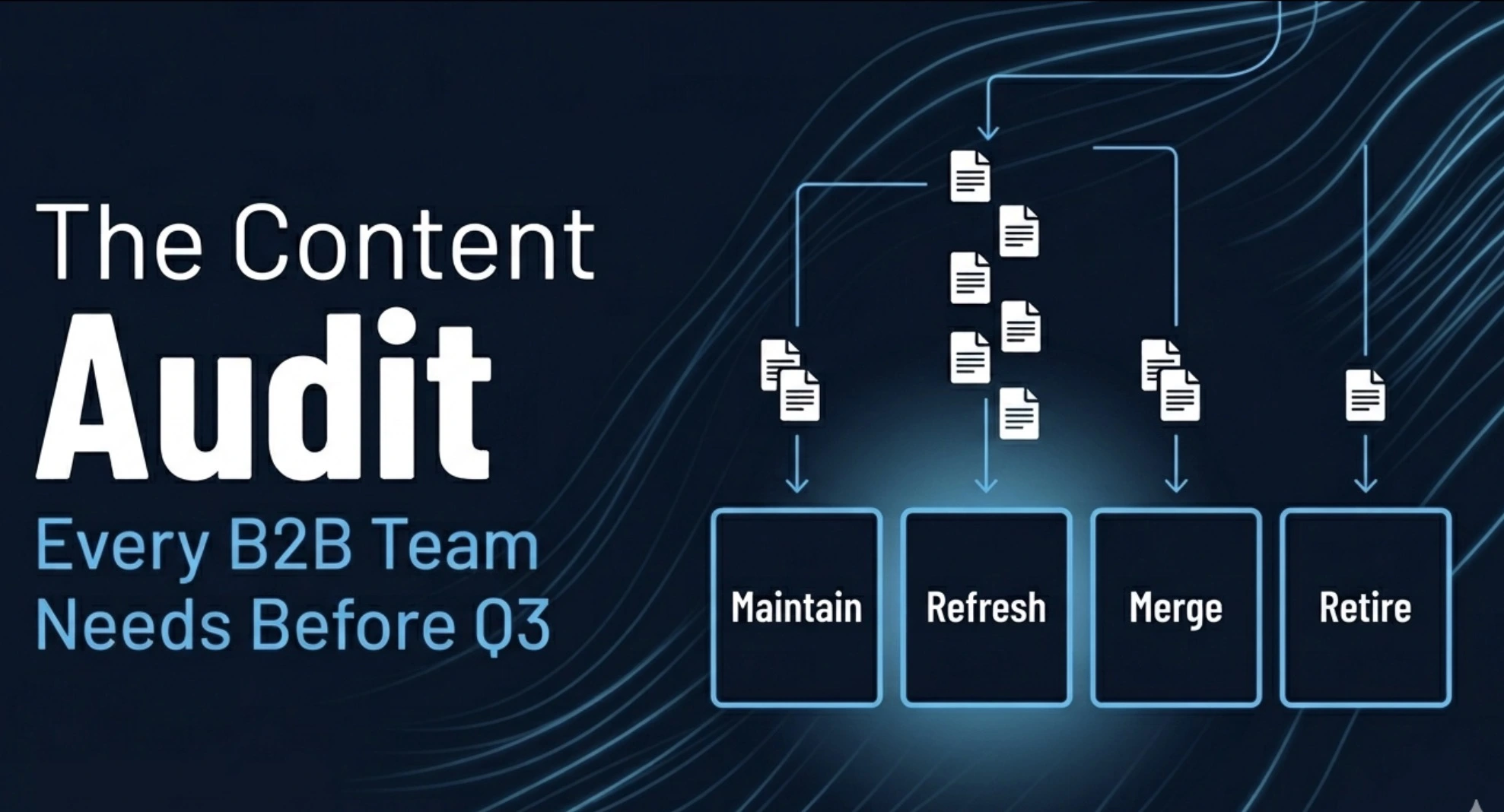
The audit itself is simple once you stop trying to evaluate every page individually and instead sort everything into four buckets.
- Maintain, typically, 10 to 20% of a mature content library. These pages are performing at or near their potential. Rankings are stable in the top five positions, traffic is steady or growing, and there is a measurable connection to the pipeline. The only work these need this quarter is light maintenance: a stat update, a broken link fix, maybe a fresher example. Do not touch the structure. It is working.
- Refresh, usually the largest bucket, 40 to 60% of the library. These pieces are fundamentally sound but have clear room to improve. Rankings or traffic have slipped, the content has aged, or the conversion path is broken, even though the topic is still relevant. This is where most of your quarterly content budget should go, not into new posts, but into making existing posts work the way they used to.
- Merge, relevant mainly for sites with three or more years of content, typically 5 to 15% of the library. These are pieces that overlap significantly with another piece targeting the same topic or query. Two competing pages on the same subject often rank worse individually than one strong page would rank alone. Merging consolidates the authority instead of splitting it.
- Retire, the pages that are no longer relevant, were never indexed, or actively work against the rest of the site. Outdated product information, abandoned campaign landing pages, thin posts that exist only because someone needed to hit a publishing quota three years ago. Removing these is not a loss. It is addition by subtraction; domain-wide quality goes up.
How to Run This Without It Taking Three Weeks
The reason most audits stall is that teams try to do all two hundred URLs with the same depth of analysis. Do not. Start with your top 20 pages by traffic or pipeline contribution. These are the pages where a refresh has the highest immediate return, and reviewing twenty pages properly is a one- or two-day task, not a two-week one. Pull four data points per page: current organic traffic trend, current average ranking position, last-updated date, and whether the page has a clear next step for the reader. That fourth one matters more than it sounds. A page can rank well and still convert nothing if there is nothing for the reader to do once they finish it. Sort into the four buckets based on those four data points alone. A page with declining traffic, a ranking that has slipped from position 4 to position 11, and a last-updated date from fourteen months ago is a Refresh candidate without needing any deeper analysis. The framework is designed to make most decisions obvious at a glance. Assign an owner and a deadline to every Refresh and Merge decision before the audit meeting ends. This is the step that separates an audit that produces results from one that produces a spreadsheet. Without a named owner, "refresh this page" becomes a wish list item that resurfaces, unchanged, at the next quarterly planning meeting.
What to Do With the Findings
Once the top 20 are sorted, the pattern usually repeats across the rest of the site. Most teams find that 60 to 70% of their content library falls into predictable clusters once they have calibrated their eye on the highest-value pages first. A rolling audit, where a subset of content gets reviewed every month rather than everything at once, keeps this from becoming a once-a-year fire drill. For quarterly planning specifically, the audit answers a question that usually gets skipped: before deciding what to write next quarter, what twelve pieces of existing content, if refreshed, would move the needle faster than anything new could? In most cases, that list is more valuable than the new-topics list, and it is the list nobody builds without running the audit first.
Frequently Asked Questions
How often should a B2B company run a content audit?
Most B2B technology companies benefit from a full audit every six months, paired with monthly spot-checks on the top 20 pages to catch ranking or traffic declines early. High-growth teams publishing 50 or more posts per year should consider quarterly full audits. The right cadence depends more on publishing volume and how fast your category changes than on company size alone.
What is the difference between a content audit and a content inventory?
A content inventory is simply a list of every URL and content asset you have published, a spreadsheet of what exists. A content audit layers performance data, current relevance, and a decision (keep, refresh, merge, or retire) on top of that inventory. The inventory is the input. The audit is the output that drives action.
Can a content audit improve AI search visibility, not just Google rankings?
Yes. AI platforms increasingly favor recently updated content when selecting sources to cite, similar to how Google rewards freshness. A content audit that identifies and refreshes outdated pages, updating statistics, adding clearer answer-first structure, and fixing broken information, improves a page's citation eligibility across ChatGPT, Perplexity, and Google AI Overviews at the same time it improves traditional rankings.
What is a realistic first step if we have never done a content audit before?
Start with your top 20 pages by organic traffic or pipeline contribution only, not the full site. Pull traffic trend, ranking position, last-updated date, and whether each page has a clear next step for the reader. Sort each into Maintain, Refresh, Merge, or Retire, and assign an owner to every Refresh or Merge decision before moving on. This takes one to two days and produces a working list that is immediately useful for quarterly planning, even before the rest of the site is reviewed.


