
Chris Orlob scaled Gong from $200,000 to $200 million in ARR. He has reviewed more discovery calls than almost anyone alive. His conclusion, repeated across his work at Gong Labs and now at Pclub.io, is that most reps fail discovery not because they lack personality or product knowledge, but because they lack preparation. They have not done the research. They do not have the right materials. They spend the call recovering from a standing start when they should be running.
82% of B2B decision-makers say salespeople arrive at discovery calls unprepared, per research from Careertrainer.ai's 2026 analysis of discovery call data. The gap between what buyers expect and what reps deliver is a content and preparation gap, one that marketing can close. Most don't.
What Is the Discovery Call Content Kit?
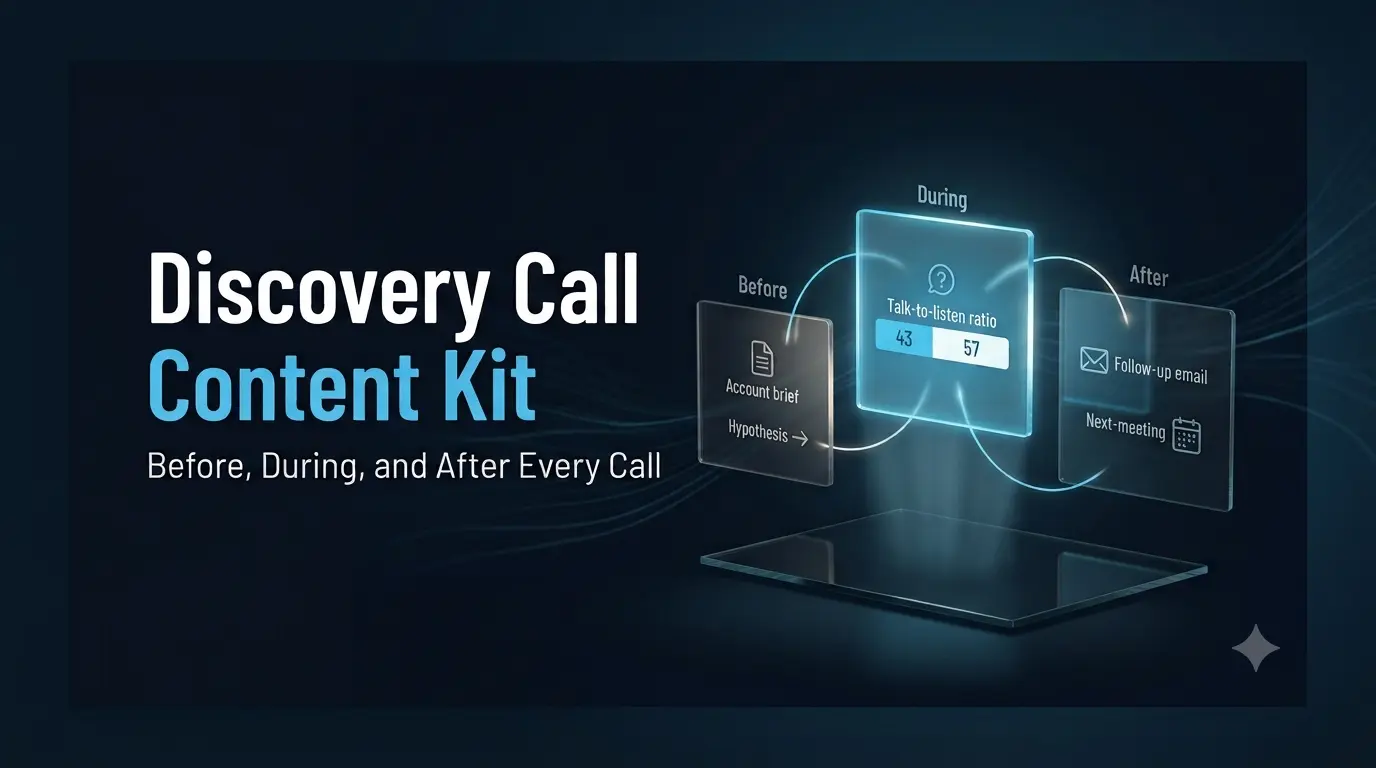
A discovery call content kit is the set of materials a rep should have in hand before, during, and after a discovery conversation, not a slide deck or a demo, but the intelligence, reference assets, and follow-up templates that turn a single call into a qualified opportunity. The distinction between a content kit and a content library matters: a kit is assembled per call, per prospect, with the right assets for the specific situation. A library is where the raw materials live.
The Before Package: Five Things That Should Exist Before Every Call
- A one-page account intelligence brief. Gong Labs data from over 300 million analyzed calls identifies a consistent pattern: top performers research prospects before every call, specifically to identify a "trigger", a recent funding round, a product launch, a new hire in the relevant department, a public earnings call where the problem the rep sells against was named. This brief should take under ten minutes to assemble and should answer: what has changed at this company in the last 90 days that makes this conversation timely?
- The relevant case study or proof point for their industry vertical and company size. Not the closest case study in the library. The most relevant one for this specific buyer. A VP of Operations at a 400-person manufacturing company does not respond to a case study from a 50-person SaaS startup. If the right case study does not exist yet, this is signal for what marketing should build next.
- The three most common objections for this prospect profile, with one specific response each. Not a full objection handling library. Three cards, one screen per card, specific to the profile of the person on the call. If they are evaluating against a named competitor, the competitive card for that competitor.
- The rep's pre-call hypothesis. This is what separates preparation from research. After doing the account brief, the rep should write one sentence: "I believe this prospect is struggling with X because of Y, and that our product addresses it through Z." Forcing this sentence before the call changes how the rep listens. They are testing a hypothesis, not executing a script. This is what Chris Orlob describes as "digging for the need behind the need", the surface problem a prospect names is rarely the problem that kills the deal.
- The meeting agenda, shared with the prospect in advance. On average, discovery calls where the rep sent an agenda in advance have measurably higher close rates than calls where they did not, per Gong research. The agenda is also a commitment mechanism: when a prospect co-creates or approves an agenda, they are more engaged on the call.
The During Reference: What Lives on the Screen While the Call Runs
Reps should have three things visible during a discovery call, not ten.
The first is the pre-call hypothesis, so they remember what they are testing and can update it in real time. The second is the objection handling quick reference, three to five entries, trigger phrase plus one response plus next step, on a single screen. Not a chapter to navigate.
The third is the talk track for the specific qualification framework the team uses, MEDDIC, SPIN, BANT, or whatever has been adopted, with the three or four most important questions for this stage of the sale highlighted. Not the full framework. The questions most commonly skipped.
Chris Orlob's research at Gong found that reps who ask between 11 and 14 questions during discovery calls have the highest close rates. Fewer than 11 suggests insufficient exploration. More than 14 suggest the call became an interrogation. The during reference should keep the rep in that range naturally, not through counting.
One process note: the talk-to-listen ratio on a discovery call should be 43% talking to 57% listening, per the Gong Labs analysis originally published by Chris Orlob and later updated by Dan Morgese. (Source: Gong.io). The during reference should not tempt reps to fill silence. It should give them permission to stop.
The After Package: The Assets That Turn Discovery Into Pipeline
60% of sales leaders cite poor discovery as the primary reason for lost deals, not poor demos or pricing, per Careertrainer.ai's 2026 discovery call benchmarks. Most of those losses happen not because the discovery call went poorly, but because the follow-up failed to capture and advance what happened.
The after package has three components.
- The call summary, sent within 24 hours. Not a transcript. A three-paragraph summary: what the rep understood about the problem, what was agreed as the next step, and why moving forward makes sense for the prospect's specific situation. This document is also the handoff if the deal moves to an account executive.
- The custom one-pager or leave-behind. Based on what emerged during the call, not before it. If the prospect named a specific use case, the follow-up leave-behind should reference that use case by name. Templates help. Personalization is what converts. Marcus Sheridan's "They Ask, You Answer" framework makes this argument at scale: the most effective sales content is the content that answers the specific question the specific buyer asked, in their own language. (Source: marcussheridan.com)
- The next meeting invite, sent within two hours of the call ending. 80% of B2B sales require five or more follow-up contacts, and the primary failure point is rep follow-through after the first conversation. Sending the next meeting invite before the follow-up email goes out prevents the deal from stalling at the most recoverable stage.
What Marketing Actually Owns in This System
Most discovery call content failure is not a sales problem. Reps do not have the right materials because marketing has not built them, has built the wrong version, or has built them without understanding how discovery calls actually work.
Marketing's specific job in this system: building and maintaining the account intelligence brief template, owning the case study library with proper vertical and company-size tagging, producing the objection handling quick reference with input from sales managers reviewing actual call recordings, and writing the follow-up email and leave-behind templates based on the most common discovery outcomes.
None of this requires understanding every nuance of the sales process. It requires sitting in on three discovery calls per quarter and reading the notes from ten more. Most B2B marketing teams do neither.
Frequently Asked Questions
What is a discovery call content kit for B2B sales teams?
A discovery call content kit is the set of materials a rep needs before, during, and after a discovery call, account intelligence, relevant case studies, objection handling, quick reference, a pre-call hypothesis, an agenda, a call summary template, and a follow-up leave-behind. The kit is assembled per prospect, not maintained as a generic library. Marketing builds the templates and source materials; reps assemble the kit for each specific account.
What research shows reps should do before a discovery call?
Gong Labs' analysis of over 300 million sales calls shows that top performers consistently identify a recent trigger at the prospect's company, a funding event, leadership change, product launch, or public statement of a business problem, before the call. This trigger shapes the opening question and the pre-call hypothesis. Chris Orlob, who led Gong Labs and helped scale Gong to $200M ARR, describes this as finding "the need behind the need": surface-level research leads to surface-level conversations that do not progress to qualified opportunities. (Source: gong.io)
What is the right talk-to-listen ratio for a discovery call?
43% talking to 57% listening, per Gong Labs' analysis. Reps who speak more than 65% of the time on discovery calls see consistent declines in conversion rates. The counterintuitive finding is that this ratio is easier to maintain with better preparation: reps who arrive with a clear hypothesis and specific questions are more comfortable with silence because they know what they are listening for.
How does poor discovery content affect deal close rates?
60% of US sales leaders identify poor discovery as the primary reason deals are lost, according to 2026 benchmarks from Careertrainer.ai's discovery call statistics report. Poor discovery typically means one of three things: insufficient account research before the call, failure to uncover a quantified business problem during the call, or inadequate follow-up after the call. Content and preparation solve the first and third problems directly. Structured questioning frameworks address the second.
What should marketing build to support discovery calls specifically?
Account intelligence brief templates, case study libraries tagged by vertical and company size, objection handling quick reference cards built from actual call recordings, follow-up email templates for the most common discovery outcomes, and leave-behind templates that can be customized within 10 minutes post-call. The test for whether any of these assets is working: are reps using them without being told to? If the answer is no, the asset is not solving the right problem or is not accessible at the right moment.
References
Careertrainer.ai, Discovery Calls Statistics 2026, 82% buyers find reps unprepared, 60% sales leaders cite poor discovery as primary loss reason: https://careertrainer.ai/en/reports/discovery-calls-statistics/
Gong.io, Mastering the Talk-to-Listen Ratio in Sales Calls, Chris Orlob and Dan Morgese, Gong Labs 43/57 golden ratio research: https://www.gong.io/blog/talk-to-listen-conversion-ratio
Gong.io, Mastering Discovery Calls: Essential Questions and Tips, Chris Orlob, 11-14 questions research: https://www.gong.io/blog/best-discovery-call-tips
Chris Orlob, pclub.io, Gong Labs founder, $200K to $200M ARR at Gong: https://www.chrisorlob.com/
Marcus Sheridan, They Ask, You Answer framework, marcussheridan.com: https://marcussheridan.com
WithRealm, The Ultimate Guide to Discovery Calls: Framework, Questions and Best Practices: https://www.withrealm.com/blog/discovery-call


