
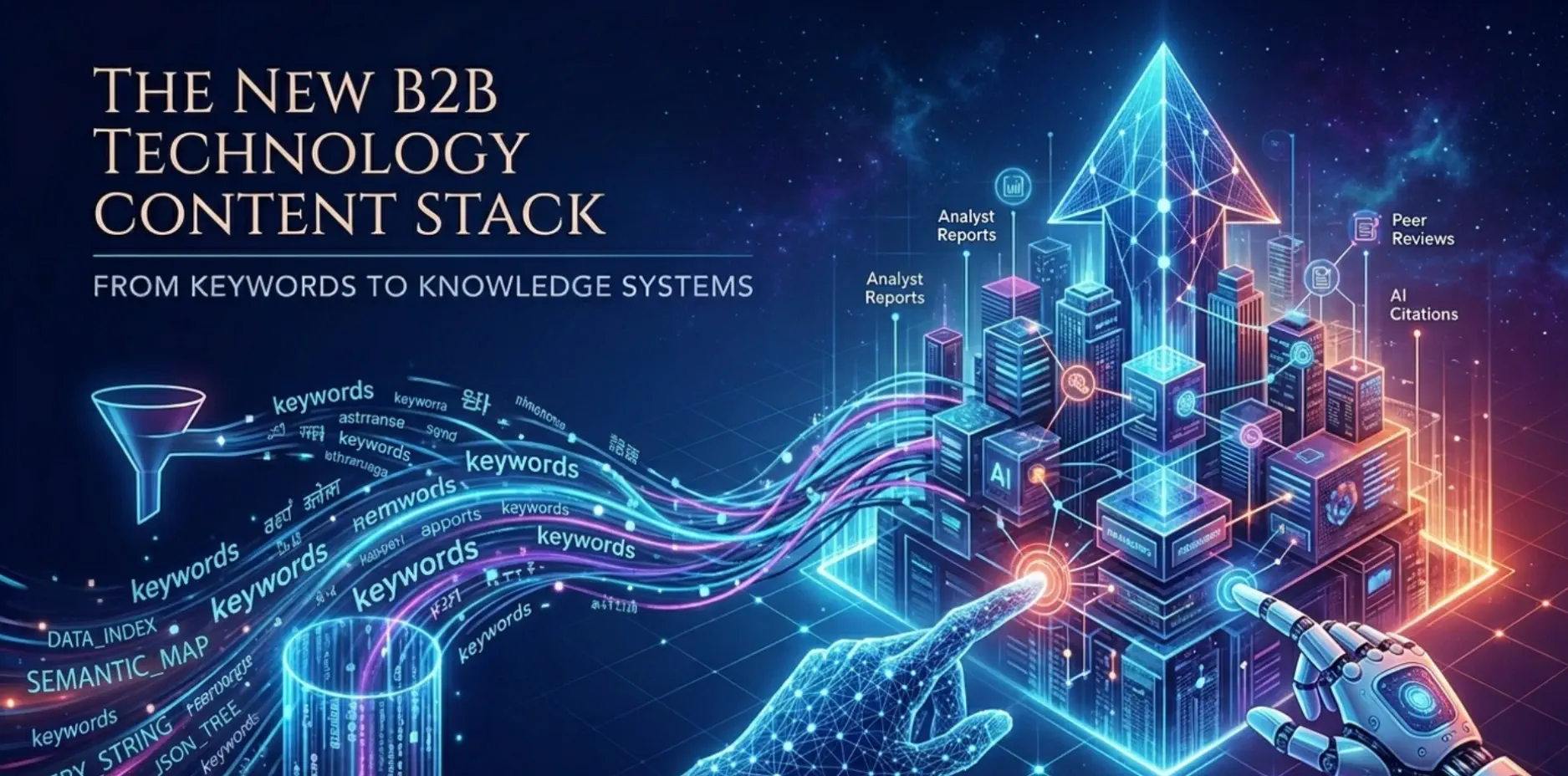
Most B2B technology content teams are working harder than ever. They are publishing more blogs, briefing more writers, updating more calendars. And they are getting less back. Organic traffic is flat or declining. Leads from content are harder to attribute. The ROI conversation in the boardroom gets more uncomfortable every quarter.
This is not a content quality problem. It is a structural one.
According to 6sense's 2025 Buyer Experience Report, 94% of B2B buyers now use large language models to synthesize and organize their research during the purchase process. That is not a trend worth monitoring. That is a full restructure of how buyers find, evaluate, and shortlist vendors, and it happened while most content teams were still optimizing title tags.
The old B2B technology content stack, keyword research, volume publishing, backlink building, and rank tracking, was built for a buyer who used Google to discover, clicked through to read, and converted on the page. That buyer still exists. But the first mile of their journey has moved somewhere else entirely.
The replacement is a knowledge system. Content designed to be understood, cited, and trusted by both humans and AI platforms. Content that earns a seat at the table before a buyer ever types your name into a search bar.
This piece breaks down what that shift looks like in practice, and what B2B technology content teams need to build instead.
What Is a B2B Technology Content Stack, and Why Is the Old One Broken?
The old B2B technology content stack generates pages that rank in a world where buyers click. In 2026, 65% of searches end without a single click, according to Search Engine Land. The system was engineered for a behavior that has already changed.
A content stack is the combination of tools, formats, frameworks, and processes a B2B team uses to plan, produce, and distribute content. The legacy version looks like this: identify target keywords, assign blog topics, publish at volume, build backlinks, and track rankings. Repeat.
That stack produced results when Google's ten blue links were the primary discovery surface. It made sense when a buyer typed a query, clicked a result, read a page, and filled out a form. Sequential, measurable, controllable.
The model cracked the moment AI Overviews started answering queries on the page. It cracked further when ChatGPT, Perplexity, and Gemini became the starting point for professional research. It broke completely when buyers began arriving at sales conversations already holding a mental shortlist, one that your content never influenced, because it was never in the right place to begin with.
The Content Marketing Institute's 2026 B2B research puts it plainly: the problem with content strategy has never been output; it is outcomes. Most B2B technology content teams are generating plenty of the former and struggling to demonstrate the latter.
The new stack does not abandon SEO fundamentals. It extends them into a knowledge system, entity-rich, answer-structured, trust-signaled content that gets cited, not just ranked. Understanding how to build that system starts with understanding how your buyers actually behave now.
How Do B2B Technology Buyers Actually Use AI to Research Vendors Today?
B2B technology buyers are no longer starting their research on Google. They are using LLMs to synthesize shortlists before they ever visit a vendor website. Your content has to work in a room you were never invited into.
The 6sense 2025 Buyer Experience Report is unambiguous: 80% of B2B deals are won by the vendor the buyer preferred before engaging with sales. This preference forms during what analysts call the "dark research" phase, an anonymous period of AI-assisted synthesis, forum reading, and peer consultation that happens completely outside your funnel.
Here is what that looks like in practice. A VP of Marketing at a mid-size SaaS company opens ChatGPT and types: "What are the best B2B content agencies for AI search strategy?" The model generates a synthesized answer. It may cite three or four agencies. It may not cite yours. By the time that VP reaches your website, their shortlist is already half-formed.
The buying committee dynamic makes this more complex. Forrester and 6sense both put the median B2B buying group at 11.2 stakeholders for deals over $50,000, up from 9.7 in 2024. Each one of those stakeholders is running their own independent research. A CTO is asking technical questions. A procurement lead is benchmarking pricing signals. A CMO is reading case studies through an AI-generated summary. They are not all ending up on your blog.
This is the structural reality that keyword-based content strategy cannot solve. LLMs do not link; they cite. To be cited, your content needs to fully answer questions, not merely rank for them. Your blog is no longer a destination. It is source material.
That distinction changes everything about how B2B technology content should be written, structured, and distributed.
What Does a Knowledge System Actually Look Like for B2B Technology Content?
A knowledge system is a content architecture where every piece is an interconnected node, not an isolated blog post chasing a monthly keyword. It is built around entities: your brand, your services, your clients' problems, and the semantic relationships between them. Structured so AI can parse, extract, and cite it.
Think of it this way. A content calendar is a publishing schedule. A knowledge system is a map of everything your brand credibly knows, organized so that both humans and machines can navigate it.
The architecture has three layers.
-
The entity layer defines who you are and what you authoritatively cover. Your brand name, your services, your methodology, and the client problems you solve, these need to be declared consistently across your website, your author profiles, and third-party platforms. Inconsistency in entity representation confuses AI systems and weakens your Knowledge Graph presence.
-
The answer layer is structured Q&A content that LLMs can extract directly. Every major section opens with a complete, direct answer in 40 to 60 words. This is not writing for robots; it is writing with discipline. Answer first. Evidence second. Expansion third. Every time.
-
The authority layer is where trust signals live. External citations, schema markup, named author credentials, third-party platform presence, and E-E-A-T signals that tell Google and AI systems this content comes from a real expert with verifiable experience.
Research from Virayo confirms the topical relevance principle: a focused DR30 site covering a specific B2B niche in depth can out-cite Forbes in LLM responses if the content is more contextually aligned with the query. Domain authority still matters as a gate, but topical depth is what gets you cited.
Hub-and-spoke architecture delivers this. A pillar page surrounded by interlinked supporting content signals genuine topical expertise. It tells both Google and LLMs that you do not just have one good page on a subject. You have the map.
How Do You Build E-E-A-T Signals That Google and AI Platforms Both Trust?
E-E-A-T, Experience, Expertise, Authoritativeness, and Trustworthiness, is not a checklist. It is a reputation architecture. Google uses it to assess content quality. AI platforms use similar signals to decide which sources to cite. Both reward the same thing: evidence that a real expert produced this for real people, drawing on real experience.
Publishing a blog with no author attribution, no external citations, and no structured data is the content equivalent of showing up to a job interview without a resume. You might say the right things. Nobody is going to believe you.
Here is what each layer requires in practice.
-
Experience means writing that only someone with direct, documented exposure to the subject could produce. First-person perspective. Specific client outcomes. Named examples. "Our team recommends" is not an experience. "When we ran an AI search audit for a B2B SaaS client in Q1, here is what we found." is.
-
Expertise means the author has verifiable credentials in the domain. Author schema markup with a "knows about" declaration. A byline linked to a LinkedIn profile with a real professional history. If the person who wrote your content cannot be found on the internet, Google quality raters and AI systems treat the content as authoritative as an anonymous tip.
-
Authoritativeness means other credible sources recognize you. Industry listicles, press mentions, podcast appearances, third-party platform profiles. Virayo's LLM SEO research found that brands with profiles on G2, Capterra, or Trustpilot increase their AI citation probability by 3x. You are not just building E-E-A-T for Google. You are building the multi-platform presence that LLMs use to evaluate whether your brand is a real category player.
-
Trustworthiness means your content is factually accurate, consistently structured, and verifiable. Use FAQPage, Article, Organization, and Person schema markup in JSON-LD. These do not just help Google parse your content; they help AI retrieval systems extract and attribute your content correctly.
What Does AEO and GEO Mean for How B2B Technology Content Gets Structured?
Answer Engine Optimization means structuring content so AI platforms extract and cite it as the answer. Generative Engine Optimization means building brand presence so LLMs include you in synthesized recommendations. Together, they demand a single writing discipline: answer first, evidence second, expansion third, every section, every time.
The underlying logic is mechanical. AI engines do not read your blog the way a human does. They look for the quickest path to a complete, verifiable answer. Aja Frost, Senior Director of Global Growth at HubSpot, put it directly in an EMARKETER analysis: "The first sentence of a page should answer the primary question completely, because answer engines are looking for that quick validation."
Every section should stand alone. AI systems pull individual chunks, not full articles. If your fifth paragraph contains the clearest answer to the question your H2 raises, the AI may never reach it.
GEO adds a distribution dimension. Virayo's research found that brands present on four or more platforms are 2.8x more likely to appear in ChatGPT responses. Brands mentioned on Quora and Reddit have 4x higher citation likelihood. This is not about spamming forums. It is about being a genuine participant in the conversations your buyers are already having, and building the multi-platform consensus signals that LLMs use to evaluate brand authority.
The structural requirements for AEO-optimized B2B technology content are specific: 40 to 60-word answer blocks at the top of each major section; clean H2 and H3 hierarchy; FAQ sections with FAQPage schema; consistent entity naming throughout; named authors with verified credentials.
Measurement has decoupled, too. According to Search Engine Land's 2026 content strategy analysis, a piece can lose Google clicks and gain LLM citations in the same quarter. Traffic metrics alone will not tell you whether your content is working in AI search. You need two parallel scorecards.
How Do You Measure Whether Your B2B Technology Content Is Actually Working in 2026?
If you are only measuring clicks and rankings, you are reading a scoreboard from the last game. B2B technology content performance in 2026 requires two parallel tracks: traditional organic performance and LLM visibility.
The Content Marketing Institute's 2026 research found that 56% of B2B marketers say it is hard to connect content efforts to ROI. The instinctive response is to blame the attribution software. The real problem is that most content was never built to influence the decision before the click, which is precisely where the decision is now being made.
-
Track one is familiar: organic keyword rankings, traffic volume, on-page conversion rate, and pipeline attributed to content-assisted journeys. This still matters. Ahrefs data shows that 76% of AI Overview citations pull from the top-10 Google results. Strong traditional SEO performance feeds LLM visibility, not the other way around.
-
Track two is newer and messier: LLM visibility means monitoring how often your brand appears in AI-generated answers to relevant queries. Tools like Semrush, Profound, and Conductor are building citation-tracking dashboards; the category is still maturing, but the data is usable. Manual prompt testing across ChatGPT, Perplexity, and Claude gives you a directional signal quickly.
The right North Star metric is not citations per month. It is citation-to-pipeline influence, content that shaped a buyer's shortlist before they contacted you. That requires closing the loop between your content team and your sales team. When a qualified lead arrives, ask: Where did they start their research? What did they already know about you? The answers reveal whether your knowledge system is working or whether you are still shouting into the void.
B2B technology content that compounds in value is content that earns citations, builds entity authority, and shapes preferences silently, weeks before a buyer raises their hand. Build for that, and the rankings follow.
The content game has not just changed the rules. It has changed the playing field. B2B technology content teams that keep building keyword calendars are competing on a surface that is shrinking. The ones building knowledge systems, entity-rich, answer-structured, trust-signaled, are competing on the surface where the next five years of B2B discovery will happen.
At Nagana Media, our work in AEO, GEO, and AI-native content strategy is built on this exact shift. If you want to audit how your current content stack holds up against the knowledge system standard, we should talk.
Frequently Asked Questions
What is B2B technology content?
B2B technology content is any content a technology company or agency produces to educate, attract, and convert business buyers. It spans blog posts, case studies, white papers, and thought leadership, and in 2026, it must be structured for both human readers and AI retrieval systems to extract, cite, and trust.
How is a knowledge system different from a content strategy?
A content strategy is a publishing plan. A knowledge system is an interconnected architecture of entities, answers, and authority signals built so AI platforms can parse and cite your brand as a trusted source. A content strategy tells you what to publish. A knowledge system determines whether what you publish actually gets found in AI-driven search.
What is AEO, and why does it matter for B2B content?
Answer Engine Optimization (AEO) is the practice of structuring content so AI platforms, such as ChatGPT, Google AI Overviews, and Perplexity, can extract and cite it as a direct answer. For B2B content, AEO means opening every section with a complete answer, using FAQ schema, and writing for extraction, not just engagement.
How long does it take to build AI search visibility with a knowledge system?
Building meaningful semantic authority for LLM citation typically takes 6 to 12 months of consistent investment, according to ALM Corp's AI SEO entity research. Brands with existing domain authority and multi-platform presence can see citation improvements within 30 to 90 days of structural content changes. Off-site presence building, G2 reviews, Reddit engagement, industry listicles, compounds over 3 to 6 months.
What schema markup does B2B technology content need for E-E-A-T?
The four schema types that most directly support E-E-A-T signals for B2B technology content are: Article (with named author and publisher), Organization (with verified contact details and sameAs links), Person (with knowsAbout declarations for the author), and FAQPage (for structured Q&A sections). These are implemented as JSON-LD and help both Google quality systems and AI retrieval engines evaluate content credibility and extract answers accurately.


