
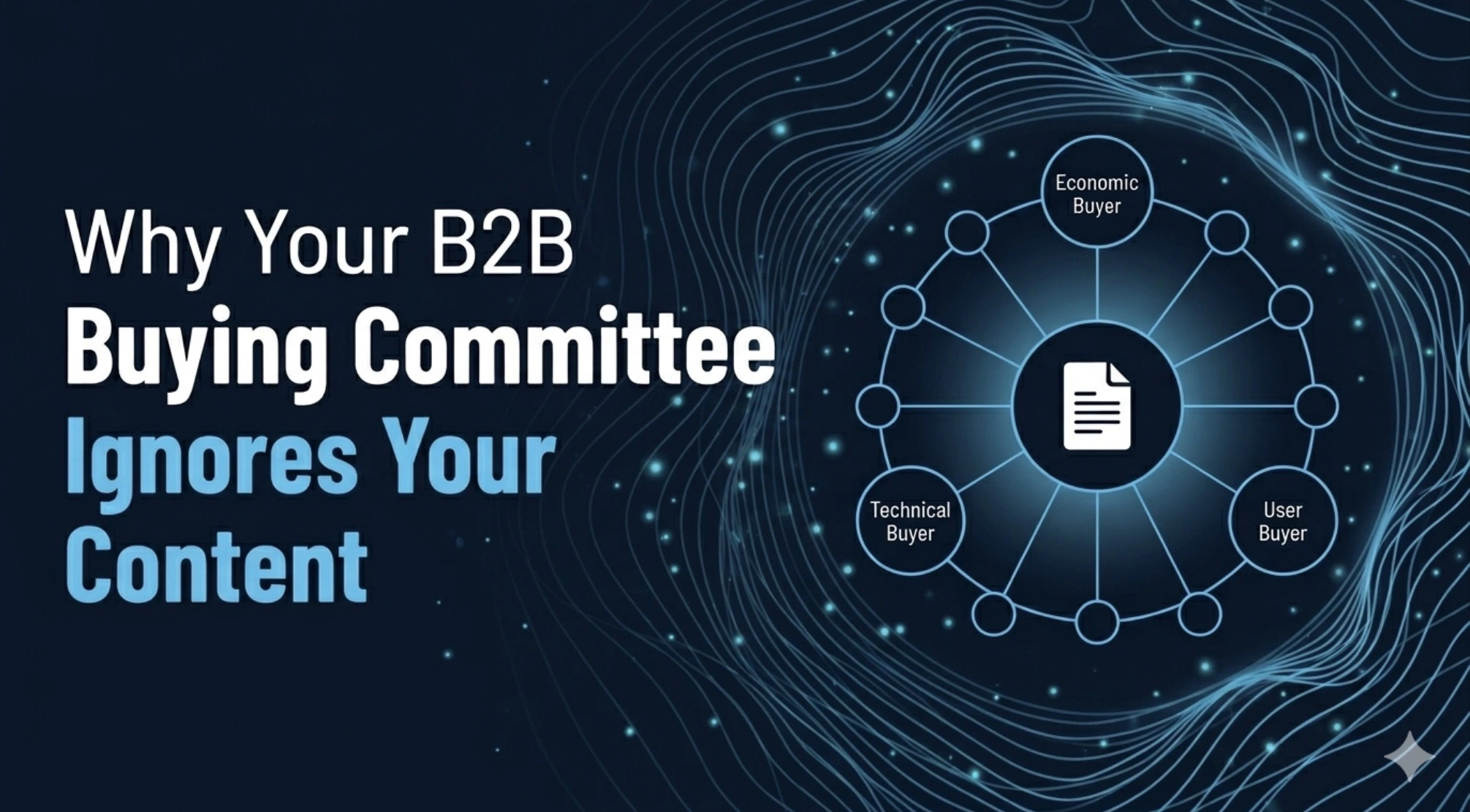
Sales says the content is generic. Marketing says sales never use what gets built. Both are right, and neither has named the actual problem. The actual problem is that one piece of content is being asked to do a job that now requires eleven different conversations.
What Is a B2B Buying Committee?
A B2B buying committee is the group of people inside a company who weigh in on a purchase decision before it gets approved. Forrester's 2025 research puts the average at 13 internal stakeholders plus 9 external participants for complex deals, 22 people touching a deal before a contract gets signed. 6sense and Forrester both peg the median at 11.2 for deals over $50,000, up from 9.7 just two years ago. That is not a typo, and it is not a one-time spike. Committees have grown from roughly 5.4 stakeholders in 2015 to 8-13 today and nearly doubled in a decade.
Why This Is a Content Problem, Not a Sales Problem
Here is the part that should change how marketing teams think about every asset they produce. Content tailored to buying-group relevance improves consensus by 20%. Content focused on a single stakeholder can have a 59% negative impact on group consensus. Read that twice. Writing for one person does not just fail to help the other ten. It actively makes it harder for the group to agree. That is the mechanism behind a stat every B2B marketer has heard but rarely connects to content: 86% of B2B purchases stall during the buying process. Stalls are not usually caused by one stakeholder saying no. They are caused by the room failing to reach a shared definition of "yes", because nobody gave them a shared starting point. Gartner's 2025 research found that 74% of B2B buyer teams show unhealthy conflict during decision-making. Groups that reach genuine consensus are 2.5 times more likely to call the deal high-quality. Consensus is not a soft outcome. It is the difference between a deal closing on time and a deal sitting in "still evaluating" for another quarter.
The Three Roles in Every Room - And What Each One Actually Needs
Strip away the job titles, and every buying committee collapses into three functional roles. Each one is reading your content with a completely different question in mind.
- The economic buyer, usually a CFO, VP of Finance, or budget owner, is asking, "What does this cost us if we do nothing, and what do we get back?" They need ROI models, payback period calculations, and benchmarks from comparable companies. A feature list does nothing for this person. A number with a timeframe attached does everything.
- The technical buyer, CTO, IT director, or solutions architect, is asking, "Will this break something, and can my team actually run it?" They need architecture documentation, security and compliance details, integration specifics, and implementation timelines. Marketing copy that says "seamless integration" is invisible to this reader. A diagram of how the integration actually works is not.
- The user buyer, the person who will log in every day, is asking, "Will this make my job easier or harder?" They need product demos, workflow walkthroughs, and peer validation from people in similar roles. This is the stakeholder most B2B content accidentally writes for by default, while ignoring the other two entirely. Nine out of ten B2B purchases now require input from multiple departments. Each stakeholder consults four to five pieces of content before joining a group discussion. If everyone in that group is consulting the same generic homepage, they are walking into the meeting with the same incomplete picture, which is exactly the setup for the unhealthy conflict Gartner measured.
The Fix Is Not More Content. It Is Layered Content.
The instinct when this problem gets named is usually "we need to write more." That is the wrong instinct, and it is expensive. The fix is restructuring what already exists into layers that share one core message but enter at different points depending on who is reading. Take a single case study. Right now, it probably reads as one long narrative aimed at nobody in particular. Split it into three entry points built around the same underlying result:
- For the economic buyer: lead with the number. "This customer reduced operational cost by 31% in the first two quarters." One sentence, no setup, followed by the financial breakdown.
- For the technical buyer: lead with the architecture. "This customer integrated the platform with their existing Salesforce and SAP environment in three weeks, without custom development." Followed by the technical details.
- For the user buyer: lead with the workflow change. "This customer's team went from a six-step manual process to a two-click automated one." Followed by a walkthrough. Same case study. Same underlying proof. Three doors into the same room. When the CFO, the IT director, and the team lead all reference the same source, even though each read a different entry point, the committee arrives at the table already aligned on what the proof actually shows. That alignment is the 20% consensus lift, made concrete.
How to Map This Without Starting From Scratch
You do not need a content audit to begin. Pick your three highest-traffic or most-shared pieces of existing content, the ones sales already sends most often, and ask one question of each: which of the three roles does this currently serve, and which two does it ignore? Most teams find the same pattern. Their best-performing content already serves the user buyer well, because that is the audience most B2B writers default to. The economic and technical layers are usually missing entirely, not poorly written. That is good news. It means the core proof point already exists. It just needs two more doors built onto it. For sales teams, this reframes how content gets requested, too. Instead of "can marketing make us a one-pager for this account?" the request becomes "this account has a CFO, a security lead, and a procurement manager in the room, which layer does each of them need from what we already have?" That is a fifteen-minute conversation, not a content brief that takes three weeks to fulfill.
Frequently Asked Questions
How many people are typically in a B2B buying committee in 2026?
The average B2B buying committee involves 11 to 13 internal stakeholders for deals over $50,000, according to Forrester and 6sense research from 2025 and 2026. For complex enterprise deals, Forrester counts 13 internal stakeholders plus 9 external participants, 22 people total touching a single purchase decision.
Why does content written for one stakeholder hurt consensus among the others?
Content built around a single stakeholder's priorities gives that person language and proof points the rest of the committee never sees. When the group convenes, members are working from different mental models of the same product, which research shows can reduce group consensus by up to 59%. Layered content gives every stakeholder a different entry point into the same underlying proof, so the group arrives aligned rather than fragmented.
What is the fastest way to start fixing this without a full content rebuild?
Take your three most-used pieces of existing content and identify which of the three buyer roles, economic, technical, and user, each one currently serves. Most content defaults to serving the user buyer. Add a short, specific entry point for the economic buyer (a number and a timeframe) and the technical buyer (an architecture or integration detail) to each piece. This produces three doors into one proof point without writing new content from scratch.
Does this apply to smaller deals too, or only enterprise sales?
The committee-size data is most dramatic for deals above $50,000, but the underlying principle, that B2B purchases nearly always cross departments, holds for smaller deals too. Even a $10,000 software purchase typically involves a budget approver and an end user with different questions. The layering approach scales down easily: two entry points instead of three is still better than one generic page trying to serve both.


