
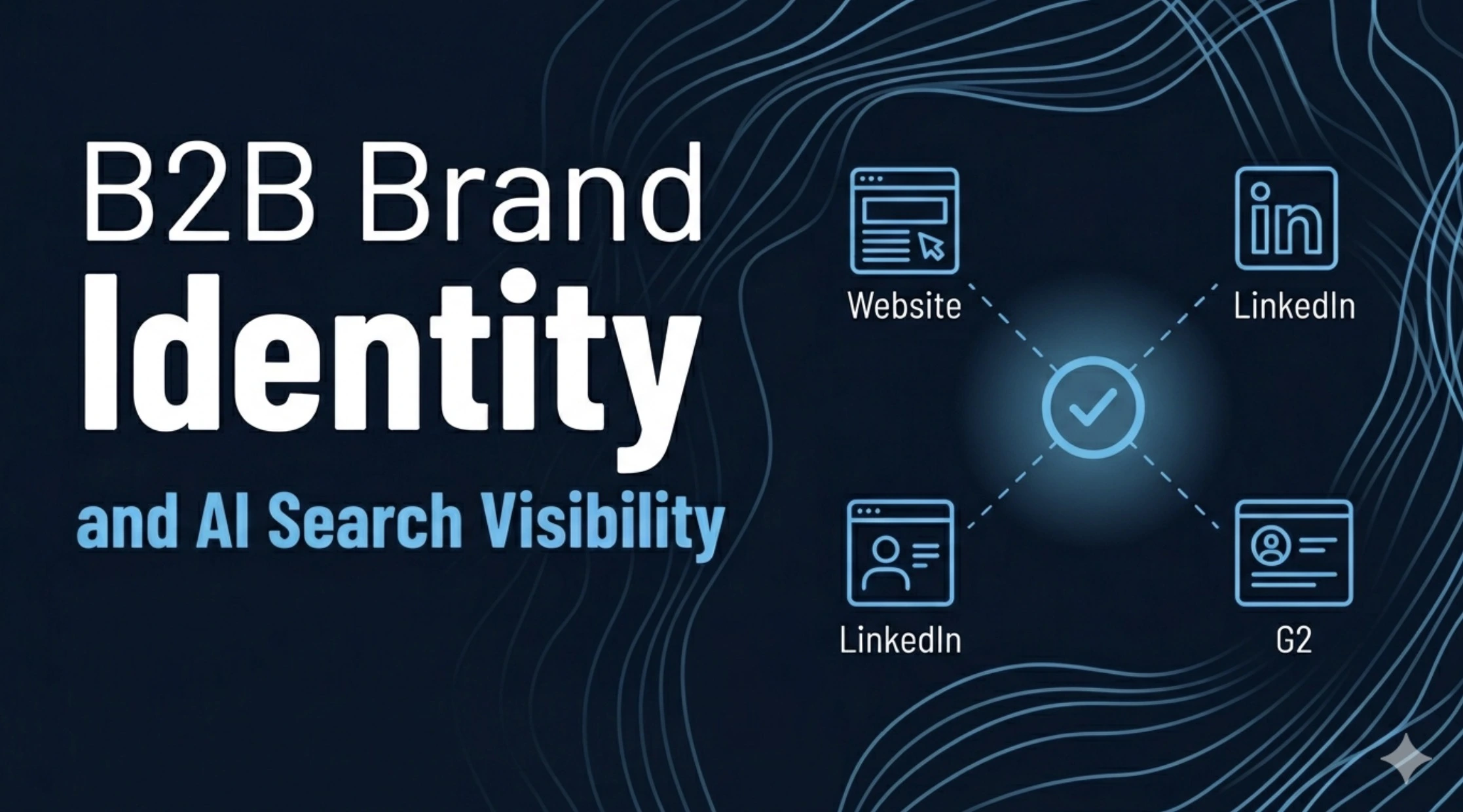
I had a client a while back whose website called them "Meridian Systems," whose LinkedIn page said "Meridian Systems Inc.," and whose G2 profile, set up by someone who'd long since left the company, said "Meridian." Three names, one company, and nobody on the current team had ever noticed, because to a human reading any one of those pages, it's obviously the same business. You just know.
AI models don't just know. And that small inconsistency turned out to be a bigger problem than anyone on that team expected.
What Does B2B Brand Identity Have to Do With AI Search?
Brand identity, in the AI search context, isn't really about logos or color palettes the way the phrase usually gets used. It's about entity clarity, whether AI systems can confidently identify your brand as one consistent thing across every place it appears, so they can cite you without second-guessing whether they've got the right company. The visual and verbal consistency most people think of as "brand" turns out to be the same consistency AI models need to trust an entity enough to reference it.
The Disambiguation Problem, Which Sounds Abstract Until It Isn't
Here's the mechanism, and it's worth sitting with for a second. When an AI model encounters a company name, it has to resolve what that name refers to. If your brand name overlaps with anything else, a mythological figure, a different company, or a generic word, the model needs clear signals to know which one you mean. Without those signals, models tend to default to whichever interpretation is most commonly referenced elsewhere, or they skip mentioning the brand entirely to avoid getting it wrong.
That second option, skipping you entirely rather than risk a wrong citation, is the quiet failure mode most companies never see happening. You don't get an error message. You just don't show up, and no dashboard tells you why.
Why "Just Be Consistent" Is Harder Than It Sounds
If your LinkedIn says "Acme Software Inc.," your website says "Acme," and G2 says "Acme Software," AI models can treat these as potentially different entities rather than confidently recognizing one. This is the exact pattern I saw with that client, and I'd guess it's true for more companies than would like to admit it.
The fix sounds almost too simple to be real: write one canonical two-to-three-sentence company description, and use it, verbatim, everywhere your brand appears. Website. LinkedIn. Crunchbase. G2. Press mentions you control. Not a paraphrase each time, not a "freshened up" version for each platform. The same words. I know that runs against every instinct a brand or content person has been trained to follow: vary your copy, keep it fresh, avoid sounding repetitive. For this one specific purpose, repetition is the feature, not the flaw.
The Knowledge Graph Layer, Made Less Scary Than It Sounds
There's a piece of this that sounds technical and isn't, really. Organization schema, with what's called a "sameAs" property, is a way of telling search engines and AI systems, directly, "this LinkedIn profile, this Crunchbase page, and this website are the same entity." It's a small piece of code your developer adds, linking your profiles together explicitly instead of hoping the AI figures it out contextually.
I've watched teams treat this as optional or low-priority because it doesn't show up anywhere visible on the page. But it's doing exactly the disambiguation work described above, just in a format AI systems can read directly instead of inferring. If your developer hasn't touched this, it's a short conversation, not a redesign.
Where Design, the Actual Visual Kind, Comes Back Into It
So far, this has mostly been about words and structured data, which might feel like a strange place to land an article about "design." Here's where the visual layer reconnects.
Consistent brand identity across touchpoints increases consumer trust by a measurable amount, and that trust signal compounds the same way the entity-recognition signal does. A visually inconsistent brand, different logo treatments, different color usage, a tone that swings between playful and severe depending on which page you land on, doesn't just confuse a human visitor. It's one more layer of the "is this actually one coherent thing" question that both humans and AI models are quietly asking.
It takes somewhere around five to seven consistent exposures for brand recognition to solidify in a person's mind, and inconsistency resets that counter. I'd argue that something structurally similar happens with AI systems, building confidence in an entity over time. Repeated, congruent signals build trust; contradictory ones reset it.
A Smaller, More Honest Example
Here's a less dramatic version of the Meridian story, something I'd guess applies to plenty of companies reading this. Your homepage describes you as "a leading provider of enterprise integration solutions." Your About page says you "help businesses connect their systems." Your latest press release calls you "an iPaaS company." All technically true. All describe the same thing. None of them uses the same words.
To a human, this reads as normal variation, maybe even good writing, avoiding repetition. To an AI model trying to build a confident, stable picture of what you do, it's three slightly different signals instead of one reinforced signal. The fix isn't to make your writing boring everywhere. It's to pick the load-bearing description, the one used for the canonical "about us" purpose, and hold that one steady, while everything else around it can stay varied and human.
What I'd Actually Check First
If you're wondering where to start, here's the order that's worked for me with clients in this position. Pull up your website, LinkedIn, Crunchbase, and G2 profile side by side. Read the company description on each one. If they're not nearly identical, word for word, that's your first fix, and it costs nothing but an afternoon.
Then check whether your developer has implemented the Organization schema with sameAs links across those same profiles. If not, that's a short technical task, not a project.
Only after those two are handled would I move on to the more visual layer, logo consistency, color usage, tone, because by that point, you've fixed the structural confusion that no amount of good visual design can compensate for on its own.
Frequently Asked Questions
Does brand design really affect whether AI platforms cite a company?
Yes, though the mechanism is less about aesthetics and more about consistency and entity clarity. AI systems need to confidently identify a brand as one coherent entity across every place it appears. Inconsistent naming, descriptions, or visual identity across platforms can cause AI models to treat what's actually one company as multiple ambiguous entities, sometimes leading the model to skip citing the brand entirely rather than risk an inaccurate reference.
What is entity disambiguation, and why does it matter for B2B brands?
Entity disambiguation is the process by which an AI model determines exactly what a name refers to when that name could mean multiple things: a company, a mythological figure, a generic term. Brands with unclear or inconsistent signals about their identity risk being misidentified or skipped by AI models that default to safer, more commonly referenced interpretations rather than guessing.
What is an Organization schema with a sameAs property, and do I need it?
It's a piece of structured data added to a website that explicitly links a company's various online profiles, LinkedIn, Crunchbase, and G2, together as representing the same entity. It helps AI systems and search engines confirm identity without having to infer it from context alone. It's a relatively small technical addition, and most developers can implement it without a major project.
How exact does brand description consistency need to be across platforms?
As close to verbatim as practically possible for the core, canonical description, the two-to-three-sentence "about us" summary is used to identify the company. This runs against typical writing instincts to vary language and avoid repetition, but for this specific purpose, consistency outweighs variety, since the goal is giving AI systems a single, reinforced signal rather than several similar-but-different ones.
Should a company fix brand consistency issues before investing in new AI-focused content?
Generally yes. Inconsistent entity signals create a structural ceiling on AI visibility that new content alone can't overcome, since the underlying confusion about who the brand actually is remains unresolved. Auditing and aligning the core brand description and structured data across major platforms is typically a faster, lower-cost fix than producing additional content, and it strengthens the citation potential of everything published afterward.
References
- Discovered Labs, Entity Recognition and Knowledge Graphs: How to Structure Your Brand for AI Understanding: https://discoveredlabs.com/blog/entity-recognition-knowledge-graphs-how-to-structure-your-brand-for-ai-understanding
- Semrush, How to Build Brand Visibility in AI Search: https://www.semrush.com/blog/brand-visibility/
- Omnibound, AI Search Visibility and Link Building Impact, 2026: https://www.omnibound.ai/blog/ai-search-visibility-and-link-building-impact
- Silicon Valley Time, Brand Identity in 2026, Stanford Digital Economy Lab trust research: https://siliconvalleytime.com/article/brand-identity/


