
I spent a chunk of last year rewriting product pages for a client, and the thing that stuck with me wasn't the AEO data, though that part mattered too. It was sitting in a room with their product marketer, watching her read the existing page aloud and just... stop. Mid-sentence. "Wait," she said, "I don't actually know what this means, and I wrote half of it." That page had been live for two years.
What Is a Feature Page, and What Is an Outcome Page?
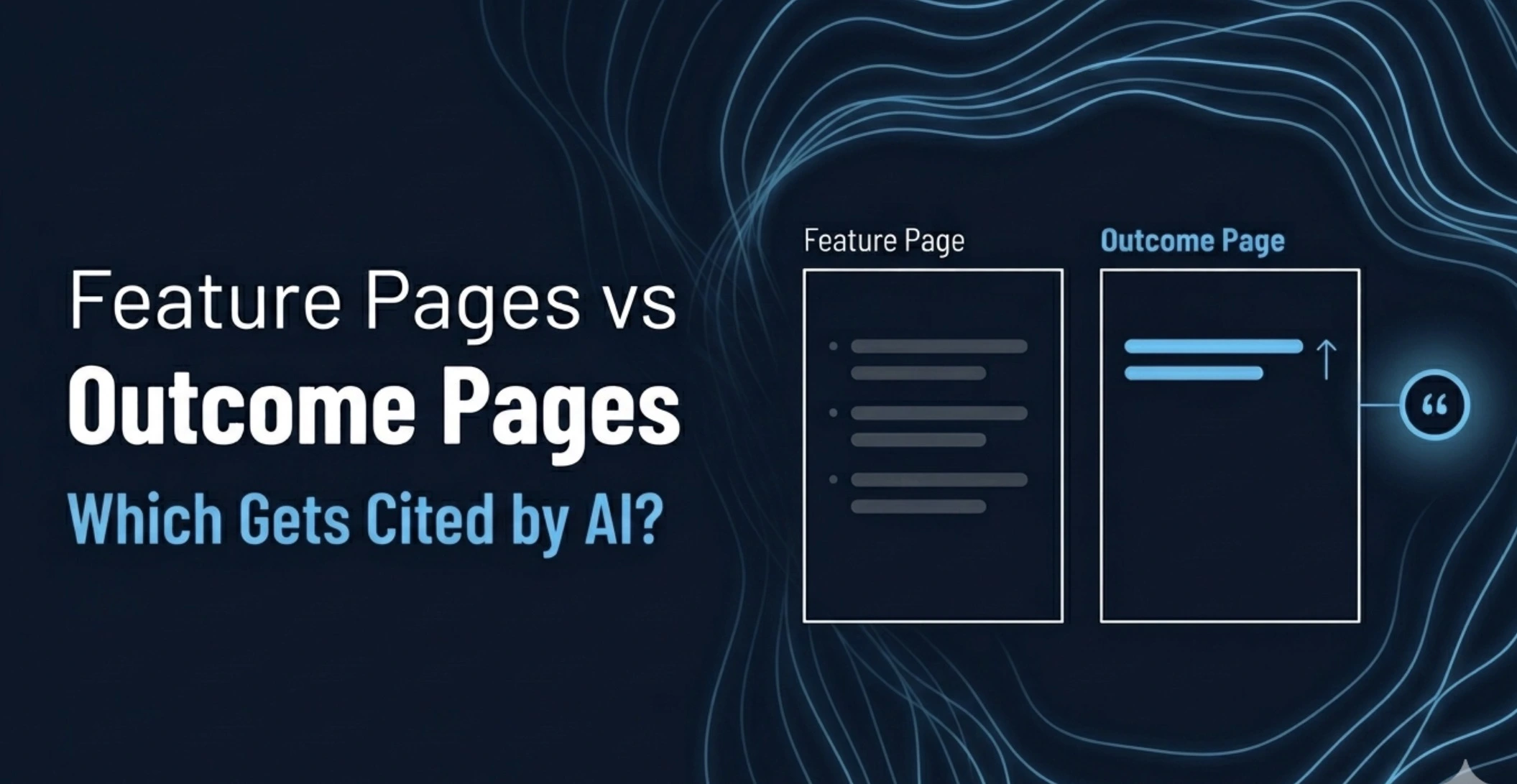
A feature page describes what a product does, organized around its capabilities. An outcome page describes what happens for the person using it, organized around a result. The difference sounds small until you put two sentences next to each other. "Includes automated workflow triggers" is a feature. "Cuts approval time from three days to four hours" is an outcome. Same capability, completely different page. Most B2B product pages are feature pages wearing an outcome page's headline. The hero section promises a transformation. Everything below it is a bulleted spec sheet.
Why This Suddenly Matters Beyond Conversion
Here's the thing that changed. Product pages now account for roughly 12% of all citations when AI platforms answer questions about features, integrations, or use cases. That's not nothing. When someone asks ChatGPT or Perplexity what a tool actually does, the model often goes straight to the product page, because that's supposed to be the canonical answer. Except a lot of product pages aren't canonical answers. They're brochures. And AI models, much like the product marketer in that room, read them and essentially shrug. Research into what AI platforms actually pull from product pages keeps landing on the same point: pages that are visually polished but semantically thin get skipped, even when they rank fine on Google. They rely on design, motion, and slogans instead of plainly stated answers. They bury the actual specifics in tabs nobody clicks, including the models doing the reading.
The Four Questions Every Product Page Has to Answer, Whether It Knows It or Not
There's a framework I keep coming back to, and it's almost embarrassingly simple. A product page that converts, and gets cited, answers four questions above the fold, in this order: is this for me, can it do what I need, is it worth the investment, and can I trust this company? Feature pages answer maybe one and a half of these. They tell you what the thing does, technically, and they assume "is this for me" is obvious from context. It rarely is. I've read product pages for three different companies in the same category that were, structurally, identical. Same six features, same order, same icons. If I were an AI model trying to figure out which one to recommend for "a mid-size logistics company," I'd have nothing to go on. Neither would a human, honestly. That's the actual problem. The AI citation gap and the conversion gap are the same gap.
What Changes When You Flip It
Here's a real example, lightly disguised. A client's integration page used to open with: "Our platform includes 400+ pre-built connectors, real-time sync, and enterprise-grade security." True. Also true of roughly every competitor. Also gives an AI model nothing to extract, because "enterprise-grade" isn't a fact, it's a vibe. The rewrite: "Connect Salesforce to SAP in four days without custom development, based on 40 enterprise deployments. Includes native S/4HANA support and SOC 2 Type II security." Same product. The second version answers "is this for me" (if you use Salesforce and SAP, yes), "can it do what I need" (connect them, in four days, here's proof), and "can I trust this company" (SOC 2, 40 deployments). It's not even longer. It's just sequenced around the reader's question instead of the product's feature list. When we ran this client's category query through ChatGPT and Perplexity a few weeks after the rewrite went live, their integration page showed up in the response. It hadn't before. I won't pretend that's a controlled experiment, but it tracks with everything else I've seen, specificity travels, vagueness doesn't.
Where to Start If You're Not Rewriting the Whole Site
You don't need to redo every page this week, and honestly, trying to would just produce more vague pages, faster. Pick your three highest-traffic product or feature pages. For each one, read the first 100 words and ask: if someone pasted just this into ChatGPT and asked "is this what I need," would the model have enough to say yes or no? If the answer is "it would need to guess," that's your rewrite priority. Then do the simplest possible fix first. Take whatever vague claim sits at the top of the page, "industry-leading," "seamless," "best-in-class," whatever, and replace it with the most specific true thing you can say instead. A number. A timeframe. A named integration. You're not rewriting the page. You're just telling the truth more precisely, which turns out to be the same thing as making it more useful. The pages that get cited aren't the ones that sound the most impressive. They're the ones that would survive being read out loud by someone checking whether they still make sense.
Frequently Asked Questions
What's the difference between a feature and an outcome on a product page?
A feature describes a capability the product has. An outcome describes what happens for the person using it. "Automated reporting" is a feature. "Cuts month-end reporting from two days to ninety minutes" is an outcome. The capability can be the same; the difference is whether the sentence is organized around the product or around the result for the reader.
Why do AI platforms cite some product pages and not others?
AI platforms tend to extract from pages that state things plainly, specific numbers, named integrations, clear use cases, rather than pages that rely on design and broad claims to do the work. A page that says "enterprise-grade performance" gives a model nothing to repeat with confidence. A page that says "processes 10,000 transactions per minute with sub-second latency" gives it something concrete to cite.
Do outcome pages perform worse for SEO than feature-heavy pages?
Generally no, and often the opposite. Specific, plainly stated content tends to match what both search engines and AI platforms are looking for when answering a query, because it directly addresses what someone searched for. Feature lists without context can still rank, but they tend to convert and get cited less, because they answer "what does this do" without answering "is this for me."
How do I know if my product pages are too feature-heavy?
Read the first 100 words of the page and ask whether someone unfamiliar with your product could tell, from those words alone, whether the product is relevant to their specific situation. If the answer relies on the reader already knowing what your category jargon means, or if every sentence could apply to three competitors without changing a word, the page is likely feature-heavy and due for a rewrite.
Should every page be rewritten around outcomes, even technical documentation?
Not necessarily in the same way. Technical documentation has a different job, helping someone who has already decided to use the product do something specific with it. But product and solution pages, the ones a buyer or an AI model encounters while deciding whether the product is relevant at all, benefit most from outcome framing, because that's the actual question being asked at that stage.


