
Let's start with a confession: I have, on at least one occasion, sent a writer a brief that said: "Write about how AI is changing B2B marketing, 1500 words, keyword: AI marketing." That's it. That was the whole brief. I then waited four days, received 1500 words that could have been written about literally any company in any industry, and felt genuinely confused about why. I was the problem. It took me an embarrassingly long time to admit that.
What Is a B2B Technology Content Brief, Actually?
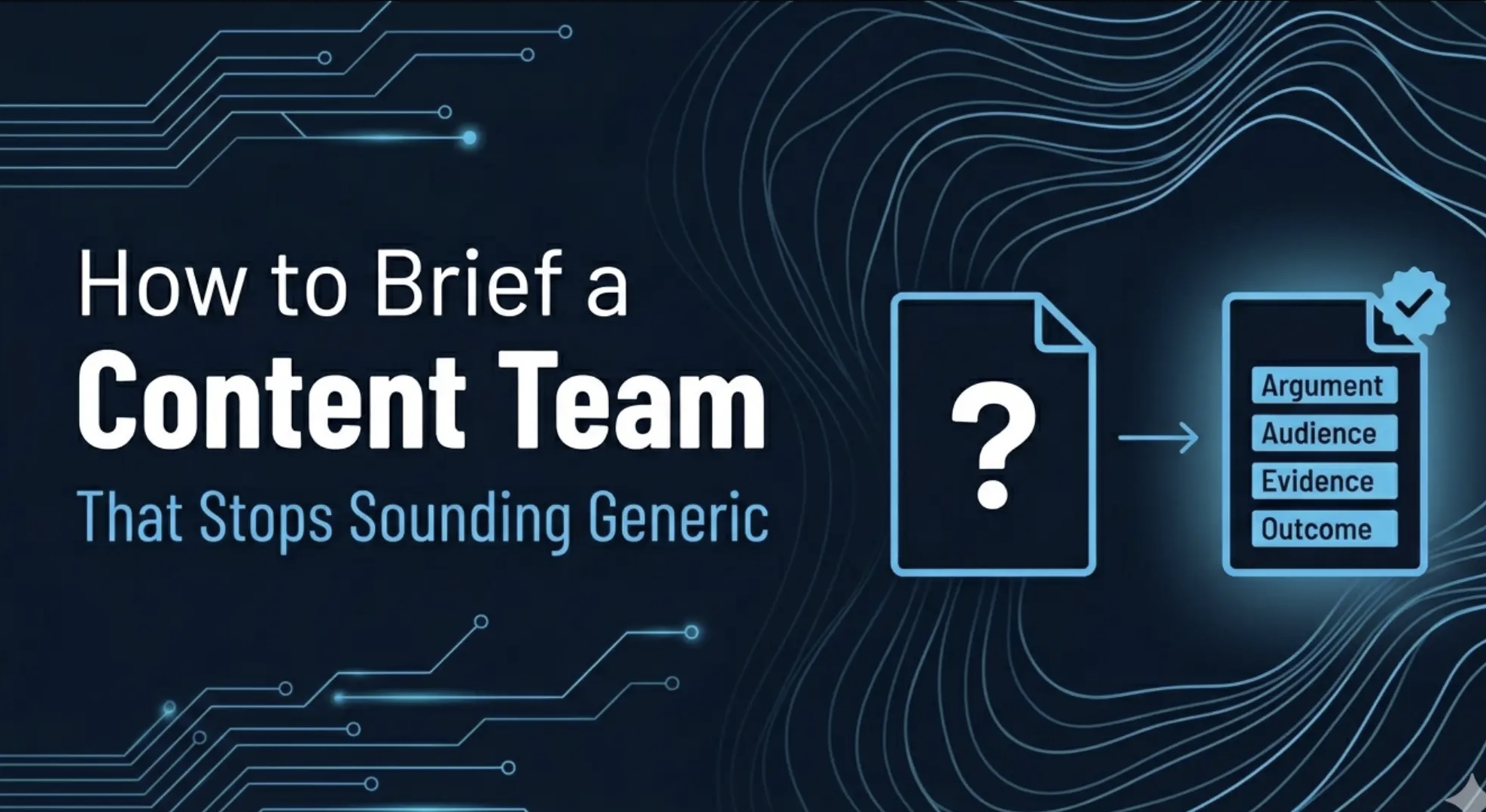
A B2B technology content brief is the document that tells a writer, or these days an AI tool, or more likely both, what this specific piece needs to do that no other piece could do. Not the topic. The topic is the easy part. The brief is everything around the topic: who's reading this, what do they already believe, what's the one thing we're saying that nobody else in our category is saying, and what should happen after they read it. Most briefs skip straight to "here's the topic, here's the keyword, go." Which is how you end up with forty B2B technology blogs that all open with some version of "In today's fast-paced digital landscape." Nobody wanted that sentence to exist. And yet.
The Stat That Made Me Take This More Seriously
AI adoption among content marketers went from 65% to 95% in about two years, according to Orbit Media's most recent survey of over 800 content marketers. Ninety-five percent. That's not a trend; that's basically everyone. Here's why that number matters for briefs specifically: when 95% of people writing content are using AI tools somewhere in the process, your brief isn't just talking to a human anymore. It's also functionally a prompt. And a brief that says "write about X, 1500 words" produces exactly the kind of output you'd expect from a prompt that says "write about X, 1500 words." Which is to say, something that sounds like it was written by someone who was told: "write about X, 1500 words." The brief used to be a nice-to-have that good writers could work around by using their judgment. Now it's load-bearing in a way it wasn't before, because the gap between a vague brief and a sharp one shows up in the output almost immediately, whether a human or a tool is doing the typing.
The One Question That Fixes Most of This
There's a framing from Animalz, the B2B content agency, that I think about a lot: every brief should answer "what can we say here that no one else is saying?" Not "what's the topic" but "what's the argument." This sounds like a small reframe, and it is genuinely not. "Write about sales enablement content" is a topic. "Most sales enablement content fails because it's organized by format instead of by sales stage, and here's what changes when you flip that" is an argument. The first one could be, and probably has been, written four hundred times. The second one is a specific claim that someone could agree or disagree with, which is exactly what makes it worth reading. If your brief doesn't contain a sentence that someone could push back on, you haven't written a brief. You've written a topic with a word count attached.
What Actually Needs to Be in There
I'm not going to pretend there's one perfect template, because there isn't, but here's what I've found actually changes the output, in roughly the order it matters:
- The core argument is stated as a sentence, not a topic. "Retention is a product problem solved through predictable signals plus automated workflows" is a brief. "Write about retention" is a vibe.
- Who's reading this, and what do they already believe? Not a generic persona paragraph, just: this is for a VP of Ops who has tried two other tools and is skeptical that a third one will be different. That one sentence changes the tone of an entire piece.
- The evidence you actually have. Case studies, benchmarks, internal data, anything specific to your company that a generic AI-written piece couldn't produce because it doesn't have access to it. This is, not coincidentally, also the stuff that makes content harder to ignore if you're an AI platform deciding what to cite.
- What happens after someone reads this? Not "drives awareness," that's not a thing that happens to a person. Something like "a reader who finishes this should understand why their current approach to X is leaving money on the table, and want to talk to someone about fixing it." That's four things. Not forty. Four.
A Brief I'd Actually Be Happy to Receive
Here's roughly what a real brief looks like, condensed: Topic: Why most sales battlecards don't get used. Core argument: the problem isn't content quality, it's that battlecards are built as reference documents when reps need them in real time, during a call, in under ten seconds. Audience: sales enablement managers who've built battlecards before and are frustrated they're not being used. Evidence: the 79% produced / 26% used gap from Crayon's research, plus the three-layer structure (positioning, comparison, landmine questions) that addresses the speed problem directly. After reading: the reader should understand exactly what to change about their next battlecard, specifically the governance block and the honest-gaps principle, not just feel vaguely inspired to "do better." Notice that the brief basically writes the outline for you. That's not an accident. A good brief and a good outline converge, because they're both just different views of "what is this piece actually for."
The Annoying Part: This Takes Longer Upfront
I'm not going to pretend writing a real brief takes the same five minutes as writing "write about X, 1500 words." It doesn't. It takes longer because you have to actually think about what you're trying to say before you ask someone else to say it. But here's the trade you're making. A vague brief takes five minutes to write and then produces a draft that needs forty minutes of "okay, but what's this actually about" edits, sometimes across multiple rounds, sometimes ending with the piece getting quietly shelved because nobody can figure out how to fix it. A sharp brief takes twenty minutes and usually produces something close to publishable on the first pass, because the hard thinking happened before the writing did, instead of after. Twenty minutes versus forty-plus-and-also-now-everyone's-annoyed. I know which one I'd pick, once I actually did the math, which took me longer than it should have.
Frequently Asked Questions
What's the difference between a content brief and a creative brief?
A creative brief covers campaign-level decisions across multiple channels, design, advertising, and messaging, often for a broader initiative. A content brief is narrower: one document, one piece of content, focused on what this specific article or page needs to accomplish and say that nothing else does.
How long should a content brief be?
Shorter than you'd think, usually one page. The goal isn't comprehensiveness; it's clarity on the few things that actually shape the output: the core argument, the audience's existing beliefs, the evidence available, and what should happen after someone reads it. A ten-page brief often hides the important parts in noise.
Can AI tools help write the brief itself, not just the content?
To a point. AI can help structure a brief or suggest angles, but the core argument, the thing that makes this piece different from every other piece on the topic, usually needs to come from someone who actually knows the product, the customers, or the data. That's the part AI can't generate from nothing, because by definition, it's the part that doesn't exist anywhere else yet.
What if the writer or AI tool ignores the brief anyway?
This happens, and it's usually a signal that the brief wasn't specific enough to be hard to ignore. A brief that says "make sure this doesn't sound generic" is itself generic. A brief that hands over a specific argument, specific evidence, and a specific reader is much harder to drift away from, because there's something concrete to come back to.
Does a sharper brief mean less room for the writer's voice or judgment?
The opposite, usually. A vague brief forces a writer to invent the angle themselves, often under deadline, which is exactly when generic phrasing creeps in because there's no time to think. A sharp brief handles the "what are we saying" question upfront, which frees up the writer to focus on how to say it well, which is where voice actually lives.


