
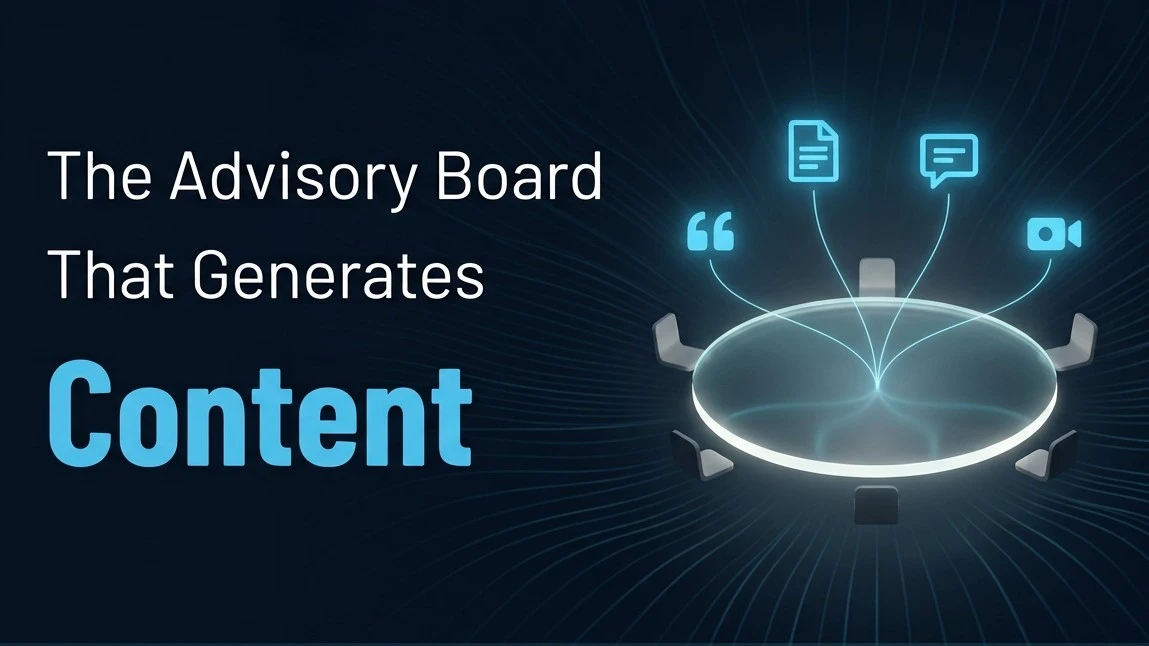
I have reviewed the output of enough customer advisory boards to notice the pattern immediately: a nicely produced meeting summary, a list of feature requests forwarded to product, and a vague line in the quarterly report about "strong customer engagement." Nothing quotable. Nothing citable. No named customer willing to go on record about a specific result. The board met, everyone learned something, and the marketing team walked away with nothing they could publish.
That is not a failure of the customers in the room. It is a failure of how the board was designed.
What Is a Customer Advisory Board, and Why Do Most of Them Underperform on Content?
A customer advisory board, sometimes called a client advisory council, is a small group of a company's most engaged and influential customers convened regularly to shape product and go-to-market strategy. Done well, it provides early warning of shifts in customer needs, reduces churn among the customers who participate, and gives a company a direct line to how its best customers actually think about the category.
Most boards are designed entirely around the feedback function: what do customers want, what is frustrating them, where should the roadmap go next. That is a legitimate and valuable purpose. It is also, structurally, a format that produces almost no usable content, because feedback conversations are framed around problems and requests, not around results and proof. A board built only to extract feedback will extract feedback. A board built to also generate content needs a second, deliberate layer of structure on top of the standard agenda.
The Structural Difference Between a Feedback-Only Board and a Content-Generating Board
The single highest-leverage change is treating the advisory board agenda as customer-driven rather than company-driven, and building in a specific segment where customers describe results, not just react to roadmap questions. A tightly-focused, customer-driven agenda combined with a clear plan for acting on the board's insight yields the greatest return, and a content-generating board applies that same principle to the specific goal of producing usable, citable material.
The practical shift is small but consequential: instead of only asking "what do you need from us," a content-generating board also asks "what have you achieved because of this, and can we tell that story?" That second question, asked deliberately and consistently, is what turns a feedback session into a content pipeline.
The Four Content Assets a Well-Run Advisory Board Can Produce Every Cycle
- Named, specific customer quotes tied to a business outcome. Not "we've been really happy with the platform." A specific result, in the customer's own words, with enough context to be genuinely citable: "moving to this platform cut our quarterly compliance reporting time from three weeks to four days." Getting quotes at this level of specificity requires asking for them directly during the meeting, not hoping they emerge organically from open discussion. A facilitator who asks each board member, by name, "what is the single most concrete result you've seen this quarter" will get usable material far more reliably than one who waits for it to surface unprompted.
- A case study candidate identified and pre-qualified in real time. Rather than the standard post-hoc process of asking a customer success team to nominate a customer for a case study months later, a content-generating advisory board identifies the strongest story candidate during the meeting itself, while the specific numbers and context are fresh, and gets a verbal commitment to participate in a follow-up interview. This alone can compress the case study production pipeline by months compared to the typical customer success referral pathway.
- A structured "state of the category" perspective from the board as a group. Advisory board members are, by definition, deeply engaged customers with a view across their own industry and its peers. A facilitated discussion specifically asking board members to characterize the current state of their category, the top three challenges practitioners like them are facing right now, produces genuinely original, quotable perspectives that a company's own marketing team cannot manufacture, because it did not experience the category from the buyer's seat.
- A recorded, structured Q&A segment that can be repurposed directly. If the board format includes a segment where members ask each other questions, moderated by the company, that segment is often the most content-rich part of the entire meeting, because it surfaces the real, practitioner-level questions and answers that a company's own content team would otherwise have to guess at. Recording this segment, with permission, and treating the transcript as a raw content asset produces material that would be difficult to generate through any other research method.
The Permission and Trust Layer This Requires
None of this works without addressing consent explicitly and early. A board convened primarily to extract feedback that then asks members mid-meeting to also provide quotable content damages the trust the board depends on if the shift feels like a bait and switch. The fix is transparency at the recruitment stage: telling prospective board members clearly that participation may include being asked, at their discretion, to contribute a quote, participate in a case study, or have parts of the discussion recorded for content use, with explicit opt-in and opt-out at every stage.
Customers who join an advisory board are, by definition, deeply engaged and often proud of the results they have achieved. Most are willing to share those results when asked directly and given control over how their name and company are used. The mistake most companies make is never asking directly, assuming customers will volunteer content on their own, and then wondering why the board produces nothing usable.
Why This Connects Directly to AEO and GEO Strategy
Original customer data and documented outcomes are exactly the kind of content that AI models cannot synthesize from anywhere else. A specific quote from a named customer, describing a specific measurable result, is precisely the citable, verifiable content that earns AI search visibility in a way that generic marketing claims cannot. An advisory board run with content generation as a deliberate design goal is, in practical terms, a recurring, structured source of exactly the proprietary proof points that AEO and GEO strategy depends on.
This reframes the advisory board from a feedback mechanism that happens to sometimes produce a usable quote, into a scheduled content production system that also happens to deliver the traditional feedback and retention benefits boards have always provided. The same quarterly or biannual meeting produces both outcomes when the agenda is designed for both from the start.
Frequently Asked Questions
What is a customer advisory board and how is it different from a standard customer feedback program?
A customer advisory board is a small, curated group of a company's most engaged and influential customers, convened regularly, typically quarterly or biannually, specifically to provide strategic input on product direction and go-to-market strategy. Unlike ad hoc customer feedback surveys or support ticket analysis, an advisory board creates an ongoing, structured relationship with a consistent group of participants, which allows for deeper, more strategic conversation than a one-time survey can produce.
How can a customer advisory board be structured to also generate marketing content?
The key structural change is adding a deliberate content-generation segment to the standard feedback agenda: asking board members directly for specific, quantified results they have achieved, identifying a strong case study candidate in real time during the meeting, facilitating a "state of the category" discussion that surfaces original industry perspective, and recording permission-based Q&A segments that can be repurposed as content. This requires the facilitator to ask pointed questions about outcomes, not just open-ended questions about needs and frustrations.
How should a company get consent to use advisory board content for marketing purposes?
Consent should be addressed explicitly at the recruitment stage, before the first meeting, so participants understand that they may be asked, at their own discretion, to contribute quotes, participate in case studies, or have parts of discussions recorded for content use. Each specific use should include an opt-in and opt-out option at the time it is requested, not a blanket agreement signed once. This transparency prevents the trust damage that occurs when a board convened for feedback purposes later asks for content contributions without warning.
What kind of content does a customer advisory board produce that other methods cannot?
Original, specific, verifiable customer outcomes and category perspective that a company's own content team cannot manufacture internally, because it comes from the buyer's experience rather than the vendor's assumptions about that experience. This is precisely the kind of proprietary, citable data that supports both traditional trust-building content like case studies and AEO and GEO strategy, since AI models favor content built on original, attributable claims over generic marketing language.
How often should a customer advisory board meet to sustain a content pipeline?
Quarterly is the most common cadence for boards designed to sustain a regular content pipeline, since it aligns naturally with content planning and reporting cycles. A biannual cadence can work if each meeting is deliberately structured to extract multiple content assets per session, but quarterly meetings generally sustain a more consistent flow of fresh customer quotes, case study candidates, and category perspective than a less frequent schedule allows.
References
- Ignite Advisory Group, What Is a Customer Advisory Board: Best Practices and Key Components, customer-driven agenda design and recruitment methodology: https://www.igniteag.com/customer-advisory-board/
- CustomerAdvisoryBoard.org, Customer Advisory Board Best Practices, Agenda, Strategy, structural components of high-performing boards: https://customeradvisoryboard.org/
- RevvGrowth, B2B SaaS Marketing Guide 2026, customer advisory boards as a growth and content strategy: https://www.revvgrowth.com/saas-demand-generation/b2b-saas-marketing
- Position Digital, B2B SaaS Content Marketing Strategy That Drives Leads in 2026, original customer-sourced content as a defense against AI content commoditization: https://www.position.digital/blog/b2b-saas-content-marketing-strategy/


