
The quarterly content workshop with sales has a predictable arc, and if you have run more than two of them, you already know how it goes. Someone from marketing opens with a slide about the content calendar. A sales rep says the case studies do not address the objections they actually hear. Someone else says the one-pagers are out of date. The conversation drifts into a general complaint about how marketing does not understand the field, and forty-five minutes later everyone leaves with the same frustration they walked in with, minus an hour of their day.
This is not a personality problem. It is a structural one. Most content workshops are designed as feedback sessions rather than production sessions, and feedback without a container becomes venting.
Why the Standard Format Fails
Companies with aligned sales and marketing teams grow revenue significantly faster than misaligned ones, and misaligned organizations in the US alone waste an estimated $1 trillion annually through lost productivity and squandered marketing spend. Most companies know alignment matters. Few have a workshop format that actually produces it.
The standard failure pattern has three causes. The workshop has no output requirement, so it defaults to discussion. The agenda is open-ended, which means the most vocal person in the room sets the direction. And the meeting happens without preparation, so people arrive with vague frustrations rather than specific, actionable input.
The fix is not better facilitation. It is a different meeting structure entirely, one that treats the workshop as a production session with a required deliverable, not a forum for airing grievances.
The Structure That Produces Content Instead of Complaints
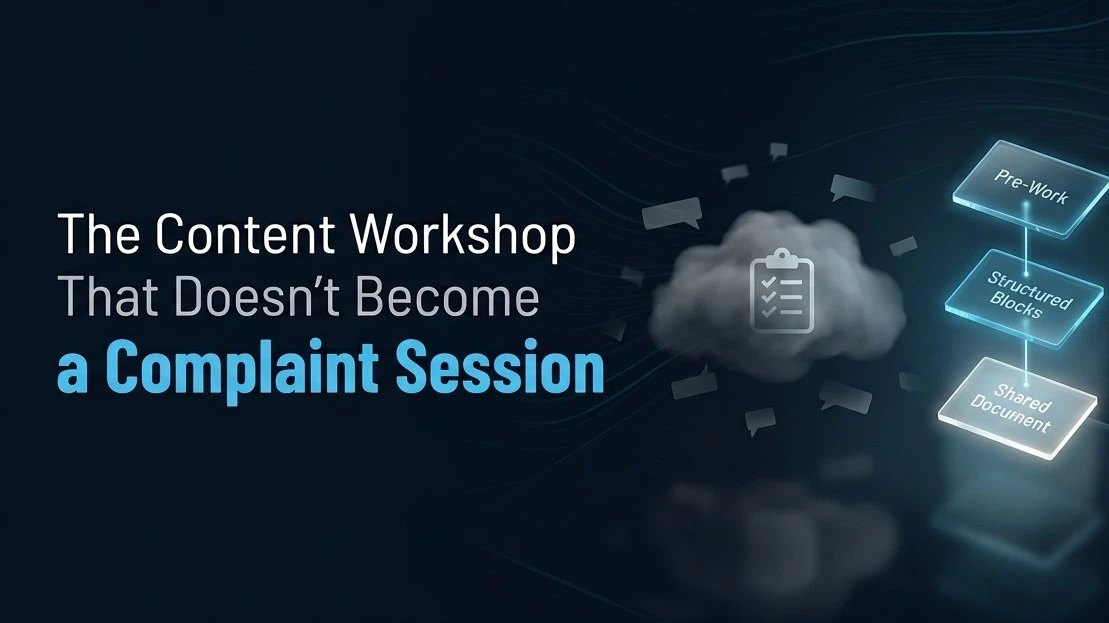
Pre-work: every attendee submits three specific items before the meeting. Not general feedback. Three specific things: one objection that came up on a call this quarter that the team does not have a good answer for, one question a prospect asked that nobody could answer well, and one piece of existing content that a rep tried to use and that did not land. This pre-work requirement changes the entire tone of the meeting. A rep who has to name a specific objection, specific question, and specific content failure arrives with material, not a mood.
The meeting itself runs in three tightly timed blocks, not open discussion. Block one, twenty minutes: review the submitted objections and questions, group them by theme, and identify the three or four that appeared from multiple reps independently. Independent repetition is the signal that something is a real pattern, not one person's pet issue. Block two, twenty minutes: for each identified theme, the group develops a one-sentence answer together, in the room, in real time. Not a full piece of content. The core argument. Block three, twenty minutes: assign ownership. Marketing takes each core argument and commits to a specific content asset and a specific delivery date, out loud, in front of the room.
The meeting ends with a shared document, not a summary email sent later. Every attendee should leave with the three or four core arguments developed in the room, the content commitment tied to each one, and the delivery date. This document is the actual output of the workshop. If it does not exist by the time people leave the room, the workshop produced discussion, not content.
The Facilitation Move That Prevents the Complaint Spiral
There is one specific facilitation habit that separates a workshop that produces content from one that becomes a venting session: redirecting every complaint into a specific question before it is allowed to become a general statement.
When a rep says "the case studies never address what buyers actually care about," the facilitator's job is to immediately ask: "Which specific objection, from which specific type of buyer, is the case study library missing?" That question forces specificity. It also, most of the time, reveals that the complaint is not actually about the entire case study library. It is about one gap, for one buyer profile, on one topic. That gap is solvable in the meeting. The general complaint is not.
This redirect needs to happen every single time a complaint surfaces without a specific example attached. It feels repetitive the first few times. It is what keeps the meeting from drifting into the pattern everyone has experienced before.
What Marketing Needs to Bring, Not Just Ask For
Content workshops with sales fail more often when marketing arrives only to collect input. The workshops that produce the most usable content are the ones where marketing arrives having already reviewed the previous quarter's call recordings or CRM notes and comes with a hypothesis: "We think the biggest content gap right now is around the security objection that's been coming up in enterprise deals. Is that right, or is something else more urgent?"
This changes the sales team's role from generating raw material to validating or correcting a hypothesis, which is a faster and more specific conversation than starting from a blank page. It also signals that marketing has been paying attention between workshops, which is the single biggest driver of whether sales takes the next workshop seriously.
The Cadence That Actually Works
Quarterly is the most common cadence, and it is often too infrequent to catch problems while they are still fresh in reps' memory. A monthly thirty-minute version of the same structure, with a smaller scope, three objections instead of a full quarter's worth, tends to produce more usable content because the material is more recent and more specific.
The quarterly session can then serve a different purpose: reviewing what got built from the monthly sessions, what actually got used by reps, and what needs to be revised. That review conversation is naturally more structured than a first-contact brainstorm, because it is anchored to specific assets that already exist rather than to a general sense of what might be missing.
What to Do When the Room Still Wants to Vent
Some venting is legitimate and should not be shut down entirely. A team that has genuine, accumulated frustration about content quality needs an outlet, and refusing that outlet entirely creates its own resentment. The distinction that matters is between venting with a time box and venting that hijacks the entire meeting.
Giving the first five minutes of the workshop explicitly to open frustration, with a visible timer, acknowledges the need without letting it consume the session. When the timer ends, the facilitator moves to the structured format regardless of whether everyone feels fully heard. This is not because the frustration is not valid. It is because an unstructured complaint session and a structured production session cannot coexist in the same meeting, and only one of them produces content that ships.
Frequently Asked Questions
What is the biggest reason content workshops between sales and marketing fail to produce usable content?
Most workshops are structured as open discussion sessions rather than production sessions with a required deliverable. Without pre-work requirements, timed agenda blocks, and an explicit output commitment, the meeting defaults to general discussion, which tends to surface complaints rather than specific, actionable content gaps. The fix is structural, not about better facilitation skill alone.
How much pre-work should sales reps do before a content workshop?
Three specific items per attendee are enough to change the meeting's character without creating a burdensome homework assignment: one unresolved objection from a recent call, one question a prospect asked that nobody answered well, and one piece of existing content that failed to land when used. This level of specificity prevents the meeting from starting with vague complaints and gives the group real material to work with immediately.
How often should sales and marketing run content workshops?
A monthly thirty-minute session with a narrow scope, three objections rather than a full quarter's backlog, tends to produce more usable content than a single quarterly session, because the material discussed is more recent and specific in reps' memory. Quarterly sessions work better as review meetings, evaluating what got built from the monthly sessions and what is actually being used by reps, rather than as the primary brainstorming venue.
Should marketing arrive at a content workshop with ideas already prepared?
Yes. Workshops where marketing arrives having reviewed recent call recordings or CRM notes and proposes a specific hypothesis about the biggest content gap tend to produce faster, more specific conversations than workshops where marketing arrives solely to collect input. Sales validating or correcting a hypothesis is a more efficient use of shared time than generating raw material from a blank page, and it signals that marketing has been paying attention between sessions.
Is it ever appropriate to let a content workshop include open complaints?
Yes, in a time-boxed format. Teams that have accumulated genuine frustration benefit from a short, explicitly bounded period, five minutes with a visible timer, to air that frustration before the meeting moves into the structured production format. Suppressing all venting creates its own resentment. The key distinction is between bounded venting and venting that consumes the entire meeting, which produces discussion instead of content.
References
- Martal, Sales and Marketing Alignment: 5 Proven B2B Strategies for 2026, joint workshop format and alignment checklist: https://martal.ca/sales-and-marketing-alignment-lb/
- Improvado, The Ultimate Guide to Sales and Marketing Alignment 2026, $1 trillion annual US misalignment cost, 208% revenue lift data: https://improvado.io/blog/sales-and-marketing-alignment
- SyncGTM, B2B Sales and Marketing Alignment: The 2026 Playbook That Actually Works, weekly pipeline meeting cadence and cultural alignment practices: https://syncgtm.com/blog/b2b-sales-and-marketing-alignment
- Salesmotion, 10 Sales and Marketing Alignment Best Practices for B2B Revenue Teams, war room session format: https://salesmotion.io/blog/sales-and-marketing-alignment-best-practices


