
Somewhere in your company's resource library is a case study that took someone three weeks to produce, went through four rounds of legal review, got a nice design treatment, and has been opened, by my extremely confident estimate, by absolutely nobody in the last quarter. I'm not saying this to be mean. I have personally written that case study. More than once. I regret nothing and also everything.
What's Actually Going Wrong, Statistically Speaking
Case studies influence the purchasing process for 73% of B2B decision-makers. Only 34% of companies use them effectively. Sit with that gap for a second, because it's doing a lot of work. The format isn't the problem. Buyers clearly want this kind of proof. The execution is the problem, and it's a remarkably specific, fixable kind of bad execution that keeps happening across basically every company I've ever looked at, including, again, companies I have personally worked for.
The Thing Every Bad Case Study Has in Common
Most case studies are written as a self-congratulatory list of services. They read like a project report: here's what we did, here's the timeline, here's the team that worked on it. They focus on features, not feelings, on tasks, not transformation. It's basically a resume with a client's logo on it.
Here's the part that I think gets missed even by people who already know case studies should be "more story-driven." Potential customers don't read case studies to learn about your process. They read them to find out if you understand the problem they personally have. That's it. That's the whole job of the document. If a prospect can't find themselves in the first three sentences, the rest of the case study, however well-written, is basically talking to an empty room.
The Structure That Actually Works
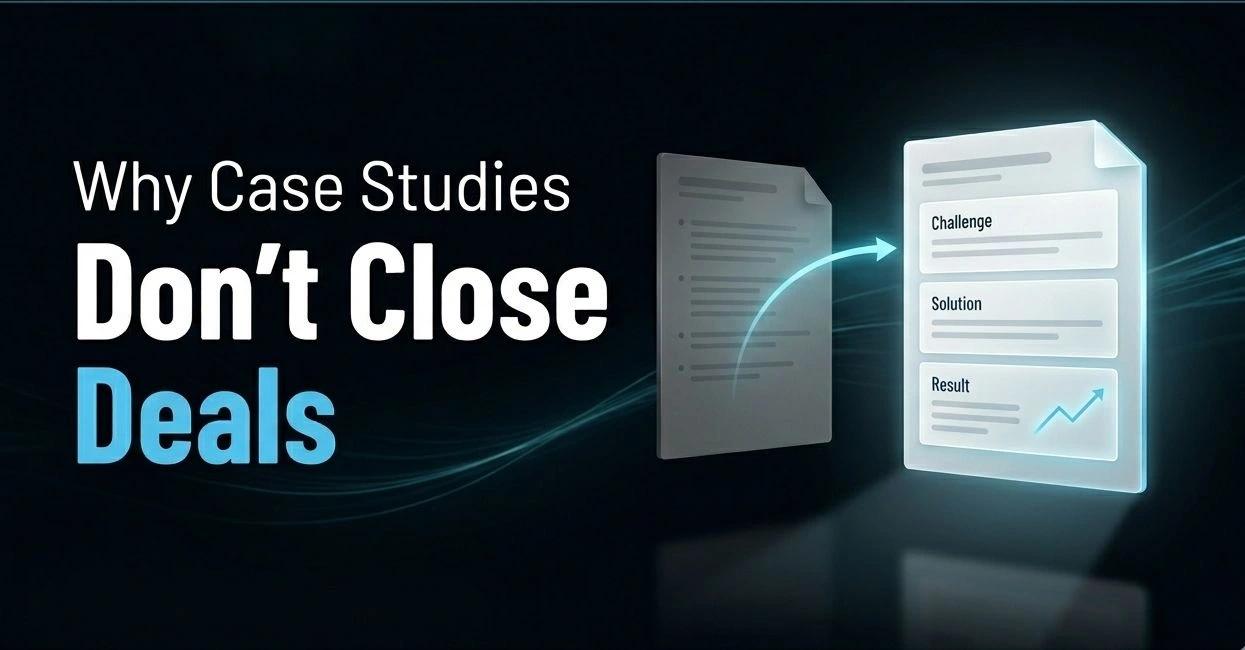
There's a simple framework worth building around, three parts: Challenge, Solution, Result. I know that sounds almost insultingly basic, and that's sort of the point; the basic version done properly outperforms the elaborate version done badly almost every time.
The challenge section is where most case studies quietly fail without anyone noticing why. "The lead qualification process was inefficient" is a sentence that says nothing to anyone. "The sales team was spending 10 hours per week manually qualifying leads" is a sentence a reader can actually picture, because it has a number and a human cost attached to it. Vague problems get vague sympathy. Specific problems get a reader nodding along, going "oh no, that's literally us."
The solution section is where most case studies overcorrect into exactly the trap I mentioned earlier, turning into a feature list. Resist it. The solution section's job isn't to prove you have a sophisticated product. It's to connect the dots between the specific pain in section one and the specific change that fixed it, in language the reader's own boss would understand, not in language that requires already knowing your product.
The result section needs a structure too, not just a number floating by itself. Context, Achievement, Relevance works well here: "The restructuring of the lead nurturing process led to a 43% increase in conversion rate, which generated an additional $1.2 million in annual revenue." Notice that's not just "43% increase." It's the change that caused it and the dollar figure it translated into. One number alone is a statistic. A number wrapped in context and consequence is a reason to believe you.
Here's Where I Have to Argue With Myself a Little
I want to flag something, because I think it's a real tension and not just a tidy point to wrap up a section. Case study format preferences aren't universal. Some buyers prefer video, some prefer text, and the honest answer to "which one should we make" is usually "both, if you can manage it." For video specifically, attention drops off hard after about 40 seconds, so keep it tight. For written case studies, somewhere around 500 words is plenty for most situations, though technical buyers evaluating complex products can sometimes justify going longer, 1,000-plus words, as long as you respect that you're now asking for more of someone's attention and need to earn every paragraph of it.
I don't have a clean universal rule here beyond "know who's actually going to read this and build for them specifically," which I realize is a slightly unsatisfying answer for an article that's otherwise been pretty prescriptive. Sometimes the honest answer is just less tidy than the rest of the framework.
The Distribution Problem Nobody Talks About
Here's something that gets buried under all the "how to write a better case study" advice: B2B buyers consume an average of five to seven different content formats before making a purchasing decision. One beautifully written case study, sitting alone on a resources page, is not a strategy. It's an asset waiting to be used in roughly one-seventh of the ways it actually could be.
A real case study ecosystem looks more like this: the detailed long-form version on the website, a two-to-three-minute video pulling direct quotes from the same client, short topic-centered snippets pulled out for social, and a slide version a rep can actually drop into a deal-stage conversation without reformatting anything. Same underlying proof, four different shapes, reaching four different moments in a buyer's process. Most companies build the first one and call it done, then wonder why it doesn't move the needle the way they hoped.
A Genuinely Practical Starting Point
Pick your single best customer result, the one your sales team already mentions on calls without needing to look it up, because that's usually a sign it's strong enough to build around. Rewrite just the opening three sentences using a specific, numbers-attached version of the challenge, not "inefficient processes," but the actual hours, the actual cost, the actual frustration in the client's own words if you have it.
Then stop. Don't rebuild the whole case study library this week. Get that one opening right, see if it changes how the piece performs, whether sales actually start sending it unprompted, and use what you learn there before doing the same fix across everything else. I promise this is more useful than trying to fix all of them simultaneously and burning out somewhere around case study number four.
Frequently Asked Questions
Why do most B2B case studies fail to influence buying decisions despite buyers wanting this kind of content?
The gap is mostly about execution, not format. Case studies influence 73% of B2B buying decisions, but only 34% of companies use them effectively, usually because most case studies are written as project summaries listing services and timelines rather than stories framed around the customer's actual challenge. Buyers read case studies to see if a vendor understands their specific problem, and a feature-focused write-up doesn't answer that question.
What's the most effective basic structure for a B2B case study?
Challenge, Solution, Result is a simple and consistently effective framework. The challenge section should use specific, numbers-attached language rather than vague descriptions, the solution section should connect directly back to that specific pain rather than listing product features, and the result section works best using a Context-Achievement-Relevance structure that explains what changed, what it achieved, and why that mattered in business terms.
Should B2B case studies be written as text, video, or both?
Both formats serve real, sometimes different audiences, and preference varies enough that picking one exclusively means missing a meaningful share of your readers. Video case studies perform best kept under roughly 90 seconds, given typical attention drop-off, while written case studies generally work well around 500 words, though more technical or complex products can justify longer written versions for audiences willing to invest more reading time.
How many different formats should a case study be turned into?
B2B buyers typically consume five to seven different content formats before deciding, which suggests a single long-form case study on a resources page is underused on its own. A more complete approach includes the detailed written version, a short video with direct customer quotes, social-ready snippets pulled from the same material, and a slide format sales reps can use directly in deal conversations.
What's the fastest way to improve an existing case study without a full rewrite?
Start by rewriting just the opening few sentences of the challenge section, replacing vague problem statements with specific, numbers-attached descriptions of what the customer was actually dealing with before your involvement. This single change often has an outsized impact, since it determines whether a reader sees themselves in the story within the first few seconds, before deciding whether to keep reading at all.
References
Brixon Group, Compelling Case Studies: How to Create Impactful B2B Success Stories in 2026, Content Marketing Institute and Forrester Research citations: https://brixongroup.com/en/compelling-case-studies-how-to-create-impactful-b2b-success-stories-in Brew Digital, How to Write a B2B Case Study That Actually Converts: https://brewdigital.com/resources/article/how-to-write-a-b2b-case-study-that-actually-converts Motarme, Anatomy of a High Converting Case Study: https://motarme.com/anatomy-of-a-high-converting-case-study/


