
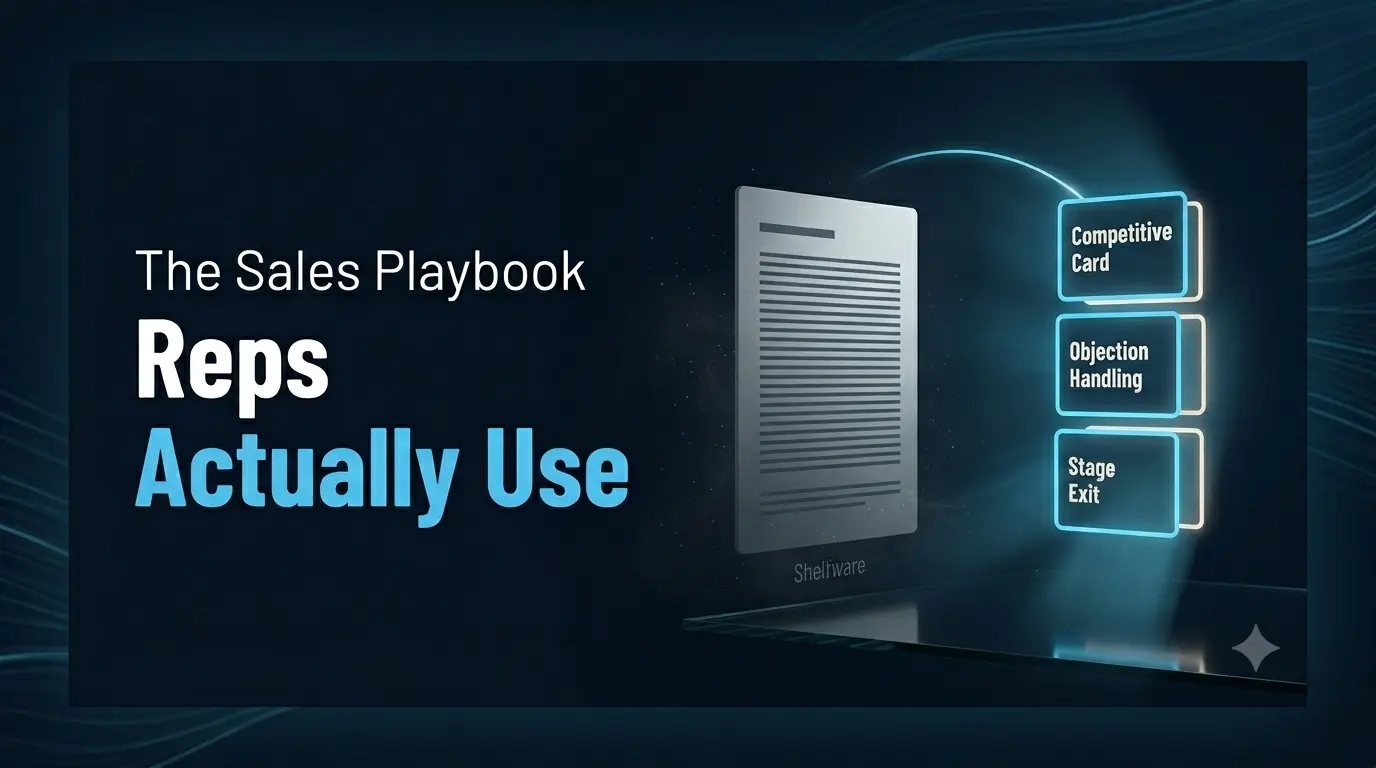
The number is 58%. That's the share of B2B sales playbooks that are never consistently used after launch, according to current research. Teams spend months building them. There's a launch with training sessions and Slack announcements. And then, within four to six weeks, the rep who asks "where do I find the objection handling guide" gets a three-second pause followed by "it should be in the shared drive somewhere."
Companies with a documented sales process grow revenue 18% faster than those without one. The gap between that number and the 58% abandoned-playbook reality is the actual problem most sales leaders are dealing with.
What Is a Sales Playbook, and Why Do Most of Them Fail?
A sales playbook is a documented set of plays, scripts, frameworks, and guidance that tells a rep what to say, what to send, and what to do in specific selling situations. Done right, it's the difference between a team where one or two top performers carry quota and a team where most reps execute consistently. Done wrong, it's a 90-page PDF that reps open during onboarding and never touch again.
Most playbooks fail for the same reason, and it isn't the content quality. The failure mode is structural. The playbook is organized around how sellers move through a CRM pipeline, not around how buyers actually make decisions. A rep opens it looking for "what do I say when a CFO raises a security concern at the demo stage" and finds a section called "Stage 4: Demo" with three paragraphs about demo best practices. Close enough to be useful, but not close enough to be used in the middle of a live call.
Reps open it once. Find it doesn't match the conversation they're in. And close it permanently.
The Architecture Problem Nobody Talks About
Average playbook adoption sits around 30% for most SaaS companies. Many organizations report it below 20%. The Alexander Group has documented that playbooks built around seller CRM stages, the most common architecture, are the ones most likely to fail adoption.
The fix is to rebuild the architecture around buyer decision moments, not seller funnel stages. Not "what should a rep do in Stage 4" but "what should a rep say when a prospect says they need to loop in their security team before moving forward" or "what should a rep send when a champion goes quiet for two weeks."
The difference sounds small. The adoption difference is not. A rep who can type a keyword into the playbook search and get the relevant play in under thirty seconds will use it. A rep who has to navigate a chapter structure while a prospect waits for a response will not.
The 80% Rule That Cuts Build Time in Half
Most playbooks fail by trying to document everything. A sales ops manager on a popular revenue operations forum described spending two months building a comprehensive competitive intelligence guide, objection handling library, and persona-level messaging framework, only to have the whole document go stale within six weeks as a competitor repositioned and a new product feature shipped.
The Alexander Group calls the solution the 80% rule: document only the plays that handle 80% of your selling situations. Not the edge cases. Not the hypothetical scenarios. The ten to fifteen situations that come up constantly across most deals, and only those. A playbook that answers twenty common situations clearly beats a playbook that attempts to answer two hundred situations incompletely.
Here's what that looks like in practice. Rather than a complete competitive positioning section, a focused competitive card for each of the three competitors your reps encounter most, each card answering "thirty-second positioning," "two places where they genuinely win and our reframe," and "the question to ask that surfaces their weak spot." That's three cards, not a chapter. Each one is findable in under a minute. Each one gets used.
The Delivery Problem That Kills Otherwise Good Playbooks
Even a well-built playbook dies if it lives in a shared drive. The rep who is mid-call does not open a browser tab, navigate to the shared drive, find the folder, find the document, and ctrl-F for the relevant section. They improvise.
Sales playbook software has evolved substantially in 2026 toward solving this specific problem: surfacing guidance inside the tools reps actually use, inside Salesforce, inside Outreach, inside whatever CRM and sequencing tools are in the daily workflow, rather than requiring reps to context-switch to a separate document. A playbook card that surfaces automatically when a rep opens a deal at a specific stage, without the rep having to think to look for it, has meaningfully better adoption than the same card sitting in a folder.
If dedicated sales enablement platforms are not in the current budget, the second-best option is a searchable digital wiki, Notion, Confluence, or Guru, with every play tagged by situation rather than organized by chapter. Keyword-searchable beats navigation-dependent, every time, for in-the-moment use.
The Three Things the Launch Needs to Include
Most playbook launches fail because they treat the launch as a delivery event rather than a change management process. There's training, there's a Slack message, and then leadership moves on and assumes adoption will follow.
It will not. The plays need to be reinforced in the first deal reviews and coaching sessions after launch, with managers asking "what play did you run here" and "where in the playbook did you find the handling for that objection." If leadership stops referencing the playbook in those conversations within two weeks of launch, reps accurately read that as a signal that the playbook isn't a real operational tool. Adoption follows manager behavior more reliably than it follows documentation quality.
The quarterly update cadence matters more than the launch does. A playbook that's updated every quarter based on actual win-loss patterns, actual competitive shifts, and actual rep feedback is a living tool. A playbook that's built once and declared finished is a document that's wrong in six weeks and abandoned by ten.
What a Minimum Viable Playbook Looks Like
If you don't have a playbook yet, or if the existing one has been abandoned, the fastest path back to usefulness is not starting over with a comprehensive rebuild. It's identifying the three to five situations where inconsistent rep execution is costing deals right now, and building one well-structured card for each.
An ICP definition specific enough that a new rep can qualify a prospect in thirty seconds. Stage exit criteria for the two deal stages where deals most commonly stall. One competitive card for the competitor reps say they lose to most. One objection handling entry for the objection that comes up most at the demo stage.
Five cards. Searchable. Embedded in the tools reps already use. Reinforced by managers in the first two weeks. That is a playbook that gets used. It's not comprehensive. Comprehensive can come later, built on the foundation of something that has already earned rep trust by being findable and relevant when they actually needed it.
Frequently Asked Questions
What's the most common reason sales playbooks fail adoption?
The most common cause is structural, not content-related. Most playbooks are organized around CRM pipeline stages from the seller's perspective, rather than around buyer decision moments that match the situations reps actually encounter on calls. A rep mid-conversation cannot navigate a stage-based chapter structure fast enough to be useful, so they improvise instead.
How long should a sales playbook actually be?
Short enough to be navigated in under thirty seconds for any common situation. Research consistently shows adoption declines as length increases, because reps in live selling situations need to find the relevant play immediately. A focused playbook covering the 80% of situations that come up regularly outperforms a comprehensive playbook covering every possible edge case, because the focused version actually gets opened.
Should reps be involved in building the playbook?
Yes, and this is one of the most reliable predictors of adoption. Playbooks built from the top down, without rep input into which situations most need documented plays, have lower adoption than playbooks co-built with the people who will use them. Including even a small group of top-performing reps in identifying the most important situations to document, and reviewing the plays before launch, creates ownership that purely top-down builds don't produce.
How do you measure whether a playbook is actually being used?
Quantitative metrics include content usage analytics from any platform tracking which sections get opened, conversion rates at the stages where the playbook provides specific guidance, and new rep ramp time compared to the period before the playbook existed. Qualitatively, the most reliable signal is whether managers naturally reference the playbook in deal reviews without prompting, since manager behavior is the strongest predictor of rep behavior.
What's the minimum time commitment to maintain a playbook properly?
Quarterly reviews are the minimum, taking two to three hours each, to update competitive cards when a competitor repositions, refresh objection handling based on what's coming up in recent deals, and retire plays that data shows aren't being used or aren't working. The quarterly review also serves as a reinforcement signal to the team that the playbook is a living tool that leadership takes seriously, which matters as much for adoption as the content updates themselves.
References
Altisima Advisory, How to Build a B2B Sales Playbook Your Team Uses, 58% adoption data and buyer-centric architecture: https://altisima-advisory.com/blog/build-b2b-sales-playbook-team-uses.html
Prospeo, Sales Playbook Best Practices That Actually Work 2026, Alexander Group 80% rule and adoption rates: https://prospeo.io/s/sales-playbook-best-practices
Chief, Designing a Self-Executing Sales Playbook, 30% adoption and delivery mechanism analysis: https://www.getchief.com/blog/sales-playbook
Sellcrafter, Why Your Sales Playbook Isn't Working and How to Fix It in 2026: https://www.sellcrafter.com/post/why-your-sales-playbook-isn-t-working-and-how-to-fix-it-in-2025


