
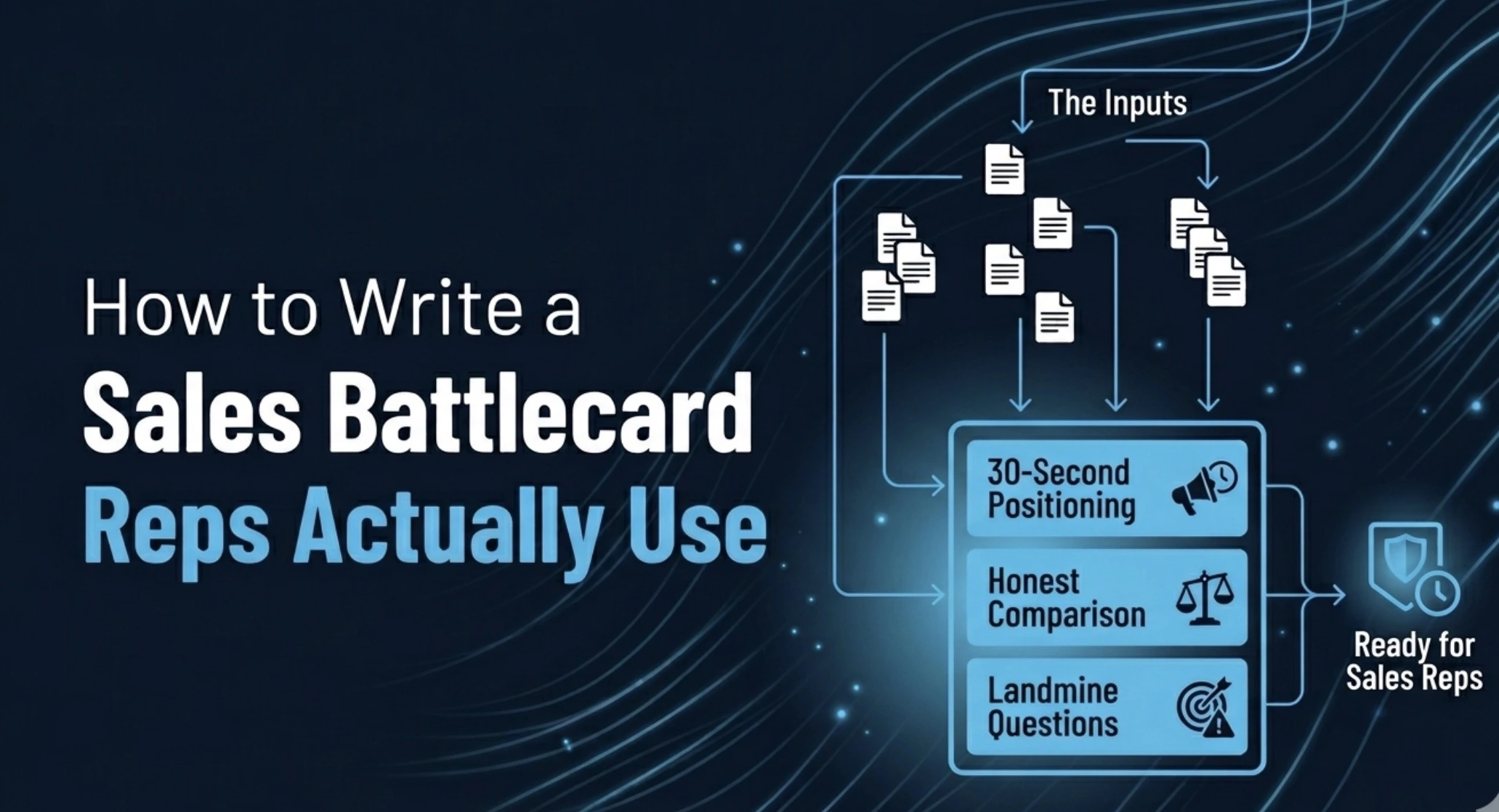
79% of competitive intelligence teams say they produce battlecards for their sales reps. Only 26% of reps say they actually use them. That gap is not a writing problem. It is a format problem, and it is fixable in an afternoon.
What Is a Sales Battlecard?
A sales battlecard is a one-page reference that gives a rep instant guidance on how to position against a specific competitor, handle the objections that competitor's name triggers, and keep a deal moving when a prospect brings that name into the conversation. Done well, it is the difference between a rep fumbling for an answer and a rep having the exact line ready before the prospect finishes the sentence. Sellers encounter a named competitor in roughly 68% of deals. That is not an edge case. That is most deals. A battlecard is not a nice-to-have reference document. It is preparation for the most common moment in a competitive sales cycle.
Why the Adoption Gap Exists
Here is the scenario that explains the 26% number. A rep is on a call. The prospect says, "We're also talking to [Competitor], and they told us your reporting is outdated. They're also 20% cheaper. Why should we pay more?" The rep has three seconds. If the answer is sitting in a fifteen-page PDF on a shared drive, it does not exist. By the time the rep finds it, the moment has passed, and the prospect has moved on, unanswered. That three-second window is the entire design brief for a battlecard. If a rep cannot find the answer in ten seconds while someone is mid-sentence, the battlecard is broken, regardless of how accurate or thorough it is. Speed beats completeness, every time, because a battlecard nobody can access in the moment is not a battlecard. It is a wiki page. There is a second reason battlecards fail, and it is more uncomfortable. Many battlecards are written as pure feature checklists where the home team wins every row. Reps see through this immediately, on the first read, and stop trusting the document, not just for that competitor, but for every battlecard the same team produces afterward. Once a rep decides the battlecards are marketing spin, they stop checking them, even when a new one might actually help.
The Three-Layer Structure That Works
A battlecard that survives contact with a live call has three layers, each answering a different question a rep needs in a different moment.
Layer one: the thirty-second positioning
This is the opening line a rep uses before any specifics come up, a short, honest framing of how your approach differs from this competitor's, in language a prospect would actually recognize. Pull the competitor's own positioning from their homepage, in their words, not yours. A rep who describes a competitor in terms the prospect does not recognize loses credibility instantly, and rarely recovers it for the rest of the call.
Layer two: the honest comparison
A side-by-side view covering your product and this competitor across the three or four dimensions prospects actually ask about. The instinct is to make this a list where you win every category. Resist it. Include the one or two areas where the competitor genuinely has an edge, paired with the reframe for why that edge does not matter for your ICP. A battlecard that admits a weakness is a battlecard a rep will trust on the next nine points. A battlecard that claims perfection is a battlecard a rep stops reading.
Layer three: the landmine questions
Two or three questions a rep can ask that surface a weakness in the competitor's approach without the rep ever badmouthing them directly. "How does their platform handle [specific scenario your ICP cares about]?" is a question, not an attack, and when the honest answer is "not well," the prospect draws their own conclusion. This layer is what turns a defensive document into an offensive one.
The Governance Block Most Battlecards Skip
A battlecard is a snapshot of a moving target. Competitors change pricing without announcing it, rewrite their homepage between your quarterly reviews, and ship features that turn yesterday's "they can't do this" into today's landmine pointed back at you. The card does not announce that it is wrong. A rep finds out live, on a call, repeats a stale claim, and the prospect corrects them. Deals rarely recover from the rep being the least current person in the room. Every battlecard needs three lines at the top that take thirty seconds to add and prevent this exact scenario: last updated date, owner, the named person responsible for keeping it current, and status, whether it is safe to reference directly with a prospect or for internal positioning only. If a claim requires legal review before it can be said out loud to a buyer, that should be flagged here, not discovered mid-call.
Where to Get the Content
The fastest battlecard build pulls from sources that already exist and takes about an hour per competitor. Pull the competitor's own positioning from their current homepage and about page, five minutes, and it is the foundation of layer one. Pull recent G2 or Capterra reviews mentioning this competitor by name, customers describing real frustrations are more credible than anything your team could write, and they are the raw material for layer three's landmine questions. Pull from your own win-loss interviews if you run them, 75% of competitive intelligence teams say win-loss data directly shapes their battlecard content, and it is the only source that tells you what actually came up in deals you won and lost against this specific competitor.
Start With Three, Not Ten
Do not try to build a battlecard for every competitor in your category in one sitting. Build three: the competitor reps encounter most often, the one that causes the most stalled deals, and the one whose name reps say makes them most nervous on a call. Those three cover the moments where deals are actually won or lost. Once those three are live and reps are using them, which you can measure simply by asking in your next sales team meeting whether anyone has opened one in the last two weeks, expand from there. A battlecard library that starts with three cards reps actually use beats a library of fifteen cards nobody opens, every time.
Frequently Asked Questions
Why do most sales reps not use the battlecards their company creates?
The primary reason is format, not content quality. Most battlecards are built as long reference documents stored in a shared drive, which is too slow to access during a live call where a rep has only a few seconds to respond to a competitor mention. Battlecards are built as one-page, scannable references, accessible inside the tools reps already use during calls, and see dramatically higher adoption than the same information formatted as a traditional document.
How often should a battlecard be updated?
A battlecard should be updated whenever the competitor it covers changes pricing, repositions their messaging, or ships a feature that changes the comparison, which can happen between quarterly review cycles. The fix is not more frequent scheduled reviews alone, but building a lightweight feedback loop where reps can flag outdated information the moment they notice it on a live call, combined with a clearly visible "last updated" date so reps know how current the information is.
Should a battlecard ever admit a competitor is better at something?
Yes, and this is one of the most important elements of a battlecard that gets used. A card that claims your product wins every comparison reads as marketing spin to a rep, and reps who notice this stop trusting the entire document. Including one or two areas where a competitor genuinely has an advantage, paired with a reframe for why that advantage does not matter for your ideal customer, builds the credibility that makes the rest of the card trustworthy.
How many battlecards should a sales team start with?
Start with three: the competitor encountered most often in deals, the one most associated with stalled or lost deals, and the one reps say makes them least confident on a call. These three cover the highest-impact moments. Building a large library before confirming reps are actually using the first few cards usually results in a library that sits unused; adoption of three cards is worth more than the existence of fifteen.


