
The thing about objection handling guides is that they are almost always written by someone who is not on the call. A sales enablement manager who has listened to recordings of forty calls, synthesized some frameworks from Gong's research, added a few templates from a certification course, formatted the whole thing into a PDF, and uploaded it to the shared drive folder that nobody has opened since Q2. I say this with complete respect for sales enablement managers, several of whom are responsible for some of the best content I have seen in this series. The problem is not the people. It is the system.
What Is an Objection Handling Content Library?
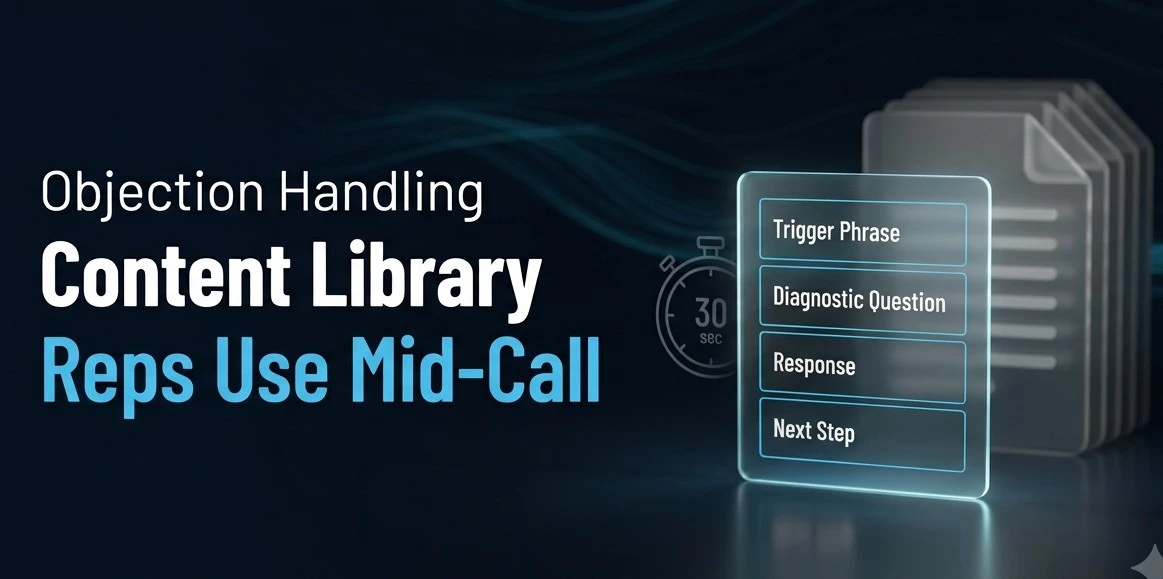
An objection handling content library is a searchable set of responses, proof points, reframes, and supporting assets that a sales rep can reach in under thirty seconds when a specific objection surfaces mid-call. The thirty-second constraint is not a nice-to-have. It is the whole design brief. An objection handling resource that requires a rep to remember where it lives, navigate to it, and hunt through a chapter structure while someone is mid-sentence on the other end of the line is not a library. It is an archive.
The distinction sounds pedantic. It is not. The majority of sales objection handling content that gets built winds up as an archive, because it is designed for completeness rather than for use under time pressure.
Why Buyers Object More, Not Less, in 2026
Here is a data point that should reframe how you think about objection handling as a content problem. 75% of B2B buyers are taking longer to make purchase decisions now than in 2023. Longer cycles mean more objections. More stakeholders means more objections. And 61% of buyers now prefer a rep-free experience for routine questions, which means by the time a rep is actually in the conversation, the buyer has already done independent research, probably in AI platforms, formed some opinions, and arrived with specific objections rather than general curiosity.
The buyer who objects on a call in 2026 is not usually unprepared. They are specifically prepared with concerns they formed during the anonymous research phase you were not part of. The objection is not a starting point for a conversation. It is a conclusion the buyer drew from their own research that you now need to address or challenge with something specific enough to change their view.
Generic rebuttals do not touch those objections. "I understand your concern, and here's what our other customers have found" is a sentence that predates the buyer's ability to compare your other customers against reviews on G2 before the call. The bar for specificity has moved.
The Source Materials Nobody Is Pulling From
Here is where most objection handling libraries get the raw material wrong, and I mean this as a structural critique, not an individual one.
Most libraries are built from sales training materials, industry frameworks, and manager intuition. The three sources that actually produce the most useful objection responses are win-loss analysis, conversation intelligence data, and direct rep interviews, none of which requires a formal research project to tap.
Win-loss analysis sounds expensive. The floor version is asking one question after every closed deal: what was the main objection that almost killed this, and what resolved it? Log those answers in a CR2M field, read them monthly, build the library from the patterns. Conversation intelligence tools like Gong surface which objection keywords appear most frequently in deals that eventually close versus deals that stall. That data is already sitting in your call recordings. Someone just has to read it. And direct rep interviews, particularly with top performers, produce something no framework can synthesize: the exact sentence that top performers use when a specific objection surfaces, in their own words, tested on real calls.
Gong's analysis of 67,149 sales calls found that top closers talk only 43% of the time after an objection surfaces. The other 57% is listening and asking questions. That finding matters for content design: the objection handling content a rep needs mid-call is not a script to read out loud. It is a question to ask, a proof point to cite, or a reframe to offer, in language specific enough to be credible and short enough to deploy in the moment.
The Format That Actually Works Under Time Pressure
Every objection handling entry in a working library should fit on a single screen without scrolling. If it does not fit on one screen, it will not be used mid-call.
The format that consistently works is four elements, each deliberately short.
The trigger phrase: the exact words or intent the rep hears that cues this entry. Not "competitor objection." Something like "they mentioned using [Competitor X] and said it was working fine."
The diagnostic question: what to ask before responding, because Gong's data confirms that responding immediately to an objection without probing first is one of the top predictors of losing the deal. "Is the concern that [Competitor X] covers something we don't, or that switching would be more work than it's worth?"
The response with one specific proof point attached: not "other customers have loved us," but "we had three customers come from [Competitor X] specifically, the one that's most relevant to your situation is [Customer Name], who moved because of [specific gap]. Happy to send you their case study."
The next step: what to say to keep the conversation moving, not just to answer the objection. "Does it make sense to spend fifteen minutes on exactly where [Competitor X] falls short for companies at your stage?"
That is it. Four elements, one screen, usable in thirty seconds. A library of twenty entries built this way is worth more than a library of two hundred entries formatted as a traditional document.
Where AI Search Visibility Feeds Into This
Here is the connection that most sales enablement teams have not made yet, and it is worth making explicitly.
Before a buyer objects to your product on a call, they formed that objection somewhere. In 2026, a meaningful share of those objections are formed in AI search. A buyer who asked Perplexity "how does [Your Company] compare to [Competitor]" and got an answer that overstated a competitor's advantage is going to show up on the call with a specific, AI-informed objection. The standard rebuttal will not address it, because the buyer's objection is not abstract: it is grounded in something a specific AI platform told them.
Running your top five competitive matchups through ChatGPT, Perplexity, and Google AI Mode quarterly, and logging what those platforms say about the comparison, is now a legitimate input for your objection handling library. If Perplexity consistently tells buyers that your competitor has stronger security features, and that is showing up as an objection on calls, that is a content problem before it is a sales problem. The fix is upstream: building the comparison content that changes what AI platforms say, while simultaneously building the sales content that addresses the objection that currently surfaces from the gap.
Frequently Asked Questions
What is a sales objection handling content library?
A sales objection handling content library is a searchable collection of responses, proof points, reframes, and supporting assets that a rep can reach in under thirty seconds when a specific objection surfaces during a sales call. The design constraint is time pressure, not comprehensiveness. A library that requires navigation through a chapter structure while a buyer is mid-sentence functions as an archive, not a reference tool, which is why most objection handling content goes unused despite being technically accessible.
Why do most sales objection handling libraries fail to get used?
Most libraries are built for completeness rather than for use under time pressure. They are formatted as long documents organized by objection category, require the rep to navigate to them mid-call, and contain generic rebuttals that do not map precisely to the specific objection the buyer just raised. The libraries that see regular use are organized by trigger phrase, formatted to fit on a single screen, and contain a diagnostic question plus one specific proof point per entry, a format that can be deployed in thirty seconds or less.
What source material produces the most useful objection handling content?
Win-loss data from closed deals, conversation intelligence from call recording tools, and direct interviews with top-performing reps produce higher-quality objection handling content than sales training frameworks and industry research alone. These sources provide the actual objections that surface in real deals, the questions that top performers use to probe before responding, and the specific proof points that move the conversation forward, none of which can be synthesized from a framework.
How does AI search visibility affect objection handling preparation?
Buyers increasingly form objections during self-directed research that happens in AI platforms before any sales conversation. An objection grounded in what Perplexity or ChatGPT said about a competitive comparison is harder to address with a generic rebuttal than one formed from a competitor's own marketing. Running competitive comparison queries through major AI platforms quarterly and logging what those platforms say is now a legitimate input for objection handling library development, because the most current objections often trace back to gaps in AI search content rather than gaps in direct competitor messaging.
How often should an objection handling library be updated?
After every significant deal close or loss, with a monthly pattern review to update the most frequently surfaced entries. A library that is not updated after a competitor repositions, after a new feature ships that changes a common comparison, or after a new stakeholder type starts appearing in deals will produce increasingly stale responses. The quarterly review cadence recommended for sales playbooks generally applies here, with a faster trigger for any competitor or category development that causes a new objection pattern to surface in multiple deals within a short window.
References
- Prospeo, Objection Handling in B2B Sales: Data-Backed Guide 2026, Gong 67,149-call study
- Apollo, How Do You Handle Sales Objections in 2026, 74% buyer team conflict data, 61% rep-free preference
- Apollo, Common Sales Objections 2026, 75% buyers taking longer to decide
- Mean CEO, Objection Handling Framework for B2B Sales 2026, objection library structure and governance


