
Right now, a VP of Technology at a mid-market logistics company is typing a question into ChatGPT. She is not Googling. She is not scrolling LinkedIn. She is asking an AI platform to shortlist integration vendors who can connect her WMS to their ERP without a six-month implementation. In forty seconds, she has three names. Yours might not be one of them.
That is the AI-first world. And most technology B2B messaging was built for a different one.
According to the 6sense 2025 Buyer Experience Report, 83% of B2B buyers fully define their purchase requirements before speaking to a single vendor. The decision is not waiting for your sales deck. It is forming in ChatGPT, Gemini, Perplexity, and Claude, in private research sessions your analytics will never capture, on shortlists your SDRs will never see being built.
The failure of technology B2B messaging is not a copy problem. It is a structural one. Most of it was engineered for a buyer who clicks, reads, and responds to nurture sequences. That buyer still exists. But the first credibility test your brand faces now happens in an AI-generated summary, not on your homepage. If your messaging cannot survive extraction by a large language model, it will not survive the modern buying process.
This piece diagnoses the three reasons most technology B2B messaging fails in an AI-first world, and shows what fixing it actually looks like, across SaaS, iPaaS, ERP, CRM, supply chain technology, pharma, and identity provider categories.
Why Is Technology B2B Messaging Failing to Reach Modern Buyers?
Technology B2B messaging is failing because it was built for a linear funnel that no longer exists. Buyers using ChatGPT, Gemini, and Perplexity to research vendors never see most of it. The first credibility test your brand faces now happens in an AI-generated summary, not on your homepage.
The numbers are not ambiguous. ChatGPT processed 2.5 billion queries per day by July 2025. Perplexity handled 780 million queries in May 2025 alone. Gemini grew 157% between April and September 2025, per Omnibound's 2026 AI search statistics report. The B2B buyer is inside these platforms constantly, researching categories, comparing vendors, and forming preferences.
The old funnel assumed a buyer who discovered you on Google, clicked through, read your website, and converted over a series of touchpoints. That model had flaws, but it was navigable. You could optimize for it. The new reality is messier. Buyers arrive at sales conversations with pre-formed shortlists. They already know what they think of you, or more precisely, what ChatGPT told them to think.
You cannot talk your way into a room you were never invited into.
Ironpaper's 2026 research puts the failure rate at 92%, nearly all technology B2B messaging misses because it describes what a company offers instead of what a buyer is experiencing. The silent "we" runs through most marketing copy: "We help supply chain teams gain real-time visibility." "We enable seamless, secure identity management." "We deliver end-to-end ERP integration." These statements are about the vendor, not the buyer. And an LLM synthesizing a competitive category will flatten them all into a single, forgettable composite.
The structural issue is that technology B2B messaging was optimized for human persuasion. AI platforms do not get persuaded. They get informed, or they get ignored.
What Does "Sounding the Same" Actually Cost a B2B Technology Company?
When your technology B2B messaging sounds identical to your competitors, AI platforms treat your brand as interchangeable. Buyers shortlist by exclusion. If nothing distinguishes you from the next SaaS, ERP, or iPaaS vendor in the category, you get cut, silently, before you ever knew you were being evaluated.
The DerivateX 2026 AI Visibility Benchmark Report measured 50 B2B SaaS companies across ChatGPT, Perplexity, Claude, and Gemini, running 1,400 buyer-intent prompts. The average AI Presence Score was 56.9 out of 100. Forty-four percent of companies scored below 50. The gap between the highest scorer, Clio at 89, and the lowest, LeadSquared at 2, was 87 points, despite both operating in established software categories with active marketing teams.
That gap is not a technology problem. It is a messaging and distribution problem. Both companies exist. Both have websites. Both are producing content. One shows up consistently when a buyer asks ChatGPT for a recommendation. The other does not.
Walk through any established B2B technology category, and the language is almost comically uniform. CRM vendors promise to "streamline your pipeline." ERP providers offer "end-to-end visibility."
Supply chain software companies deliver "real-time operational intelligence." Pharma tech vendors "accelerate drug development timelines." Identity providers offer "seamless, secure access." Every one of these phrases has been used by dozens of vendors in the same category. Every one of them means nothing to an LLM trying to differentiate one brand from another.
In a category where everyone uses the same three buzzwords, the language model synthesizes a composite vendor that sounds like nobody in particular. Your brand becomes background noise.
The pipeline cost is real. TrustRadius found that 80% of B2B buyers trust AI tools at least sometimes, up 19 points year over year. They are acting on these summaries. They are forming shortlists based on them. If your technology B2B messaging cannot distinguish you in an AI-generated answer, no amount of outbound email will fix what the shortlist has already decided.
How Do AI Platforms Like ChatGPT and Gemini Evaluate Technology B2B Messaging?
ChatGPT, Gemini, Claude, and Perplexity do not read your homepage the way buyers do. They look for specific, attributable claims, named outcomes, verifiable differentiation, domain-expertise signals, and cite sources that clearly provide these. Vague messaging gets averaged out. Specific messaging gets cited.
Each of the four major AI platforms behaves differently. ChatGPT and Gemini each mentioned 100% of the 50 companies in the DerivateX 2026 benchmark. Perplexity mentioned 90%. Claude was the most selective at 88%. Critically, the DerivateX data showed that sentiment across all four platforms was near-perfect; 44 of 50 companies scored 19 or 20 out of 20 on brand sentiment. The AI platforms are not hostile to your brand. They simply do not have enough specific, credible, well-distributed information to surface it consistently.
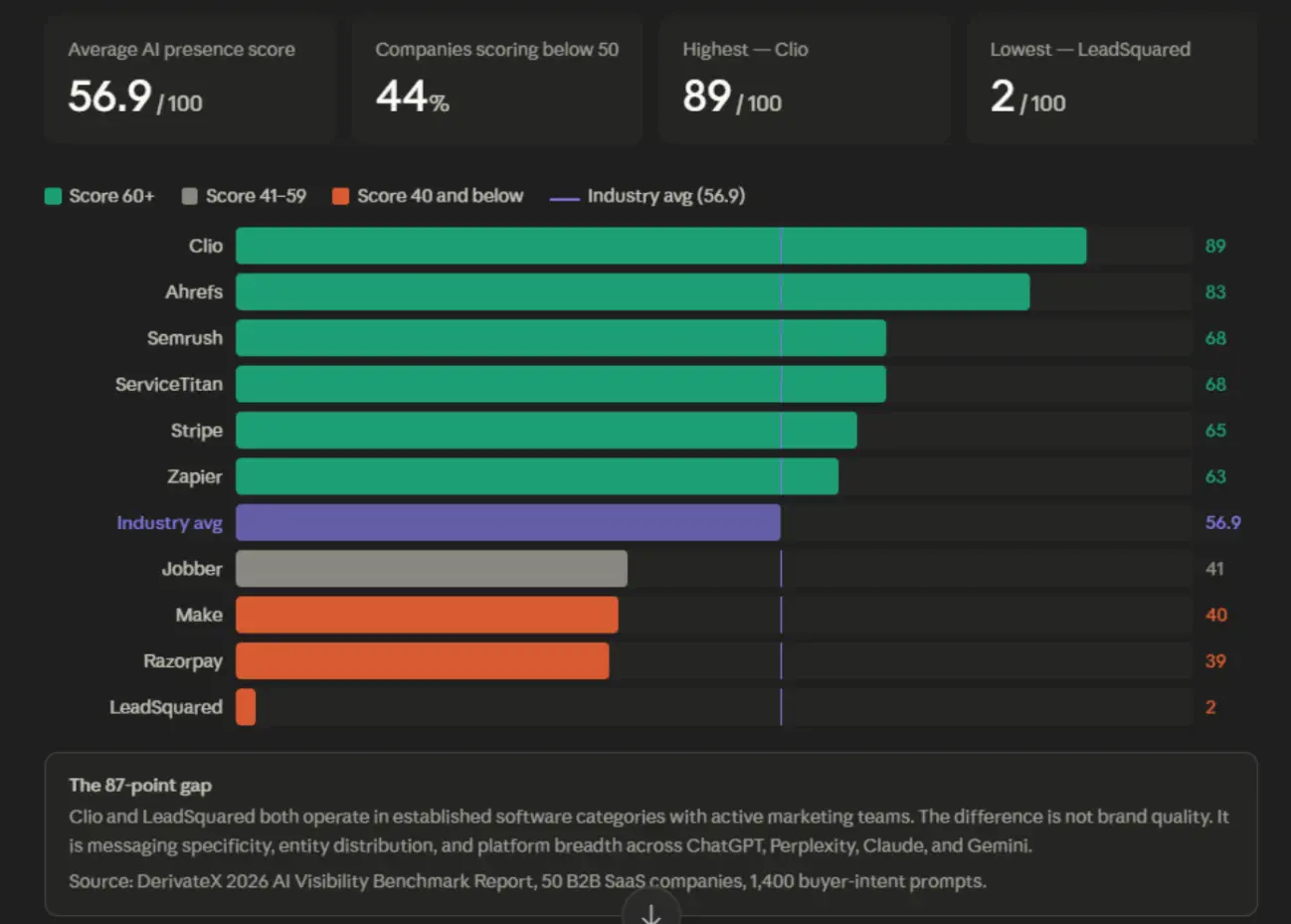
The visibility gap is driven entirely by mention frequency and platform breadth, not brand perception. That is the key insight. AI platforms are not deciding your brand is bad. They are deciding your brand is undocumented.
This is where AI SEO, AEO, and GEO intersect with messaging strategy. Answer Engine Optimization (AEO) means structuring your claims so AI platforms can extract and cite them directly. Generative Engine Optimization (GEO) means building a consistent brand presence across the platforms where LLMs pull their training and retrieval data. Both disciplines require specific, outcome-oriented messaging, not category language.
The SEO layer matters too. Ahrefs data shows that 76% of AI Overview citations come from pages that rank in Google's top 10. Weak traditional SEO compounds weak messaging. Your differentiation has to earn its way into Google rankings before it can earn its way into AI citations. The two disciplines are not separate strategies. They are the same strategy at different altitudes.
For an iPaaS company, this means every claim about integration speed needs a number attached. "Reduces integration time by 60%" is citable. "Faster integrations" is not. For a pharma technology vendor, compliance specificity is the differentiator. "Supports 21 CFR Part 11 audit trails out of the box" earns a citation. "Accelerates drug development" earns nothing.
What Does Effective Technology B2B Messaging Actually Look Like in 2026?
Effective technology B2B messaging in 2026 is specific, outcome-oriented, and structured for extraction by both humans and AI. It names the buyer's problem precisely, quantifies the consequence, and states the differentiation in terms no competitor can copy, because it is anchored in real outcomes, not category language.
The devil is in the details. The gap between messaging that gets cited and messaging that gets ignored lives entirely in specificity. Ironpaper's pain-point framework gives the right structure: Problem (what is happening inside the buyer's business) + Consequence (the cost of not solving it) + Differentiator (what only you can claim, with proof). When all three are present, the message becomes tangible. When anyone is missing, it becomes brochure copy.
Here is what that looks like across different technology verticals.
- A CRM software company says, "Streamline your pipeline." Effective technology B2B messaging says, "sales teams using our CRM cut average deal cycles from 47 to 31 days, verified across 200 enterprise accounts." One is a category claim. The other is a citation-ready fact.
- A supply chain technology vendor says "real-time operational intelligence." Effective messaging says "reduces inventory discrepancy rates by 23% within 90 days of deployment, validated in three pharmaceutical distribution clients." One is furniture. The other is evidence.
- An identity provider says "seamless, secure access." Effective messaging says "eliminates password-based breaches for organizations with over 5,000 employees, zero credential-based incidents across 18 months of client data." One gets averaged into the category. The other gets cited.
The specificity test is simple. Could a competitor copy this exact claim, word for word, and have it be true for them too? If yes, it is a category descriptor, not a differentiator. Real differentiation is specific enough that it only belongs to you.
LinkedIn's 2025 B2B Marketing Benchmark found that 94% of marketers agree that trust is the key to B2B success. Trust in technology B2B messaging is not built through aspiration. It is built through specificity, verification, and consistency across every platform where a buyer might encounter your brand.
How Should SaaS, iPaaS, and Enterprise Technology Companies Adapt Their Messaging for AI SEO and GEO?
SaaS, iPaaS, ERP, and other enterprise technology companies need to treat their messaging as source material for AI platforms, not just copy for human readers. That means writing for extraction, building entity consistency across every platform, and earning third-party citations that LLMs use to validate brand credibility.
The three-layer framework applies directly to technology B2B messaging.
- The entity layer is the foundation. Your brand name, your category, your core services, and your differentiators need to be declared consistently across your website, your G2 profile, your LinkedIn company page, your Capterra listing, and any analyst or media mentions. Inconsistency in entity representation confuses AI retrieval systems and weakens the Knowledge Graph's presence.
- The answer layer is where AEO lives. Every core claim on your website needs a structured, 40-to-60-word version that answers the buyer's question directly. For SaaS companies, that means FAQ-formatted answers to "what does [your product] do" and "how is [your product] different from [competitor]."
- The authority layer is the GEO play. Presence across four or more platforms multiplies citation probability by 2.8x, per Virayo's 2026 research. For technology companies, that means G2 and Capterra reviews, Reddit participation in relevant technical communities, LinkedIn thought leadership from named executives, and targeted outreach to land on category listicles that AI systems index heavily.
The zero-click context makes this urgent. Omnibound's 2026 data shows 58.5% of US searches and 59.7% of EU searches ended without a click in 2025. Your technology B2B messaging has to do its full job before a buyer ever reaches your website. If the AI-generated answer does not include your brand, or includes it inaccurately, the click you never received was your best shot.
For ERP and CRM companies navigating category consolidation from Oracle, SAP, and Salesforce, the answer is verticalization. AI platforms reward domain depth. A mid-market ERP vendor with specific, credible messaging for pharmaceutical distribution will out-cite a generic ERP vendor in that category every time, regardless of domain authority.
How Do You Audit Your Technology B2B Messaging for AI-First Readiness?
Auditing technology B2B messaging for AI-first readiness means running your own brand through the same queries your buyers are running, in ChatGPT, Gemini, Claude, and Perplexity, and comparing what comes back against what you intended to communicate. The gap between those two things is your messaging problem, made visible.
This is a four-part audit. None of it requires expensive tooling to start.
- The presence audit is first. Open ChatGPT, Gemini, Claude, and Perplexity. Run ten buyer-intent queries in your category. Does your brand appear? In what position? Is the description accurate?
- The specificity audit is second. Take your homepage headline. Read it out loud. Then ask: could any of your top three competitors put their name on this sentence and have it be true? If yes, your homepage is not differentiated.
- The entity audit is third. Check that your brand name, category, and core services are described identically across your website, G2, Capterra, LinkedIn, and any press mentions.
- The E-E-A-T audit is fourth. Does every key claim have a named source, a verifiable outcome, and a structured format? Does your content have author attribution with real credentials?
Adobe Digital Insights reported in January 2026 that AI referral traffic converts 31% better than non-AI traffic. The buyer who arrives via an AI citation is already informed, already interested, and already partway through a decision. Your messaging needs to be built for that buyer, precise, credible, and specific enough to earn the citation in the first place.
Tooling for ongoing monitoring includes Semrush, Profound, and Conductor for LLM citation tracking. Manual prompt testing across all four major platforms gives a directional signal quickly and costs nothing but time.
The Way Forward
The technology B2B messaging crisis is not a writing problem. It is a structural mismatch between how most companies communicate and how AI platforms extract, evaluate, and cite brand information.
SaaS companies, iPaaS vendors, ERP and CRM software providers, supply chain technology brands, pharma tech companies, and identity providers are all facing the same moment. The buyers are on the AI platforms. The shortlists are forming. The question is whether your messaging is specific, structured, and distributed enough to be in those answers.
At Nagana Media, our AI search visibility audits are built specifically for technology companies navigating this shift. If you want to know where your brand stands across ChatGPT, Gemini, Claude, and Perplexity, and what it would take to close the gap, that conversation starts with your current messaging.
Frequently Asked Questions
What is technology B2B messaging? Technology B2B messaging is the set of claims, language, and positioning frameworks a technology company uses to communicate its value to business buyers. In 2026, effective technology B2B messaging must be structured for both human readers and AI platforms like ChatGPT, Gemini, and Perplexity, which now synthesize vendor shortlists before buyers engage sales teams.
Why does B2B messaging fail in AI search? Most technology B2B messaging fails in AI search because it uses category language that LLMs cannot distinguish between vendors. Vague claims like "end-to-end visibility" or "seamless integration" get averaged into a composite response. AI platforms cite specific, outcome-oriented, verifiable claims, not aspirational positioning statements. The fix is specificity: named outcomes, quantified results, and evidence that only your brand can provide.
How do SaaS companies improve their messaging for ChatGPT and Gemini? SaaS companies improve their messaging for ChatGPT and Gemini by restructuring core claims as answer blocks, 40-to 60-word direct responses to the questions buyers ask AI platforms. This means leading with outcomes, attaching specific numbers to every key claim, implementing FAQPage schema markup, and building consistent entity presence across G2, Capterra, Reddit, and LinkedIn so AI platforms have multiple corroborating sources to draw from.
What is the difference between AEO and GEO for technology B2B messaging? AEO (Answer Engine Optimization) is the practice of structuring technology B2B messaging so AI platforms can extract and cite it as a direct answer. GEO (Generative Engine Optimization) is the practice of building a multi-platform brand presence, so LLMs include your brand in synthesized recommendations. AEO governs how you write. GEO governs where you show up. Both are required for consistent AI search visibility in 2026.
How do ERP, CRM, and supply chain companies stand out in AI-generated search results? ERP, CRM, and supply chain technology companies stand out in AI-generated results through verticalization and specificity. Generic category claims get flattened by LLMs. Domain-specific, outcome-oriented claims, "reduces pharmaceutical inventory discrepancy rates by 23%" or "cuts mid-market CRM deal cycles from 47 to 31 days", survive extraction intact. The more specific the claim and the more narrowly it targets a buyer's operational context, the more likely it is to be cited by ChatGPT, Gemini, and Perplexity over a generic competitor.


