
There's a survey stat I can't stop thinking about, and not in a good way. 76% of B2B leaders admit they're creating content that isn't tied to any data-driven strategy. Seventy-six percent. That's not a rounding error or a weird outlier. That's three out of every four people making content, by their own admission, mostly just making content. I say this as someone who has, at various points, also just made content.
What Is a Lead Generation Content Stack, Actually?
A lead generation content stack is the set of content types, organized by funnel stage and channel, that a B2B company relies on to turn strangers into pipeline. It sounds like a fancy way of saying "the stuff we publish," and honestly, it kind of is, except the word "stack" implies the pieces fit together on purpose. For most companies, they don't. They're just stacked, the way a junk drawer is stacked.
The Number That Should Worry Everyone, Including Me
61% of marketers say generating quality leads is their single biggest challenge, and this has been true for three years running. Three years of the same problem, persisting. If a problem survives three consecutive annual surveys without anyone fixing it, that's usually a sign the problem isn't really "we need more content." It's something structural underneath.
Here's the structural thing, as far as I can tell. 72% of B2B leaders say AI-generated content has actually hurt their brand distinctiveness. Read that next to the 76% "not tied to strategy" stat and a pattern starts to form, and it is not a flattering pattern. A lot of teams turned on the content faucet, AI made that faucet easier to leave running, and the result is more content that, by the leadership's own assessment, makes the brand less distinctive while still not solving the lead quality problem. We built a machine that produces volume and accidentally optimized against the thing that actually matters.
I want to be clear that I'm not above this. I have absolutely produced a piece of content because the calendar said Thursday and not because I had a real reason to say something. The honest version of this article includes that confession.
What Actually Works, According to People Who Measured It
Buried under the volume problem is a genuinely useful, much smaller list of things that move pipeline. None of them are exotic.
Companies that blog consistently generate up to 13 times more leads than companies that publish sporadically. Not "blog well" or "blog with perfect SEO," just consistently. Showing up regularly appears to matter more than most teams want it to, possibly because showing up regularly is harder and less fun than chasing the next clever idea.
SEO-sourced leads close at 14.6%, compared to 1.7% for outbound. That's not a small gap. That's an eight-times difference in close rate between two channels that both technically produce "leads." If your reporting dashboard treats those two leads as equivalent because they both hit the same MQL threshold, your dashboard is lying to you, gently, every week.
92% of B2B buyers begin their research already considering at least one specific vendor. Which means most of the actual competition for pipeline isn't happening in your form fills. It's happening earlier, in the AI answer engines, the peer communities, the category content someone reads before they ever fill out anything. By the time someone reaches your contact form, a meaningful chunk of the decision has already been quietly made somewhere you weren't measuring.
The Quality Versus Volume Thing, Settled By the Data, Not By Vibes
I used to think "quality over volume" was one of those phrases people say to sound thoughtful without committing to anything specific. Turns out there's an actual number behind it: top-quartile demand gen teams hold their cost per lead nearly flat by reallocating budget away from paid volume channels and toward account-based and partner-sourced motions, paired with tighter qualification. Median teams, meanwhile, are roughly where they were two years ago. Not worse. Just stuck. The gap between "top quartile" and "stuck" isn't really a tools gap. It's a discipline gap. The teams pulling ahead are rejecting roughly 30% of their own marketing-qualified leads at the scoring stage, before a single SDR ever picks up the phone. That's a team willing to say "this lead, despite hitting our criteria, isn't actually a good lead" out loud, in a meeting, and act on it. Most teams find that uncomfortable. The data says it's also where the advantage lives.
Building the Stack That Doesn't Embarrass You in a Year
Here's roughly how I'd organize a stack that's actually trying to fill a pipeline rather than fill a calendar, based on everything above.
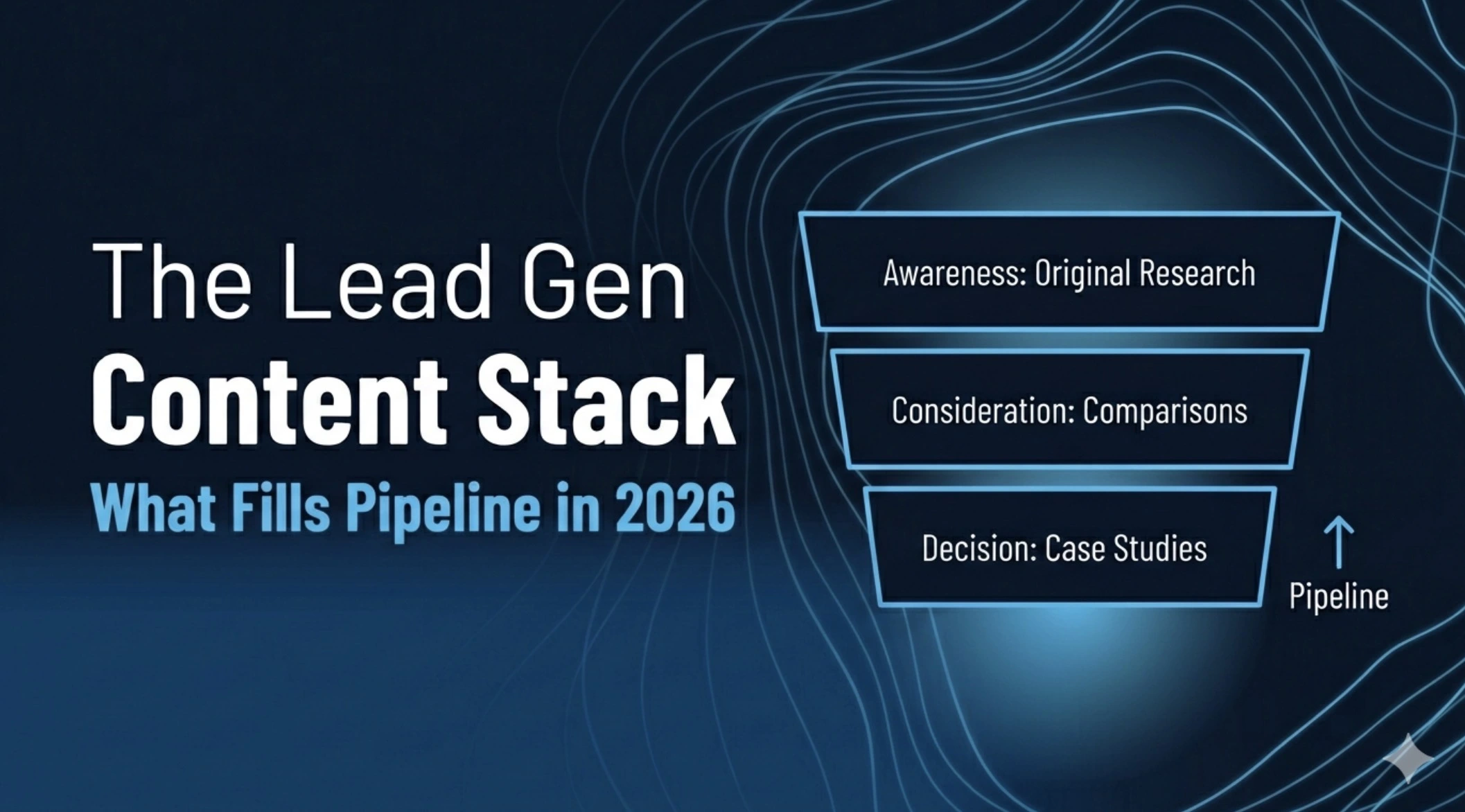
At the top, original research and category-defining content, the stuff that earns organic attention because it says something nobody else is saying, not because it hit a keyword target. This is the slow-compounding layer. It won't show results in week two. It's also the layer that builds the 13x blogging advantage over time, because consistency in this layer is what creates the compounding effect in the first place. In the middle, the content that actually supports a buyer already in motion, comparisons, implementation guides, the stuff someone reads after they've decided your category is worth solving, and are now narrowing down who solves it best. This is where most of the SEO-sourced, 14.6%-close-rate leads tend to originate, because the intent is already specific.
At the bottom are the sales-facing assets, case studies, ROI calculators, and the things that get shared directly inside a deal in motion. Smaller volume, highest per-piece leverage.
And running underneath all three layers, a genuinely uncomfortable but necessary habit: before adding anything new to the stack, ask whether it's solving a real, specific problem for a real, specific reader, or whether it exists because the content calendar had a Thursday-shaped hole in it. I will not pretend I always get this right. I suggest we all try a little harder, including me.
Frequently Asked Questions
What's the difference between a lead generation content stack and a regular content calendar?
A content calendar is a schedule. A content stack is meant to be a deliberate set of content types mapped to specific funnel stages and buyer intent, where each piece has a reason to exist beyond filling a publishing slot. In practice, many companies have a calendar but not a real stack, which is part of why 76% of B2B leaders report their content isn't tied to a data-driven strategy.
Why does SEO-sourced content close at a higher rate than outbound leads?
SEO-sourced leads tend to arrive with self-directed intent; the person found the content because they were actively researching a problem, rather than being interrupted by an outbound message. This higher intent at the point of contact is reflected in close rates: 14.6% for SEO-sourced leads compared to 1.7% for outbound, according to recent B2B benchmark data.
Is blogging consistently more important than blogging well?
The data suggests consistency carries more measurable weight than most teams expect, with companies that publish consistently generating up to 13 times more leads than sporadic publishers. This doesn't mean quality doesn't matter, but a consistent publishing cadence appears to be a prerequisite for the compounding effects that drive that multiplier, rather than an optional nice-to-have.
How should a B2B team decide whether a new piece of content is worth producing?
A useful filter is asking whether the content solves a specific, real problem for a specific, real reader, versus existing primarily to fill a calendar slot. Given that 72% of B2B leaders report AI-generated content has hurt their brand distinctiveness, often by enabling more low-intent volume, this filter matters more now than it did when content production was slower and more deliberate by default.
What should marketing teams measure instead of just lead volume?
Close rate by source and the percentage of leads rejected at the qualification stage before reaching sales are both more revealing than raw lead counts. Top-quartile demand gen teams reject around 30% of their own marketing-qualified leads at the scoring stage, a discipline that correlates with holding cost-per-lead flat while median teams remain stuck at prior-year performance.
References
- Callbox, B2B Lead Generation Statistics 2026: https://www.callboxinc.com/blog/b2b-lead-generation-statistics/
- Digital Applied, B2B Lead Generation Statistics 2026, 180 Data Points: https://www.digitalapplied.com/blog/b2b-lead-generation-statistics-2026-data-points
- Prospeo, B2B Lead Generation Statistics for 2026, DemandScience 2026 survey citation: https://prospeo.io/s/b2b-lead-generation-statistics
- Martal, Lead Generation Statistics 2026: Benchmarks and Trends: https://martal.ca/lead-generation-statistics-lb/


