
68% of B2B deals are competitive. Reps self-rate their competitive preparedness at 3.8 out of 10. According to Salesmotion, that gap costs mid-market B2B technology companies an estimated two to ten million dollars annually in winnable deals. The fix does not require a competitive intelligence team or a $40,000-per-year software platform. It requires a process that someone actually runs.
What Is a Competitive Intelligence Process for B2B Technology Sales?
A competitive intelligence (CI) process for B2B sales is the set of activities that gives reps accurate, current, deal-relevant information about named competitors before and during active selling situations. Not a folder of PDFs about every company in the category. A working system where the right intel reaches the right rep at the moment they actually need it, which is usually thirty seconds before a prospect brings up a competitor's name.
The distinction between a CI process and a CI repository matters more than most teams realize. A repository is where battlecards go to age quietly. A process is what makes sure the information inside the battlecard is still accurate and that the rep can find it mid-call.
Why AI Changed the Foundation of Competitive Intelligence in 2026
Here is the part of the competitive intelligence strategy that shifted significantly in the past two years, and that most guides haven't caught up with yet. Standalone CI tools that simply scrape competitor websites and aggregate public data are rapidly becoming the baseline rather than the advantage. Generative AI can now perform that same public data aggregation instantly and at near-zero marginal cost.
What AI cannot replace is buyer-sourced intelligence: what prospects actually say in the room, which competitor claims they were told, what objections buyers raised that the competitor's sales team surfaced first, and which reasons buyers chose you or them. According to win-loss research across B2B companies, formal buyer interview programs correlate with a 63% increase in win rates, jumping to 84% for programs that have been running for more than two years. That data exists nowhere in a web scrape.
For B2B technology companies specifically, SaaS, ERP, CRM, iPaaS, and supply chain platforms, the value of competitive intelligence has shifted from "what does this company say on their website" to "what do buyers tell us after they made their decision." The first question gets answered by ChatGPT in thirty seconds. The second question only gets answered by talking to buyers directly.
The Three-Layer Structure That Works Without a Dedicated Analyst
Most B2B technology companies cannot justify a full-time competitive intelligence hire until they reach a certain revenue threshold. The process below runs on existing roles with a few hours of coordination per month.
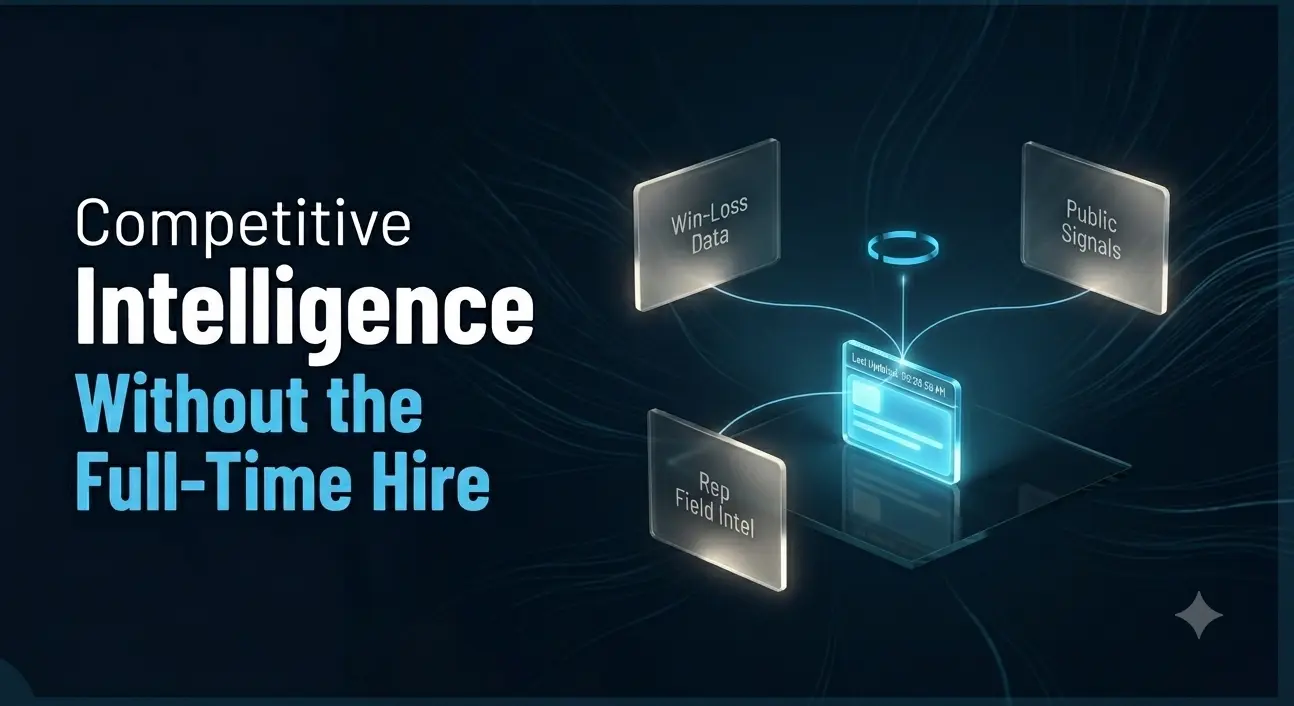
- Layer one: win-loss data from your own deals. This is the highest-value, lowest-cost intelligence available. After every deal closes or is lost, one structured question gets asked in the CRM or to the rep: which competitors came up, what did the prospect say about them, and what influenced the final decision. No interview required. No software required. Just one consistent question and someone who reads the answers and looks for patterns monthly. Companies that formally track this information correlate it with 63% higher win rates. Most companies do not do it, which means doing it at all is a structural advantage.
- Layer two: public signal monitoring on three to five competitors. Not every competitor. Three to five, specifically the ones that come up most in deal conversations. Set up Google Alerts for each competitor's name. Follow their LinkedIn company page and note when they announce new features, new pricing, or new leadership. Run their homepage and G2 profile against your own once per quarter to identify what they're claiming now that they weren't claiming six months ago. This takes one person about two hours per month. The output is a brief monthly update delivered to reps in the channel they already use, Slack, email, whatever actually gets read.
- Layer three: rep field intel. Reps hear things in discovery calls and demos that never make it into any system. A competitor told the prospect they were integrating with a specific platform. A competitor dropped their price by 20% on the last proposal. A competitor's rep told the prospect that your support team is slow. This intelligence is real-time, specific, and completely invisible unless you build a lightweight channel for reps to report it. A weekly five-minute standing question in a sales team meeting, "What did you hear about competitors this week that the rest of us should know," is the lowest-overhead version. A dedicated Slack channel where reps post competitive mentions is the slightly higher-overhead version that scales better.
Where AEO and GEO Fit Into Competitive Intelligence
There is a CI dimension that most B2B technology companies miss entirely: what AI platforms say about you and your competitors when buyers are researching the category.
A prospect does not ask your rep how you compare to Competitor A. They ask ChatGPT. They ask Perplexity. They type "best alternatives to [Category Leader]" into Google AI Mode and read the synthesized response before they've ever talked to a human at your company. What those platforms say, which companies they recommend, which differentiators they cite, which weaknesses they surface, is competitive intelligence that now directly affects whether you show up on the buyer's shortlist before the sales conversation begins.
The AEO and GEO audit Nagana Media runs for B2B technology clients includes a competitive citation analysis across ChatGPT, Perplexity, Google AI Overviews, and Claude: which competitors are being cited for your target queries, what language is being used to describe each competitor, and where your brand appears in the AI-generated comparison responses.
You can read more about how AI search visibility works for B2B technology companies at naganamedia.com. That's a different kind of competitive intelligence than monitoring a competitor's homepage, and it's increasingly the intelligence that determines whether you're in the first conversation or the fourth one.
The Quarterly Battlecard Update Is the Most Important Habit
A battlecard that's accurate when it's built is useless six months later if a competitor has repositioned, repriced, or shipped a feature that changes the comparison. The biggest CI failure mode in B2B technology companies is not building battlecards. It's building them once and assuming they're done.
The quarterly battlecard review takes about thirty minutes per competitor card. Pull the competitor's current homepage, their most recent G2 reviews, and whatever came in from layer three rep intel over the past quarter. Update the positioning card, update the pricing if it's changed, update the honest-gaps row if a competitor has genuinely shipped something that closes one of your advantages. Date-stamp the update at the top so reps know how current the information is.
A card with last updated six months ago is a card a rep will stop trusting. A card with the last update this month is a card a rep will reference before an important call.
The Starting Point Is Smaller Than You Think
If your team has no CI process right now, the minimum viable version is: one question added to every closed-won and closed-lost opportunity in the CRM, three competitor names on a Google Alert, and one monthly Slack message summarizing what came in.
That's it. That's the foundation. It gives you a win-loss signal, basic monitoring, and a distribution habit. It takes about two hours to set up and about ninety minutes per month to maintain. Nothing in the preceding paragraphs matters if nobody runs the process, and nobody runs a process that requires six hours a month of coordination that wasn't already built in. Start smaller than you think you need to. Add layers when the value is clear enough to justify the time.
Frequently Asked Questions
What is competitive intelligence for B2B technology sales?
Competitive intelligence for B2B technology sales is the process of collecting, organizing, and delivering accurate, current information about named competitors to sales reps before and during deal cycles. In AI SEO and content strategy terms, it now also includes monitoring what AI platforms say about your company and competitors when buyers are researching the category, since an increasing share of the initial shortlisting process happens in AI-generated answers rather than through direct human research.
Do I need dedicated CI software to run an effective process?
No, especially not at the early stage. Win-loss questions in your CRM, Google Alerts on three to five competitor names, a rep intel reporting channel, and quarterly battlecard reviews cost nothing and produce more useful intelligence than a $15,000 CI platform that nobody maintains. Dedicated tools like Klue or Crayon add real value when your team is large enough that the curation and distribution problem is the bottleneck, not the intelligence itself.
How does AI search visibility fit into competitive intelligence?
Buyers increasingly use ChatGPT, Perplexity, and Google AI Overviews to compare vendors before speaking with a sales rep. What those platforms say about your competitors, what they say about you, and whether your brand appears in the AI-generated comparison responses directly affect your position on the buyer's shortlist before any sales conversation begins. AEO and GEO strategy for B2B technology companies now includes a CI layer: running competitor comparisons through AI platforms quarterly to understand the narrative being constructed about your category.
Why is buyer interview data more valuable than web scraping in 2026?
Generative AI can now aggregate and summarize any competitor's public web presence in seconds, which means basic web monitoring provides a baseline but no longer constitutes a competitive advantage by itself. What remains genuinely proprietary is what buyers actually said in the room: which competitor claims they were told, what objections the competitor's rep surfaced, and why buyers ultimately chose one vendor over another. This information exists only in post-decision conversations, and companies that run formal win-loss programs see win rates improve by 63% on average.
How often should competitive battle cards be updated?
Quarterly as a minimum, with immediate updates when something significant changes: a competitor reprices, ships a major feature, or reposition their messaging. Each card should carry a visible last-updated date. A card from six months ago will be trusted less than one updated this month.
References
Salesmotion, Best Competitive Intelligence Tools for B2B Sales Teams 2026, Crayon 2025 data on competitive deal frequency and rep preparation scores: https://salesmotion.io/blog/best-competitive-intelligence-tools-sales
Clozd, B2B Competitive Intelligence Strategy 2026, win-loss interview impact on win rates: https://www.clozd.com/blog/b2b-competitive-intelligence-strategy-2026
Klue, Top Competitive Intelligence Tools for B2B Tech Teams in 2026: https://klue.com/topics/competitive-intelligence-tools-b2b-software


