
The "Why Us" page is where most B2B technology companies accidentally describe themselves as a different company than they actually are. The page says "industry-leading" and "best-in-class" and "trusted by thousands of companies worldwide," and every single one of those things is both technically defensible and completely useless to a buyer trying to make a decision. None of it distinguishes you from the other eleven companies that used the same sentences to describe themselves this week.
None of it gets cited by AI, either. And those two failures are caused by the same underlying problem.
What Is a "Why Us" Page, Functionally?
A "Why Us" page, also called a differentiators page, a why choose us page, or an about-the-product page, is the page a buyer visits after they have decided they need a solution in your category and are now deciding whether it should be you. It is not a discovery page. It is a decision page. The buyer already understands your category. They want to understand whether your specific approach, your specific track record, and your specific strengths match what they specifically need.
Forrester's 2026 Buyers' Journey Survey found that generative AI and conversational search are now more meaningful information sources for B2B buyers than vendor websites, product experts, or sales representatives. A meaningful percentage of buyers now arrive at your "Why Us" page after an AI search tool has already built them a preliminary shortlist. They are there to confirm or disconfirm what they read. A page full of superlatives does neither. It just makes the confirmation harder.
Why Superlatives Are Not Differentiation
This requires saying plainly, because "we need to sound more authoritative" is the instinct behind most superlative-heavy pages. Superlatives do not create authority. They signal the absence of specific proof.
"Industry-leading" means nothing unless it is followed by a metric that proves leadership. "Best-in-class" is a marketing claim, not a differentiator. "Trusted by thousands of companies worldwide" tells a buyer that the company has customers, which is the baseline expectation for any company with a functional product.
The question a buyer on a "Why Us" page is actually asking is: "What makes this company the right choice for a company like mine, given what we specifically need?" That question has a specific answer for most B2B technology companies. The answer just requires naming things precisely rather than gesturing at them broadly.
AI systems perform better when product descriptions, category definitions, buyer fit, and differentiators are explicit. If your category, service line, and buyer fit are ambiguous, AI systems have very little precise material to work with.
The Three Things That Do Work
Each of the following has consistent research support and observable pattern in pages that actually convert at the decision stage.
Named, specific use case fit. "Built for mid-market manufacturing companies with ERP integration requirements" is specific enough that a buyer who is not a mid-market manufacturer reads it and self-selects out. That self-selection is not a problem. It is the page doing its job. A buyer who is a mid-market manufacturer reads the same sentence and feels found. Specificity simultaneously improves conversion among qualified buyers and improves AI citation by giving the model a clear, extractable statement about buyer fit.
Specific outcomes with context. "Our customers reduce implementation time by an average of 40% compared to competing platforms, based on 87 enterprise deployments completed in the last eighteen months" is a citable claim. It has a number, a basis, a timeframe, and a comparison. An AI model can extract that sentence, attribute it to your company, and use it to answer "how does [Your Company] compare to alternatives on implementation time." "We deliver faster implementation than anyone in the category" is not extractable because there is no fact inside it.
Third-party validation in the right format. Reviews, analyst recognitions, and customer quotes are trust signals that matter both to buyers and to AI citation authority. For the "Why Us" page specifically, the format matters: a quote from a customer describing a specific problem solved, with their name, company, and role attached, is more valuable than a generic testimonial in a rotating slider that AI systems cannot reliably parse. Named, structured proof beats anonymous, decorative proof every time.
The Structure That Ties This Together
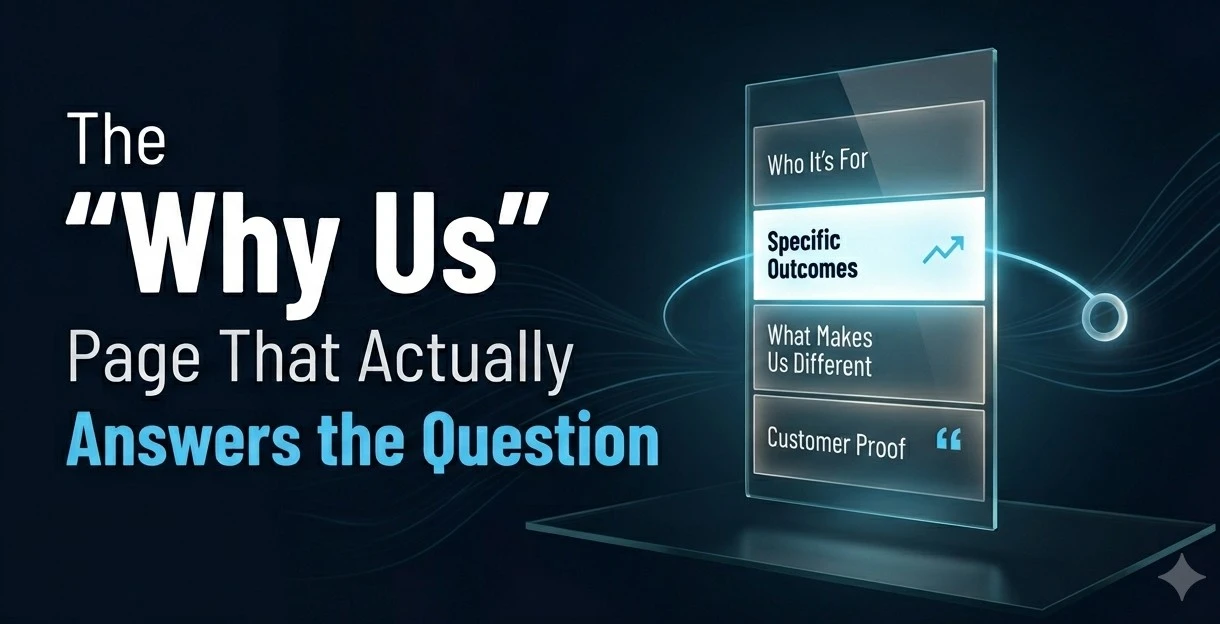
A "Why Us" page that works has four sections in this order, and each section answers one of the four questions buyers and AI models are both asking.
Section 1: Specifically who this is for. One short paragraph stating your ideal customer profile in concrete terms: company size, industry vertical, specific operational situation, and what problem they are usually facing when they find you. Not "companies looking to grow", something like "B2B technology companies between 50 and 500 employees that have outgrown their current CRM but have not yet reached the scale where a full enterprise system makes sense." A buyer either nods or moves on. That is the goal.
Section 2: The specific outcome you deliver, with the proof. Two to three claims, each with a number or a named reference attached. Not ranges. Not "typically." The specific result with the context that makes it verifiable. If you do not have internal data that supports specific claims, this section is the reason to start collecting it, because this is the section buyers and AI models most need.
Section 3: Where you are genuinely different from the alternatives. Not better at everything. Specifically different on the dimensions that matter most to your ICP. If you genuinely have faster implementation, say so with the data. If you genuinely have deeper integration with a specific ecosystem, say so with the named integrations. If a competitor has an advantage on a dimension that does not matter to your core buyer, acknowledge it and explain why it does not affect most of the decisions you win.
Section 4: The third-party voice. Three to five structured customer quotes, each named and attributed, each describing a specific situation, not general satisfaction. "This platform cut our quarterly reporting time from three weeks to four days" is a quote. "We've been really happy with the service" is noise.
The GEO Connection That Most Teams Miss
Pages structured this way are not just better for human buyers. They are specifically better for AI citation because each section is built around extractable, self-contained claim units.
When a buyer asks ChatGPT "why should I choose [Your Company] over [Competitor]," the model is looking for exactly the content described above: buyer fit, specific outcomes, named differentiators, and attributed proof. A page full of superlatives gives the model nothing to extract and attribute. A page built on the four-section structure gives the model four distinct answer blocks it can use.
AI search visitors are 4.4 times more valuable than traditional organic visitors based on conversion rate. In B2B, LLM-referred traffic converts at nearly double the rate of standard organic. The "Why Us" page, as the final decision gate before a buyer contacts sales or books a demo, has the most direct impact on that conversion. A vague page at that stage does not just fail to earn a citation. It fails the conversion that the citation made possible.
Frequently Asked Questions
What is a "Why Us" page in B2B marketing?
A "Why Us" page is a decision-stage page that buyers visit after they have already decided they need a solution in a given category and are evaluating whether a specific vendor is the right choice. Unlike top-of-funnel pages that create awareness, "Why Us" pages are evaluated by buyers with specific requirements who want to understand buyer fit, specific outcomes, differentiation from alternatives, and third-party proof. The goal is not to educate, it is to confirm or disconfirm the match.
Why do B2B "Why Us" pages underperform despite high buyer intent?
The most common reason is superlative-heavy language that makes accurate claims at a level of generality that provides no decision-relevant information. "Industry-leading" and "trusted by thousands" are claims no buyer can evaluate or compare. They fail to give buyers what they came for, specific evidence that this vendor is the right match for their situation, and they fail to give AI platforms the specific, extractable information needed for confident citation.
How does the four-section structure improve AI search citation for a "Why Us" page?
Each of the four sections, buyer fit, specific outcomes with proof, named differentiators, and attributed customer quotes, produces self-contained extractable claim units. When a buyer asks an AI platform why they should choose a specific vendor, the model is looking for exactly these elements. A page structured around vague marketing language provides nothing the model can extract with confidence. A page built around specific, verifiable, named claims provides multiple extractable answer blocks across a single page.
Should a "Why Us" page acknowledge competitor strengths?
Yes. Acknowledging a genuine competitor advantage on a dimension that does not matter for your core buyer builds credibility on the dimensions where you do claim an advantage. AI models also weigh content with honest comparative context higher than one-sided marketing. A page that admits "Competitor X has a larger integration library; we offer deeper native integrations with the top five systems our customers actually use" is more trustworthy and more citable than one claiming universal superiority.
How specific should outcome statistics be on a "Why Us" page?
Specific enough to be verifiable in principle: a number, a basis for the number, a timeframe, and ideally a comparison point. "Customers reduce reporting time by 40% on average, based on 87 enterprise deployments in the eighteen months ending Q2 2026" is appropriately specific. "Customers achieve significant efficiency gains" is not a statistic. The goal is enough specificity that a skeptical buyer or AI model can assess the claim rather than dismiss it.
References
Machine Relations Research, B2B Buyers Now Research Vendors in AI Engines Before Visiting Any Website, Forrester 2026 Buyers' Journey Survey: https://machinerelations.ai/research/b2b-ai-vendor-research-2026
ALM Corp, How B2B Brands Get on AI Shortlists, AI explicitness and entity clarity requirements: [suspicious link removed]
Nerdbot, How B2B Companies Can Optimise for AI Citations in 2026, 4.4x conversion rate and citation structure: https://nerdbot.com/2026/02/15/how-b2b-companies-can-optimise-for-ai-citations-in-2026/
Pedowitz Group, AI Content Strategy for B2B: Building a Content Engine That Serves Both Search and AI Engines: https://www.pedowitzgroup.com/blog/ai-content-strategy-b2b-blog


