
I have sat in the meeting where a content lead asks whether a new case study format can include a comparison table, and the design lead says the component library does not have one, and building it will take three sprints. That meeting happens at almost every B2B technology company with a mature design system, and it happens because the system was built to look right at launch, not to accommodate what content actually needs eighteen months later.
A design system content scalability problem is not a design failure. It is a planning failure, and it is fixable before it happens if you build the system around content requirements instead of visual requirements.
What Does It Mean for a Design System to Scale With Content?
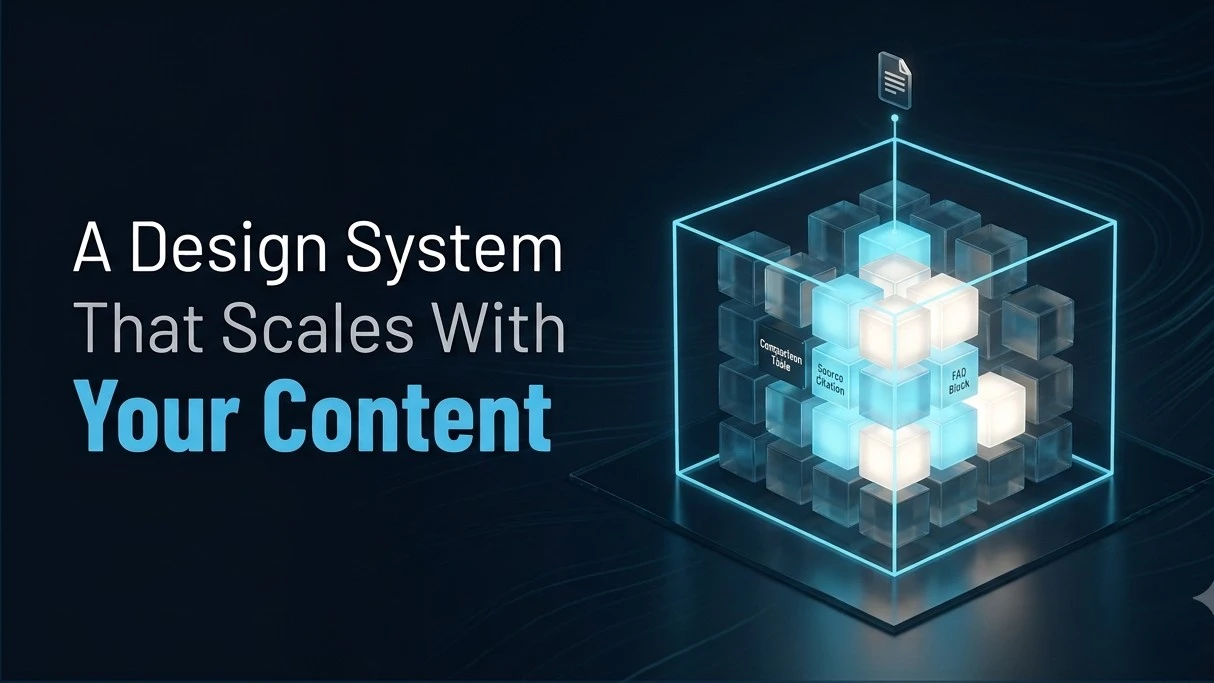
A design system that scales with content is one where adding a new content type, a comparison table, a customer quote block, or an integration specification page does not require an engineering sprint or a designer redrawing a template. It means the system was built with content operations in mind from the start: modular components that content teams can assemble without a developer, a content model that anticipates growth rather than fixing today's page types in place, and governance that lets the system evolve without becoming inconsistent.
Enterprise products change often. New features, new integrations, new markets. Building with reusable components and a documented design system makes it possible to grow without reinventing patterns every time content needs something new.
Why Most Design Systems Fight Content Instead of Supporting It
The typical design system gets built around the launch content: the homepage, a handful of solution pages, a blog template. It looks polished because someone designed every pixel of those specific pages. Eighteen months later, the content team wants an integration specification page with a data table, a named-source citation block, and an FAQ section formatted for AI extraction, and none of those exist as components. The content team either forces the new content into an existing template that was not designed for it, or waits for a development cycle that was never budgeted.
This happens because the design system was treated as a creative project with a fixed deliverable rather than as infrastructure that needs the same growth planning as a database schema or an API. Modular design breaks a site into reusable components, content cards, feature blocks, CTAs, testimonial modules, that can be mixed and matched across pages, and that modularity is exactly what most B2B design systems are missing at the point where content teams start needing new formats.
The Four Components Every Content-Scalable Design System Needs
A component library organized by content function, not by visual style. Most component libraries are organized the way a designer thinks: hero sections, cards, buttons, typography scales. A content-scalable system is organized the way a content strategist thinks: components for stating a claim with a source, components for comparing two or more items, components for a direct answer to a question, components for a named customer result. When a content team needs a new piece, they should be able to find "the block that shows a comparison" rather than needing to invent a new visual pattern from scratch.
A content model that anticipates the content types the roadmap will need, not just the content types that exist today. Before the system is built, someone needs to map what content the company will plausibly need in twelve to twenty-four months: comparison pages, integration pages, customer advisory content, author bio pages, FAQ-heavy answer content built for AI extraction. Building components for those needs before they arrive is dramatically cheaper than retrofitting them under deadline pressure later.
Governance that allows extension without permission gridlock. A system that requires a full design review and engineering sign-off for every new content block will always lag what content teams actually need. The systems that scale well have a lightweight extension process: a documented pattern library that content teams can propose additions to, with a fast review cycle rather than a full redesign cycle, so a legitimate new content need can be addressed in days rather than quarters.
Documentation that a content person, not just a developer, can read and use. Design system documentation written exclusively for engineers assumes the content team will always need a developer as an intermediary. Documentation that includes plain guidance for content operators, when to use this block, what it is for, how long the text inside it should run, lets a content team self-serve far more of their own production without waiting on a design or development queue.
The Content Types Most B2B Design Systems Are Missing Right Now
Three content formats are becoming standard requirements for B2B content programs and are absent from most existing design systems, which means most companies are about to hit the exact wall this article describes.
Structured comparison tables that are readable as clean HTML, not embedded images, because both human buyers and AI crawlers need to extract the data inside them directly. A named-source citation block that displays an attributed claim with a visible source name in prose, distinct from a generic blockquote, because attribution formatting has become a specific content requirement as AI search visibility strategy has matured. And a structured FAQ block with visible question-and-answer formatting that supports both human scanning and AI extraction, which most legacy design systems built before 2023 do not have as a distinct component at all.
How to Build the System Without Overbuilding It
The instinct once a team recognizes this problem is to build every conceivable component before launch, which produces its own failure mode: an enormous, over-engineered system that took too long to ship and that nobody fully understands. The better approach is building the core five or six components that current content definitely needs, documenting the extension process clearly, and treating the first twelve months of content production as the test that reveals what components eighteen and beyond can be added next.
A design system is never actually finished. Treating it as infrastructure that gets planned quarterly reviews, alongside a genuine content roadmap conversation with whoever owns content strategy, produces a system that grows in the direction content actually needs rather than the direction a single launch project happened to require.
Frequently Asked Questions
What is a content-scalable design system?
A content-scalable design system is a component library and governance structure built to accommodate new content formats, a comparison table, a sourced-quote block, and a structured FAQ section without requiring a full engineering sprint or a new visual design each time. It is organized around content function rather than visual style, anticipates content needs the roadmap will require in the next twelve to twenty-four months, and includes a lightweight process for content teams to propose and add new components without a full redesign cycle.
Why do most B2B design systems eventually conflict with content team needs?
Most design systems are built around the launch content set: the homepage, a handful of solution pages, a blog template. They are optimized for how those specific pages should look, not for how the content program will grow. When content teams need a new format eighteen months later, a comparison table or an AI-optimized FAQ block, the system has no component for it, and adding one requires a development cycle that was never budgeted into the original design project.
What components should a B2B design system include for AEO and GEO-ready content?
A structured comparison table rendered as clean HTML rather than an embedded image, so both buyers and AI crawlers can extract the data. A named-source citation block that displays attribution in prose format, distinct from a decorative blockquote. A structured FAQ block with visible question-and-answer formatting that supports AI extraction. These three components are commonly missing from design systems built before AI search visibility became a content requirement, which means most companies will need to add them regardless of how comprehensive their existing system is.
How much should a company invest in a design system before content needs are fully known?
Build the five or six components current content definitely requires, document a clear and fast extension process, and treat the first twelve months of actual content production as the signal for what to build next. Overbuilding a design system before real content needs are known produces an overly complex system that took too long to ship and that the team does not fully understand. Underbuilding produces the retrofit problem this article describes. The middle path is building for known needs plus a documented, fast path for adding what becomes needed.
Who should own the decision to add a new component to a B2B design system?
Ownership works best as a shared responsibility between design, engineering, and whoever owns content strategy, with a lightweight review process rather than a full design committee. Content teams are usually the first to recognize a new component need because they are the ones hitting the wall in production. A design system governance model that requires content teams to make a full business case before a component gets built will always lag behind actual content requirements, while a model with no review process at all risks inconsistency across the system.
References
- Grafik, Future-Proofing Your B2B Website: What Scalable Architecture Really Looks Like, modular design and reusable component practices: https://grafik.agency/insight/future-proofing-your-b2b-website-what-scalable-architecture-really-looks-like/
- Parallel, B2B UX Design: The Definitive Guide for Complex Products 2026, modular scalable interfaces and design system practices: https://www.parallelhq.com/blog/b2b-ux-design
- Fratzke Media, B2B Website Design Best Practices and Examples 2026, AI search structuring and content architecture: https://www.fratzkemedia.com/insights/b2b-website-design
- Directive Consulting, 15 B2B Website Best Practices for 2026, modular content sections and personalization architecture: https://directiveconsulting.com/blog/15-b2b-website-best-practices-for-2026-built-for-buyers-not-just-browsers/


