
40 to 60% of qualified B2B opportunities end in no decision. Not lost to a competitor. Not killed by a specific objection anyone can point to. They just stop. The deal that stalls after a price conversation almost never stalled because the number was wrong. It stalled because the buyer, now facing internal scrutiny on that number, did not have what they needed to defend it to the people who were not in the room.
Most sales teams respond to a price stall with a discount. The better response is a specific piece of content that gives the buyer what they actually need at that moment: ammunition to defend the deal internally.
What Is a Negotiation Content Playbook?
A negotiation content playbook is a defined set of assets, matched to the specific stage where a deal has stalled, that a rep can send within hours rather than improvising a response from scratch. It is distinct from a general sales enablement library because it is built around one specific moment: the deal has gone quiet after a price conversation, and the rep needs to know exactly what to send, to whom, and why.
The average B2B deal now involves 13 stakeholders across departments, each with different concerns and different veto power. A price stall is rarely one person saying no. It is usually one person going quiet because they cannot yet justify the number to five other people who were never part of the sales conversation.
Why Price Stalls Are Almost Never About Price
The instinct when a deal stalls on price is to assume the number itself is the obstacle and respond by moving the number. This is usually the wrong diagnosis. The buyer who says "it's a bit more than we budgeted" is frequently not asking for a discount. They are asking for something that will let them defend the number to the finance stakeholder who joins procurement conversations specifically to scrutinize cost, terms, and vendor consolidation opportunities.
The economic buyer who eventually signs off has often never heard the full sales pitch. They join late, and they ask almost exclusively about ROI and risk. A stalled deal frequently means the champion inside the account has run out of material to answer those two questions on their own, and is now stuck between a rep who wants an answer and a buying committee that needs more than "trust me, it's worth it."
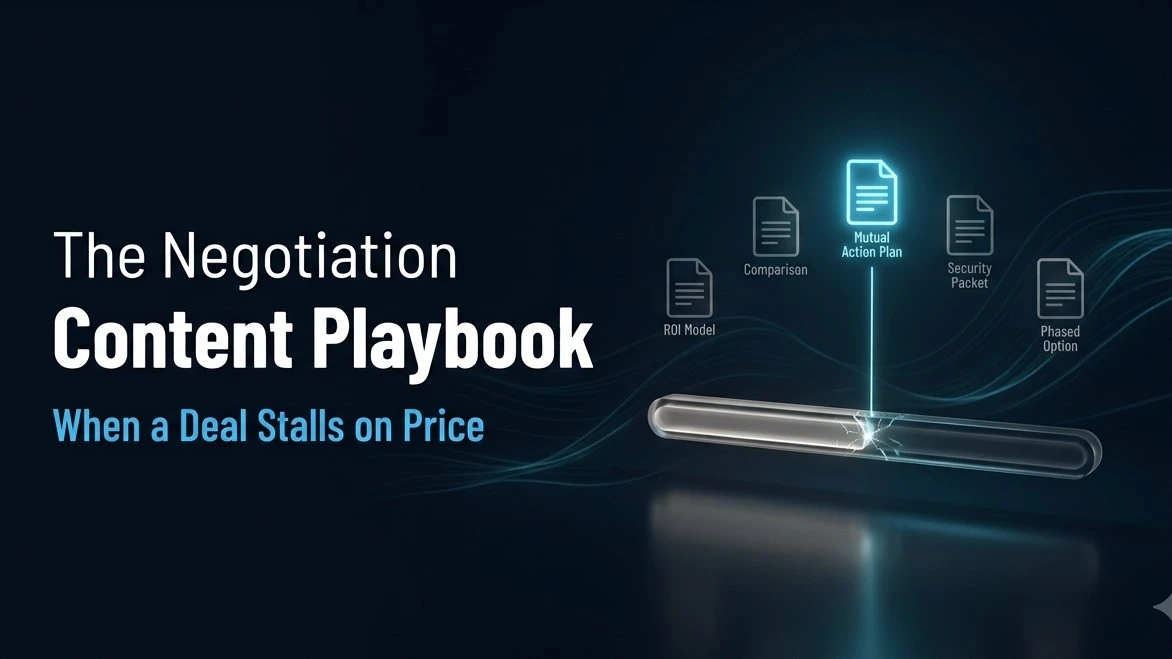
The Playbook: Five Assets Matched to Five Specific Stall Patterns
- When the stall is "I need to justify this to finance": send a quantified ROI model, not a general one-pager. The asset that moves this specific stall is a calculation, built with the champion's own numbers wherever possible, showing payback period and total cost of ownership against whatever the buyer is currently doing, including the cost of inaction. A generic ROI one-pager with placeholder numbers reads as marketing. A model with the champion's actual team size, actual current spend, and actual timeline reads as a business case they can forward without editing.
- When the stall is "we're comparing you to a cheaper alternative": send a specific, honest comparison, not a rebuttal. Reframing the conversation around outcomes rather than reacting defensively to the price gap is the tactic that actually moves this stall. The asset is a direct, named comparison showing where the cheaper option is genuinely adequate and where it creates risk or hidden cost, specifically for this buyer's situation. A comparison that pretends the cheaper option has no merit reads as biased and gets discounted by a sophisticated buying committee. A comparison that concedes real ground on some dimensions earns trust on the dimensions where the case is genuinely strong.
- When the stall is silence after a proposal, with no stated objection at all: send a milestone-based mutual action plan. This is the single highest-leverage document in the entire playbook, because unstated stalls are the hardest to diagnose. A mutual action plan lays out, jointly, the specific steps and dates remaining before signature, with an owner assigned to each step on both sides. It converts an ambiguous silence into a concrete, trackable commitment, and it is one of the few documents that gives the rep a legitimate reason to follow up with a specific date attached rather than a vague check-in.
- When the stall is "we need security and compliance to review this first": send pre-cleared documentation, not a promise to follow up. Deals that surface security and compliance requirements late lose weeks waiting for documentation the vendor could have prepared in advance. The asset is a pre-built security and compliance packet, SOC 2 documentation, data handling policies, relevant certifications, ready to hand over the moment the requirement surfaces rather than after a scramble.
- When the stall is a competing internal priority, not this vendor specifically: send a phased implementation option. Sometimes the deal is not stalled because of price or competition. It is stalled because the buyer's internal bandwidth is consumed elsewhere this quarter. The asset here is a phased rollout proposal that reduces the immediate lift required, letting the buyer commit to a smaller first step now rather than the full deal, which keeps the relationship moving instead of losing the deal to "let's revisit next quarter" and the silence that follows.
The Preparation That Has to Happen Before Any of This Works
None of these five assets can be produced from scratch under deal pressure and still land well. The ROI model needs a template built in advance, with placeholders a rep can populate quickly with the specific buyer's numbers. The comparison content needs to already exist for the two or three competitors that come up most often, built and reviewed before a live deal needs it. The mutual action plan needs a standard template the team uses consistently, not something built fresh for every negotiation. The security packet needs to exist before the first deal that asks for it, not after.
This is a marketing and sales enablement responsibility, not something an individual rep should be expected to assemble under deadline pressure in the middle of a live negotiation. A negotiation content playbook that lives only in the head of the best-performing rep on the team is not a playbook. It is a bottleneck.
Why This Matters More as Buying Committees Grow
Economic pressure has pushed approval authority downward and outward across most B2B categories. Security reviews, data privacy sign-off, and procurement gates that used to apply only to large enterprise deals now apply to far smaller purchases. Every additional reviewer in the process is another point where a deal can stall, and the content that moves a stall at the finance stakeholder's desk is different from the content that moves it at the security team's desk.
A negotiation content playbook built around this reality treats each stakeholder type as needing a distinct kind of proof, rather than assuming one strong pitch to the champion is sufficient to carry the deal through everyone else's scrutiny. The rep's job in a stalled deal is increasingly less about persuading one person and more about equipping that person to persuade five others who the rep will likely never speak with directly.
Frequently Asked Questions
Why do most B2B deals stall on price when price is rarely the actual objection?
A stated price concern is frequently a proxy for an internal justification problem. The buyer champion often cannot yet defend the cost to finance, security, or other stakeholders who were not part of the sales conversation. Responding with a discount addresses the stated objection but not the underlying problem, which is that the champion lacks the material needed to make the internal case. A quantified ROI model or a specific comparison document that the champion can forward internally addresses the actual blocker more effectively than a price concession.
What is the single most useful document for an unexplained deal stall?
A milestone-based mutual action plan, because it converts ambiguous silence into a concrete, jointly-owned set of next steps with dates and named owners on both sides. Unstated stalls are the hardest to diagnose and the hardest to follow up on gracefully. A mutual action plan gives the rep a legitimate, specific reason to reach out again rather than a vague "just checking in" message that buyers increasingly ignore.
Should sales content for price negotiations be built during the deal or in advance?
In advance, for every asset in the playbook. ROI model templates, competitor comparison documents, mutual action plan templates, and security and compliance packets should all exist before a live deal needs them, ready to be populated with deal-specific details quickly. Building any of these assets from scratch under negotiation pressure produces slower, weaker material and creates a dependency on whichever rep happens to be the best improviser on the team.
How does the growth of B2B buying committees affect negotiation content strategy?
As buying committees have grown, and as procurement, security, and compliance gates have extended to smaller deal sizes, a single strong sales pitch to one champion is no longer sufficient to move a deal through to signature. Each stakeholder type, finance, security, procurement, has different concerns and needs different proof. A negotiation content playbook that accounts for this treats the champion's job as equipping several other people to say yes, rather than assuming persuading the champion alone is sufficient.
What is the difference between reactive discounting and a negotiation content playbook?
Reactive discounting treats every price stall as a pricing problem and responds by lowering the number, which erodes margin and does not address stalls that are actually about internal justification, competing priorities, or unaddressed compliance requirements. A negotiation content playbook diagnoses the specific type of stall and responds with the specific content that resolves that type, preserving pricing integrity while giving the buyer what they actually need to move the deal forward internally.
References
- Salesgenie, B2B Sales Negotiation Tactics That Win More Deals, stakeholder count data and value-first framing tactics: https://www.salesgenie.com/blog/b2b-sales-negotiation/
- Tomba, B2B Decision Making in 2026: Buying Committee Guide, stakeholder mapping and consensus-building research: https://tomba.io/blog/b2b-decision-making
- Apollo, What Is B2B Sales: 2026 Process and Buyer-Led Strategies, 86% of purchases stalling and mutual action plan guidance: https://www.apollo.io/insights/what-is-b2b-sales
- Guideflow, What Is the Sales Cycle: The Complete Guide to Faster Deals for 2026, no-decision outcome analysis and stage-level stall diagnosis: https://www.guideflow.com/blog/what-is-sales-cycle


